The home of architecture and design in the Asia-Pacific
Get the latest design news direct to your inbox!

Get the latest design news direct to your inbox!
Architectus elevates Flinders University’s Adelaide presence with a culturally resonant vertical campus, amalgamating advanced learning environments with industry integration and community engagement.

September 12th, 2024
Design comes to the fore at Flinders City Campus, taking higher education in South Australia to new heights. The vertical city campus for Flinders University was conceived by Architectus, in the centre of Adelaide. The campus signals a new era for Flinders University, fostering collaboration and empowering learning opportunities for students.
With a locale flanked by the Riverbank precinct beside Adelaide Railway Station, the campus acts as a bridge between Flinders University and key technology, business, government, law and arts hubs. This strategic location is set to heighten research initiatives and industry partnerships, providing students with opportunities for engagement and growth.

“Design cues were taken from the site, which is a significant Kaurna meeting place, together with the history of the Climbing Tree,” says Andrew Schunke, Studio Leader at Architectus. “First Nations people used Wadna (wooden pegs) to climb the magnificent eucalyptus trees that line the banks of the Karrawirra Pari (River Torrens), to hunt possums and survey the land. The scars can still be seen on the trees today. The flora and foliage as well as the Climbing Tree narrative are expressed in timber forms and materiality throughout the fitout.”
In considering the ‘place of meeting,’ the layout and positioning of common learning facilities improve collaboration and circulation. The eight-level campus features multi-mode learning and teaching spaces as well as student-led study zones including a law library, a Moot Court, a staff workplace, event facilities, outdoor terraces and an executive education suite – respectively digitally equipped and intuitive to use. “This layout allows students to use the spaces as they need and want; to socialise, to study, to rest but it also makes the floorplate highly adaptable. Depending on future needs, flexibility is accommodated generally through the middle of the floorplates. On the combined teaching and learning and workplace floors, the staff area is at one end of the floorplate, with learning and teaching at the other. The space in the middle is flexible and can enable either function to grow,” says Diana Rosenthal, Principal at Architectus.

Schunke continues: “On the lower levels of the building, there is a commercial lobby with a large void, and the floorplate slowly grows as you move up the building. Everything radiates out from the interconnecting stairs, landing on each floor at collaborative informal student-focused spaces. Emanating out from there are teaching and learning spaces, meeting areas, quiet informal spaces, libraries, balconies and staff spaces.”
While the decision may deviate from the norm, the learning and teaching settings are purposely intertwined with the academic workplace to promote collaborative opportunities between staff and students. Schunke explains further: “The project leaps forward in higher education by providing a purpose-built vertical campus complete with learning and teaching and workplace environments positioned to strengthen industry engagement and collaboration across colleges and degrees to position student success.”
Related: Flinders Uni HMRC also by Architectus

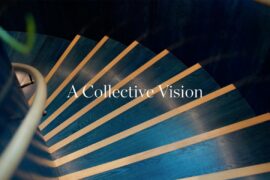
Timber structures and materials shape the main building vestibule, reinterpreting Wadna through architectural details, with tactile design features crafted locally. Complementing the form, the interior layout is influenced by native flora and riverscape. Earthy tones dominate the lower levels, transitioning to ochres and warm grey bark tones in the middle, and culminating in leaf-type colours of treetops at the upper levels. This staging of materiality and colour aids intuitive wayfinding throughout the building.
“Vertically, the palette reflects a great River Red Gum with colour changing per level whilst the timber detailing is consistent throughout. We’ve also placed a strong focus on acoustic control, with custom textured ceilings helping to minimise noise reverberation, especially in the larger, informal spaces. These acoustic elements also help to create a softness, texture, and warmth to the space. The rich materiality of the timbers, vinyl, carpets, textured wall paneling, upholsteries and paints are not what you may traditionally see in learning spaces,” explains Schunke.
Architectus
architectus.com.au
Photography
Shannon McGrath


More on designing for student experience in this Q&A with Architectus
INDESIGN is on instagram
Follow @indesignlive
A searchable and comprehensive guide for specifying leading products and their suppliers
Keep up to date with the latest and greatest from our industry BFF's!
The internet never sleeps! Here's the stuff you might have missed