The home of architecture and design in the Asia-Pacific
Get the latest design news direct to your inbox!

Get the latest design news direct to your inbox!
How an Indian firm Vijay Gupta Architects provides the framework for a holistic education.

October 12th, 2022
Based in New Delhi, Vijay Gupta Architects (VGA) is a well-established master planning, architectural and interior design practice with a pan-India presence and a diverse body of work across varied scales. They recently completed work on a new educational project, namely the Amity International School in Mohali, part of Punjab state in northern India.
“Learning environments can play a pivotal role in a child’s life by creating a conducive character for overall growth and development,” explains VGA partner and principal architect, Saurabh Gupta, on the Amity School project. “Spaces can create memories and enhance the learning experience greatly.”
The firm’s innovative design for the new Amity International School attempted to go beyond the rigid morphology of traditional educational spaces and planning. By drawing inferences from other efficient models of tackling urban density, the project sought to embody a progressive spirit through an elevated level of spatial vibrancy by rethinking the design of conventional Indian school complexes.
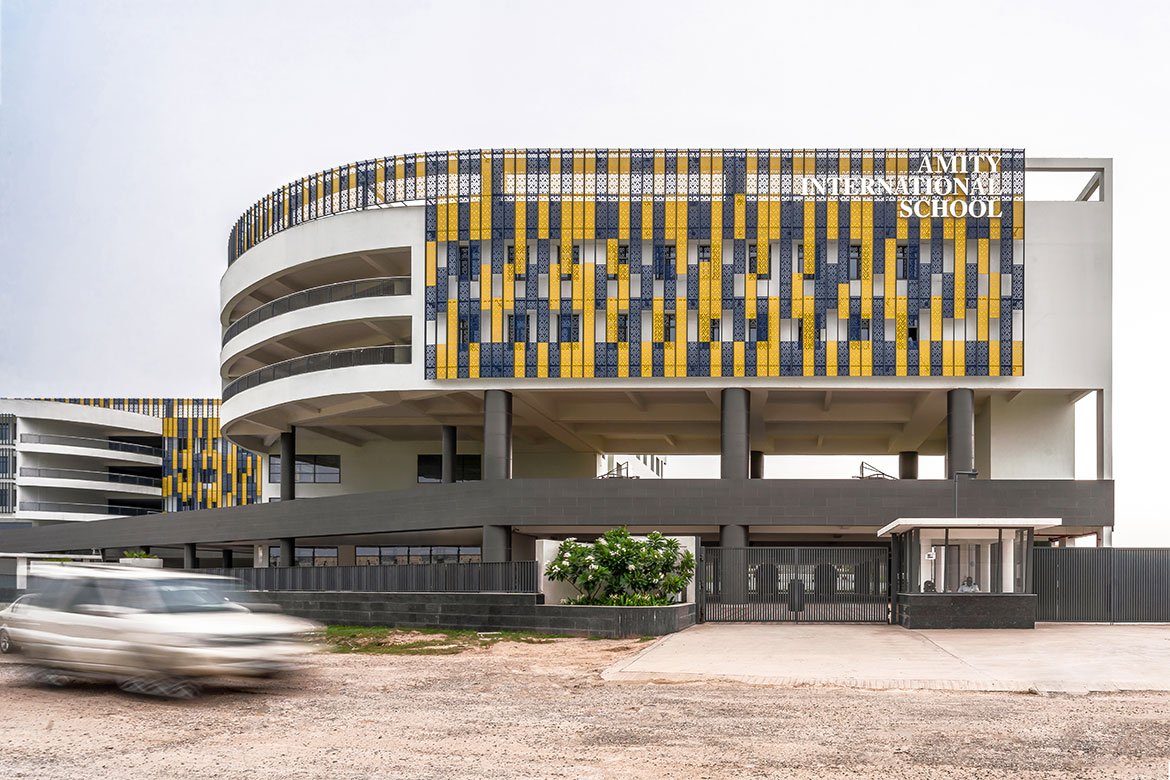
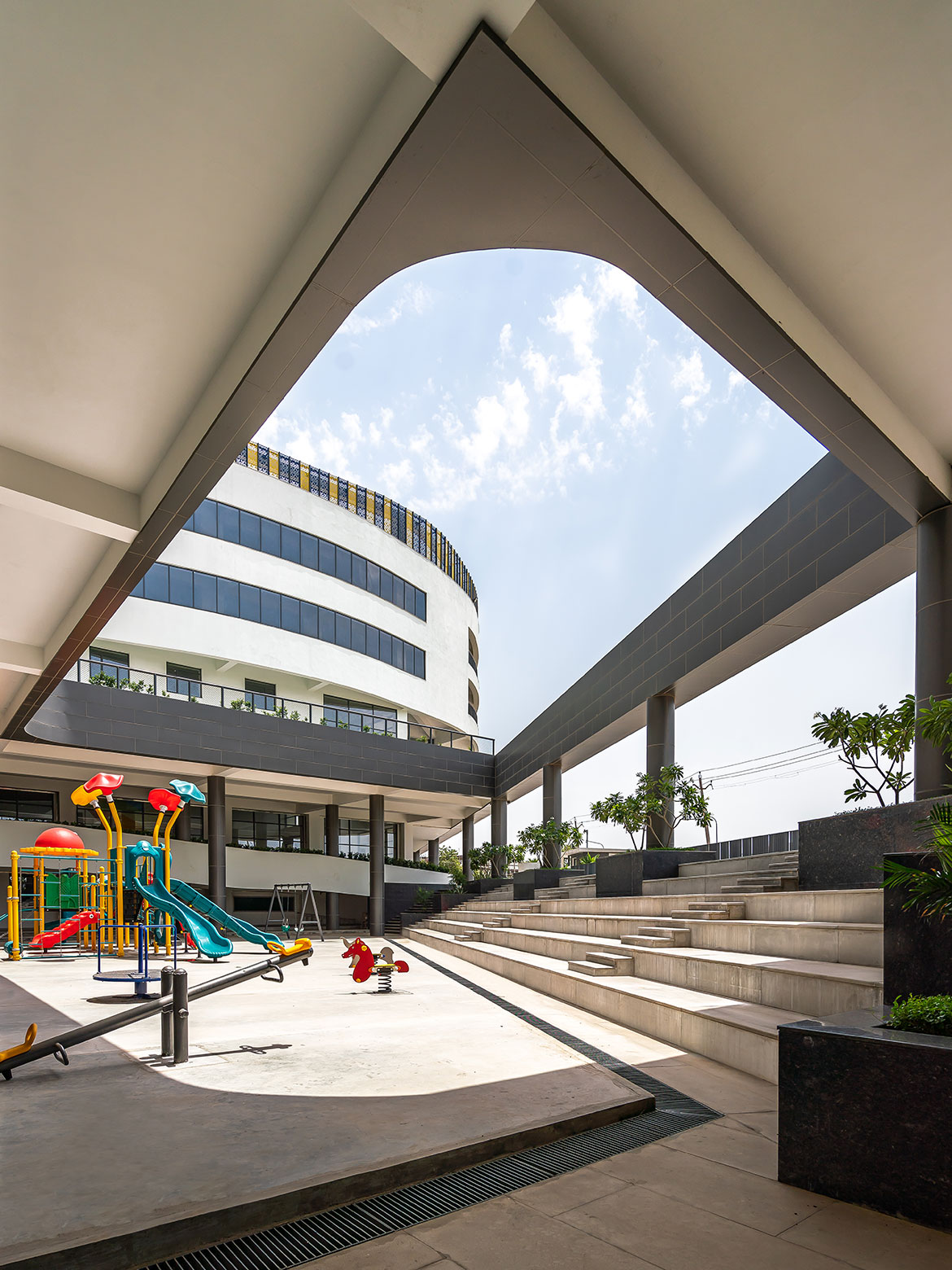
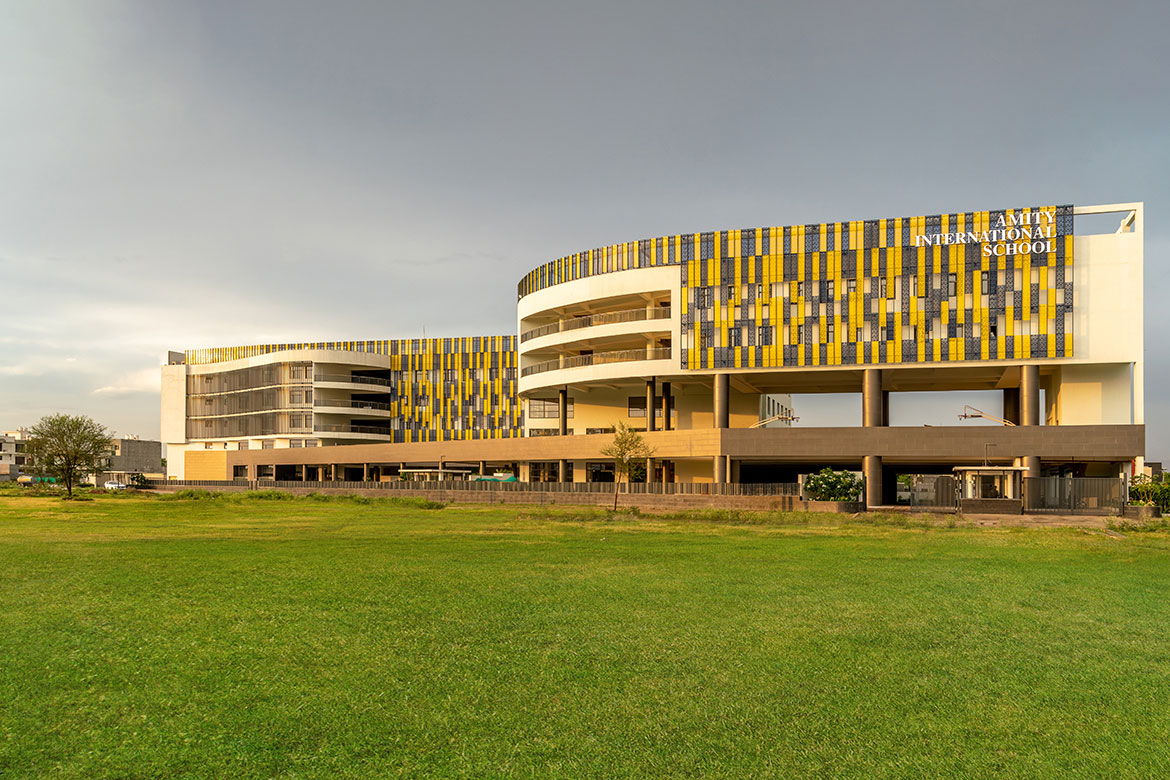
The site posed challenges in terms of size, orientation and surroundings, which were ingeniously navigated, while developing a distinctive design scheme. To balance spatial requirements with site constraints, the building mass has been lifted to the podium level, spilling over into a large collonaded platform connecting the cafeteria and doubling up as a play area. Similarly, by providing activity areas at each level of the five-storey structure, the school complex enables spaces for engagement and exploration at numerous junctures.
“While formal environments can help students focus better, informal areas are just as important and contribute significantly to the learning process,” explains Gupta. “Based on this principle, Amity Internation School encapsulates playgrounds, shaded walkways, play areas, and open spaces across floors, forging both engaging and exploratory spaces at several junctures.”
A playful mix of punctures and louvres lightens the visual load of the imposing five-storey structure. These facade elements allow natural light across all spaces. One of the most prominent details of the project is the curtain wall that wraps around the built form on the southern side. Made out of laser-cut aluminium panels and strategically placed to protect the building from the harsh sun, this fluid envelope of blue and yellow asserts a distinct visual identity to the complex. The building follows an organic form, achieved through well-crafted concrete details, with a bare ceiling exposing the structural system.
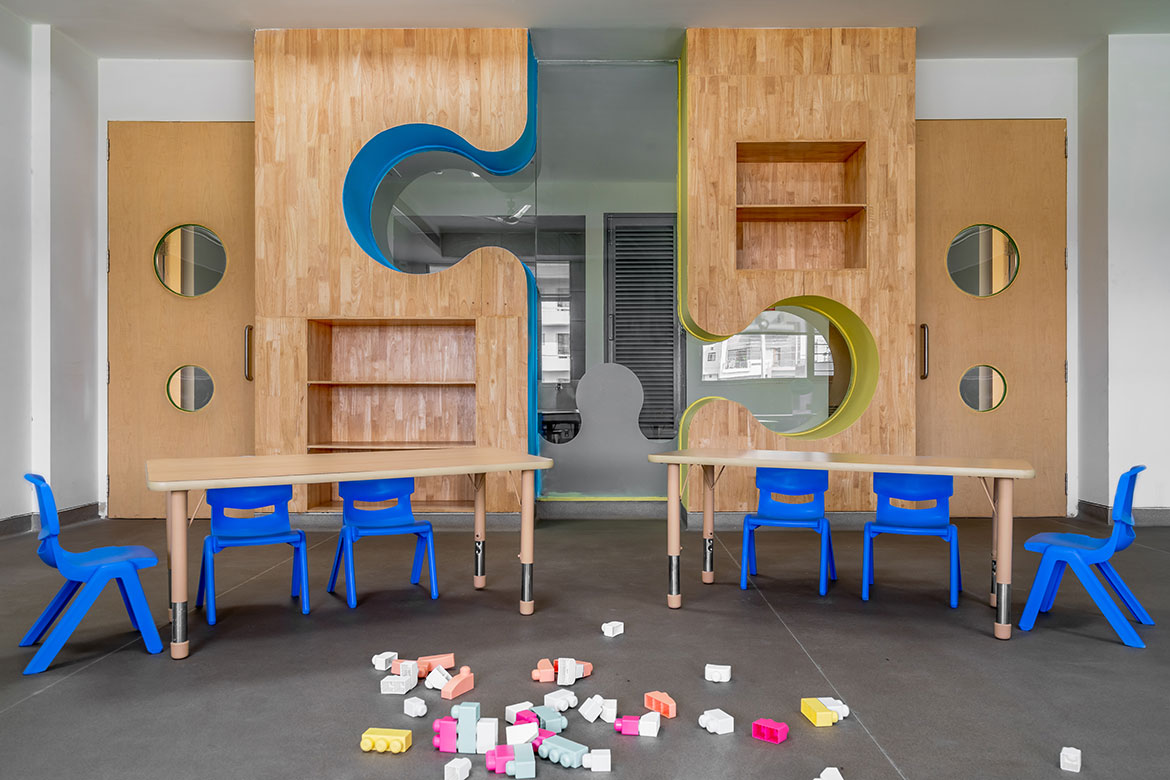
The interior spaces are shaped in a tactile language, with the minimal but vibrant colours bringing together an elevated sense of dynamism. Wooden porous partitions, organically designed, enable visual connectivity within the spaces at all times. The north and south facades are a good example of functionality and aesthetics, as they allow the building to be climate-responsive – important in the harsh northern Indian weather – while establishing a distinct visual identity for the international school. Efficient planning through cross domain learning was instrumental in developing a design scheme that is fit for holistic education.
Ultimately, VGA’s comprehensive design for Amity International School lays the blueprint for a truly holistic education – one where physical activity, social interaction, and creative exploration are just as crucial to the students’ ongoing development as formal teaching.
Vijay Gupta Architects (VGA)
vga.co.in







.
Amity International School
Client: Ritnand Balved Education Foundation
Location: New Delhi, India
Site Area: 2.7 Acres
Built-Up Area: 3,00,000 sqft
Project Cost: 75 Crores
Start Date: August 2019
Completion Date: December 2021
Principal Architect: Saurabh Gupta
Design Team: Akanksha Gupta
Structural Engineer: Technical Project Consultants
Contractor: Ahuja Builders Private Limited
INDESIGN is on instagram
Follow @indesignlive
A searchable and comprehensive guide for specifying leading products and their suppliers
Keep up to date with the latest and greatest from our industry BFF's!
The internet never sleeps! Here's the stuff you might have missed