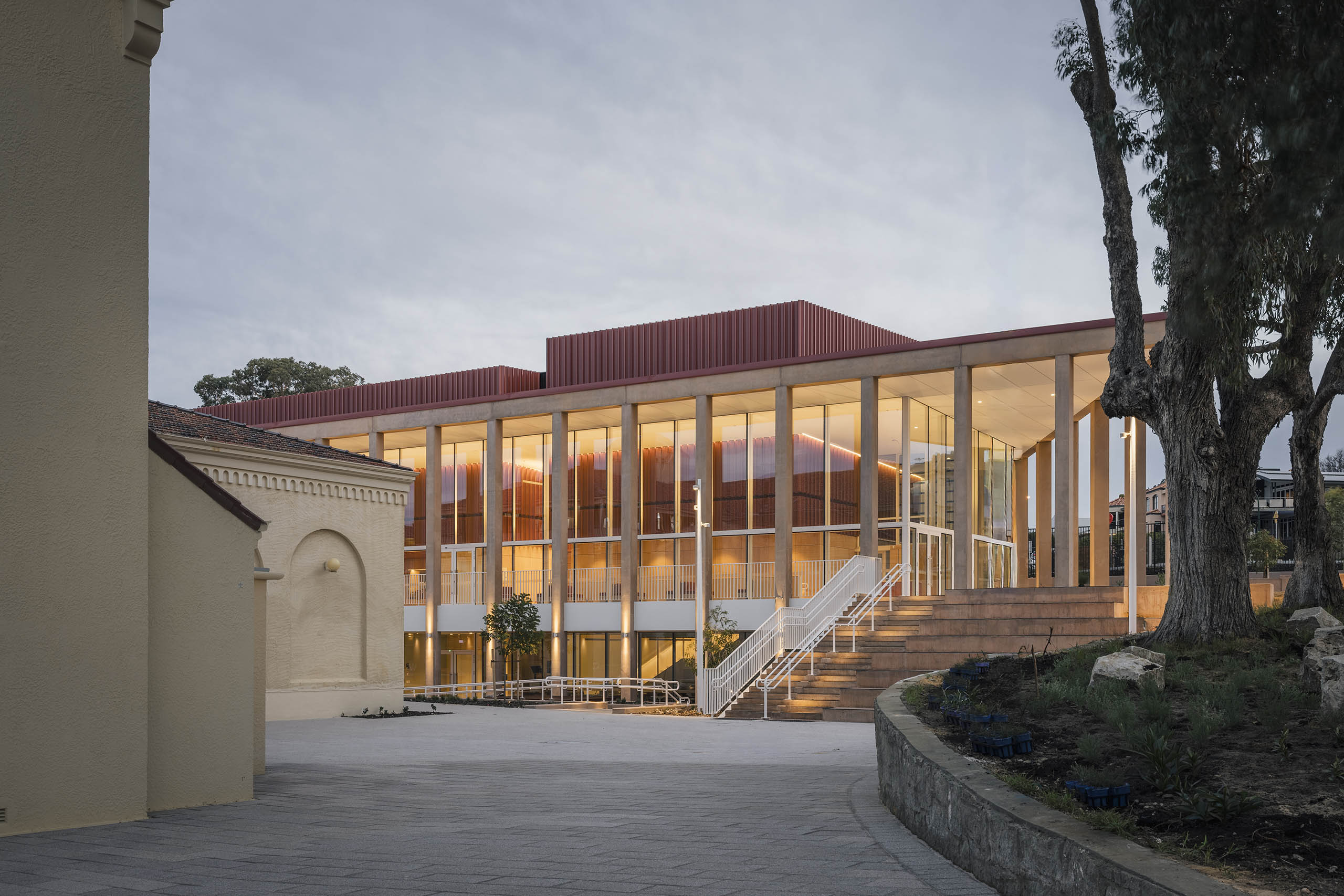
When Hayball arrived to work on Scientia Terrace at Monte Sant’ Angelo College, the site already had a rich heritage – both culturally and architecturally. The girls’ school and the original Sisters of Mercy convent occupy a deceptively large, heritage-listed site in a busy part of Sydney, and Hayball’s recent work represents a significant addition of facilities.
Part of the challenge at the site involved dealing with significant level changes across the campus. A new six-storey Social Enterprise, Sports, Sports Science and Science Building manages, by taking much of its programme underground, to maintain the character of the outdoor gathering space at the heart of the site. The overall functional organisation sets up a vertical spectrum ranging from ‘pure’ science facilities on the top floor to sports on the bottom; in between, they cross over and blend.

Visitors are greeted at Scientia Terrace by a student-led Fairtrade cafe, while the ground floor coheres internally at a pitch space designed to encourage gathering and enable students to discuss ideas in an open, non-adversarial space. Indeed, this whole ground floor space has been designed with Hayball’s social value philosophy in mind – facilities alongside the cafe and pitch space include a fabrication lab to create goods, an ethical shop in which to sell them, and flexible innovation workshops.
Dave Tordoff, Principal at Hayball, explains that, while the school already had these socially minded programmes in place, new design facilities have really allowed them to flourish. As such, the Social Enterprise Centre keys into a legacy of social justice and service that the Sisters of Mercy prides itself on.

“For many years Monte students have been inspired by the Sisters of Mercy to undertake a series of outreach programmes as part of the Colleges’ extensive Social Justice Programme,” says Nicole Christiansen, Principal of Monte Sant’ Angelo Mercy College. “The need for a Social Enterprise Centre was born out of this incredible work.”
This intermingling of facilities – a 40-metre running track on the ground floor that caters, obviously, to both sporting needs as well as sports science measurements – captures the cross-curricular focus of the school across STEM and sports subjects. As an institution, it’s clear that the school prides itself on widening access to what have historically been restricted as gendered areas of learning and experience.
Related: Dr Fiona Young on education design

As a core part of the school’s identity, enabling access for girls to STEM subjects has been a crucial consideration for the designers. Tordoff explains how they responded to these needs not only through the design of facilities such as labs, but also in creating space for role model narratives. “It was really important to have a space that could incorporate displays and storytelling for the amazing female role models within STEM subjects.”
Returning to the outdoor gathering space, elegantly landscaped terraces create a focal point and set the tone for a language of circles that ties together all parts of the project, from the masterplan to small private spaces.

“The building’s fabric has to reflect the culture of the place and the circle as a space for gathering is very important at Monte,” explains Tordoff. He notes how the students observe a convention around not sitting on an existing lawn at the centre of the school, saying that “we wanted to create a new circular space at the bottom of the campus that would become theirs.”
Part of the brief for the project was to encourage students to spend longer on campus, enhancing learning and pastoral care. The design also allows staff and the school community to use the facilities after-hours. It’s all part of an education design philosophy that sees a school as much more than simply a collection of rectilinear classroom spaces.

Indeed, those classroom spaces vary greatly, always with a purpose in terms of the activities required. The ‘super labs’ on the top floor, for instance, provide copious open space with walls that can be fully opened or closed, while other spaces allow for various configurations relating to theory or demonstration work with acoustic requirements, practical lab use and so on.
Building up a sophisticated picture of different uses requires a high level of client engagement and collaboration. Dr Julia Atkin from Learning by Design worked with Hayball on education projects at Monte and Hilltops Young High School and comments, “Hayball are able to take an incredibly complex design challenge and provide a physical design for the facilities to achieve newly imagined possibilities.”
Hayball
hayball.com.au
Photography
Martin Mischkulnig


Read on – Ivanhoe’s world class sporting complex by McIldowie Partners.