The home of architecture and design in the Asia-Pacific
Get the latest design news direct to your inbox!

Get the latest design news direct to your inbox!
In Singapore, old meets new and does it with style and grace in FARM’s culturally appropriate, site-specific design. It’s a place that provides connection for everyone who visits.


January 29th, 2025
There is a new destination to visit in Singapore that combines the delights of retail and dining, the day-to-day of working and learning, all with a place to stay. Heritage meets contemporary life in this project, making New Bahru the place to visit both now and in the future.
What was once the Nan Chiau High School, with a vast hall, corridors and rooms, has become a contemporary design landmark that provides the experiential in the dynamic Lion City of Singapore. From a disused school to a multifaceted offering, New Bahru is now home to more than 40 independent made-in Singapore brands, Alma House serviced apartments, a pre-school, ballet school, wellness facilities, activity areas and small and large event spaces. The best of the original historic architecture has been retained and adapted and the result is a place where everyone can meet and gather to enjoy this transformed architectural gem.
The name New Bahru (Bahru means ‘new’ in Malay) reflects the hope that the project will bring people together in this lifestyle precinct but also plays on the Singaporean penchant for repeating words such as swee swee, play play and jalan jalan.

The vision for New Bahru comes from The Lo & Behold Group and has been realised by the talented architects at FARM. The adaptive reuse project has been sensitively re-imagined through the lens of Tiah Nan Chyuan, Director, FARM and his team of Sri Saravanan and Derong Lin. The design has brought new life to the derelict buildings and, indeed, to all Singaporeans.
Nan Chyuan explains: “We fell in love with the site after our first visit. The existing building had a lot of character which was very charming. Our aim was to avoid over-designing the space, how to retain enough of the existing to create a common basis for everyone to understand the historical context of the site as a school, yet leave enough room for imagination and curiosity, so that we can match the vision and ambition for the project.
“When it comes to balancing the needs of the old and new, it was not necessarily a binary condition but a process of amplification of the historical features to help encore the new design elements. Retaining the existing architecture elements helps to create a layer of legibility across the site. Legibility is more important and is different from consistency. Consistency when applied incorrectly can become quite repetitive. Legibility on the other hand allows for more room for interpretations and imaginations.”

At 20,156 square metres, the site is large and the buildings are positioned around a courtyard. It’s a horseshoe shape that includes the Big Block and most of New Bahru’s retail and hospitality venues, wellness, education, arts and cultural destinations along with 83 serviced apartments. The Small Block is situated on its own, facing the other buildings and is home to Kiztopia Prestige and The Orange Tree Preschool.
Wee Teng Wen, Managing Partner of The Lo & Behold Group says: “It’s amazing how, all around the world, interesting architecture and creative businesses can come together to create vibrant neighbourhoods we’ve come to love; where you can spend a day meandering around, discovering something meaningful. A lovingly refurbished school building to escape the mundaneness of cookie-cutter malls.”
With the idea of bringing creatives together, The Lo & Behold Group also included other local designers and they bring a diverse perspective to the many interiors within New Bahru. Designers such as Hjgher, Wynk Collaborative, Pupil Office and Parable worked with joint-venture partner Sunray Group Holdings in the development of the refurbishments and each shop and space is a credit to its designer who has interpreted the brand and its site to perfection.
Related: The Standard, Singapore

Along with FARM to conceive the architecture, London-based Singaporean creative consultant Sacha Leong of Nice Projects was involved with the project, as was renowned botanical design studio, This Humid House, through landscaping.
However, it is the architectural interpretation that impresses with New Bahru. Originally designed by James Ferrie and Partners in 1969, the school’s brutalist architecture was a marked departure from other contemporaneous Chinese institutions of the day. FARM has respected and retained the original architecture wherever possible, while ensuring the new additions are not only in keeping with the heritage but also complement it.
Many eclectic elements, such as the breezeblock façade, the barrel-vault arches above the school hall, the steps in the old science labs and even the small U-shaped motifs on the pillars were retained and seen as part of the larger design language of the site. FARM has used aluminium and steel in the new additions and, juxtaposed with the concrete of the original structures, old and new are both distinct yet aligned. Bold colours drawn from the development’s brand identity help modernise the space and give the buildings depth of character.

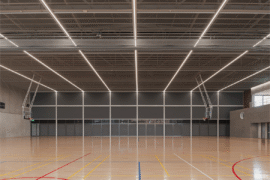
To anchor the site and provide a place where all can gather, FARM has introduced a lawn. In the Seventies, there were running tracks and two basketball courts, and this adjoins Oatside Funside Playground.
The past iterations of New Bahru have seen much history in the 80 years of the building’s existence. From a headquarters for volunteer soldiers resisting enemy forces during the Japanese Occupation to a school for young girls (who, at the time, were expected to remain at home), the site of 46 and 58 Kim Yam Road, River Valley district has lived a life. Now with the revitalisation that is New Bahru there is the opportunity to present change for the future and celebrate community in the best ways possible – through collaboration, connection and culture.
FARM is a cross-disciplinary design practice with projects that span the breadth of architecture and interior design, product design and merchandising, graphic design and branding, art installation and sculpture and exhibition design. It is curatorial by nature, is a community-centred arts organisation and also supports a design and research lab.

The ethos behind FARM is to cultivate a culture of imagination and, underpinning this, is a belief that joyful creativity is essential in our lives. Established in 2005, FARM now has more than 50 staff in its Singapore-based studio. It is passionate about the local community and endeavours to find ways to interact and bring design to the city and country and beyond.
In New Bahru, FARM has realised all the attributes that its studio holds dear. With architecture that is respectful and appropriate and a place that enriches the lives of many people, this is a project that does credit to Singapore and the developers, but most of all to the talented architects who have understood and translated the project’s many aspirations to the built form.
FARM
farm.sg
Photography
Finbarr Fallon


INDESIGN is on instagram
Follow @indesignlive
A searchable and comprehensive guide for specifying leading products and their suppliers
Keep up to date with the latest and greatest from our industry BFF's!
The internet never sleeps! Here's the stuff you might have missed