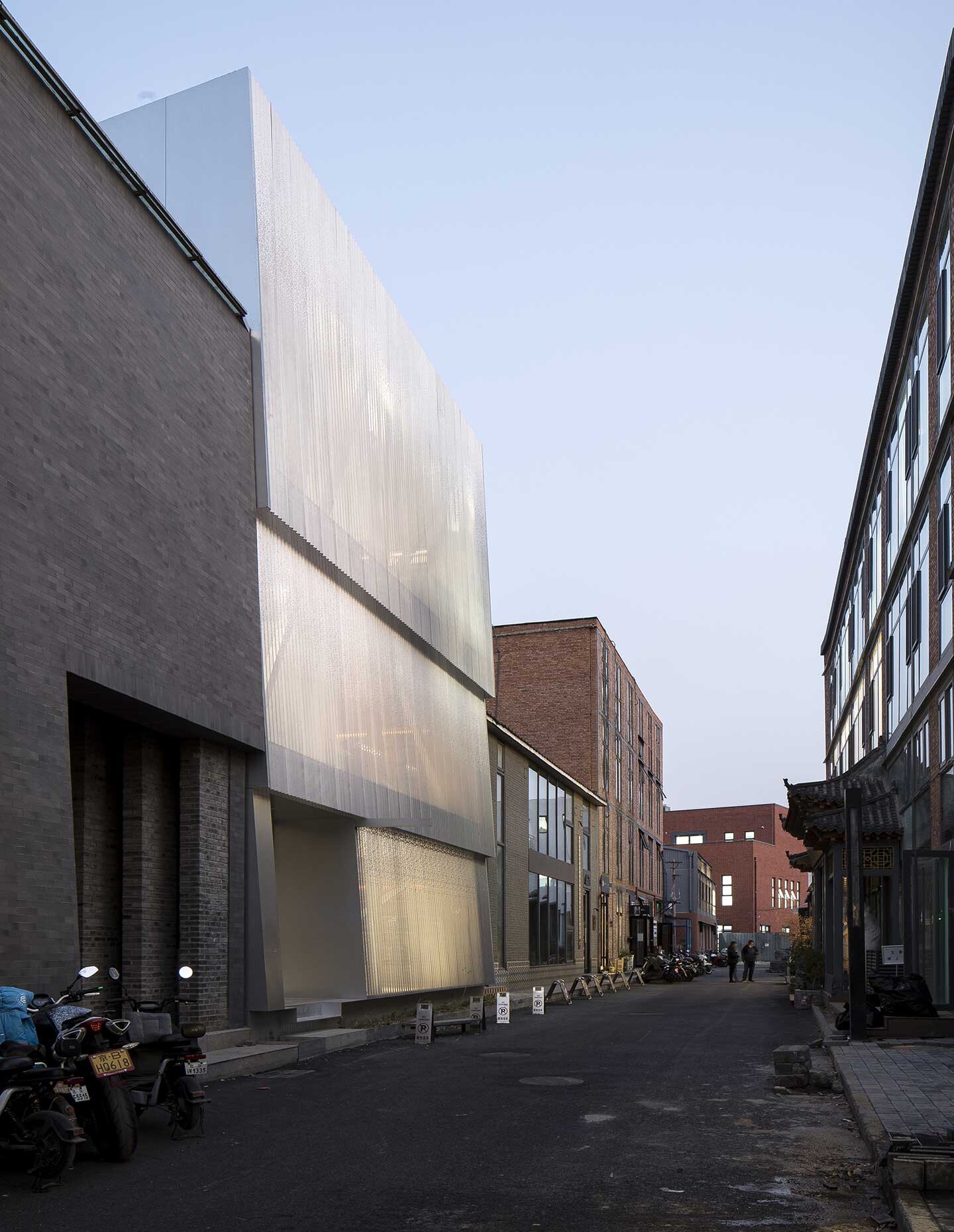
Two significant elements drove the site selection for TAOA’s new studio. The first is the location in Beijing‘s 798 Art District. The second was the condition of the existing building.
To understand the context, Beijing’s 798 Art District is home to both the 798 Photo Gallery and the Ullens Center for Contemporary Art. With open air cafés and art installations lining the streets, the district, also known as Dashanzi, is Beijing’s go-to area for a hipster lifestyle. It is also an industrial heritage park with decommissioned military factories (including the eponymous Factory 798, which produced electronics) housing an assortment of art-centric spaces that have continued to evolve. “The entire area pulses with a raw vitality and freedom, standing in stark contrast to the surrounding commercial development. This unique character made it an ideal location for TAOA’s office,” says Tao Lei, lead architect and TAOA founder.
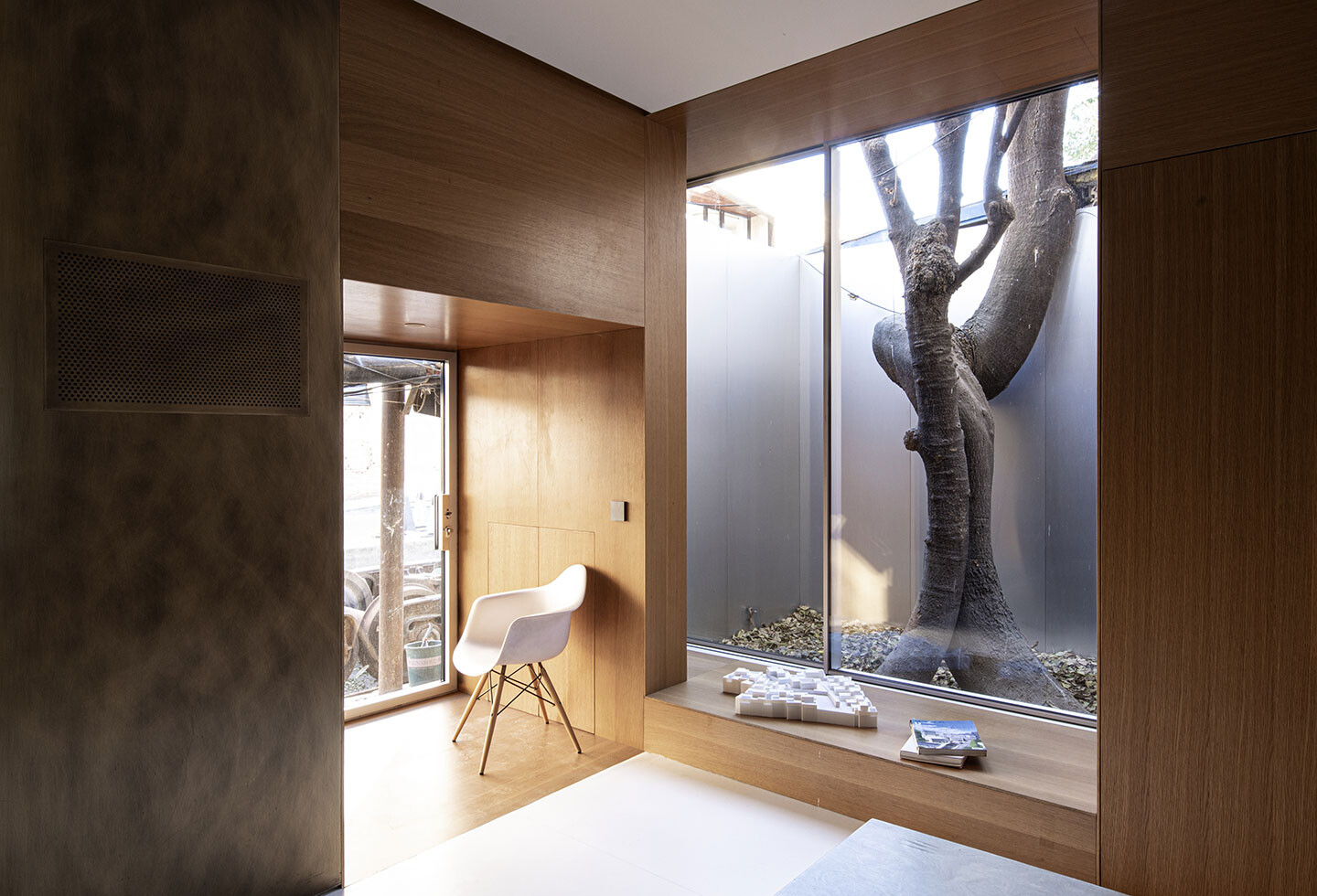
Deliberately choosing to renovate an existing three-storey building, Lei was interested in how its age and uncertainties would influence and shape the design. Effectively, he saw the building as a prompt for the design team to approach the project from a fluid perspective. The decision was fortuitous as a narrow gap, with a large tree, was found between the building and its neighbour during the demolition phase. As the building was tightly bound between two neighbouring structures to the north and south sides, the only option prior to this discovery had been to open to the street side on the west and the 798-district boundary at the rear.
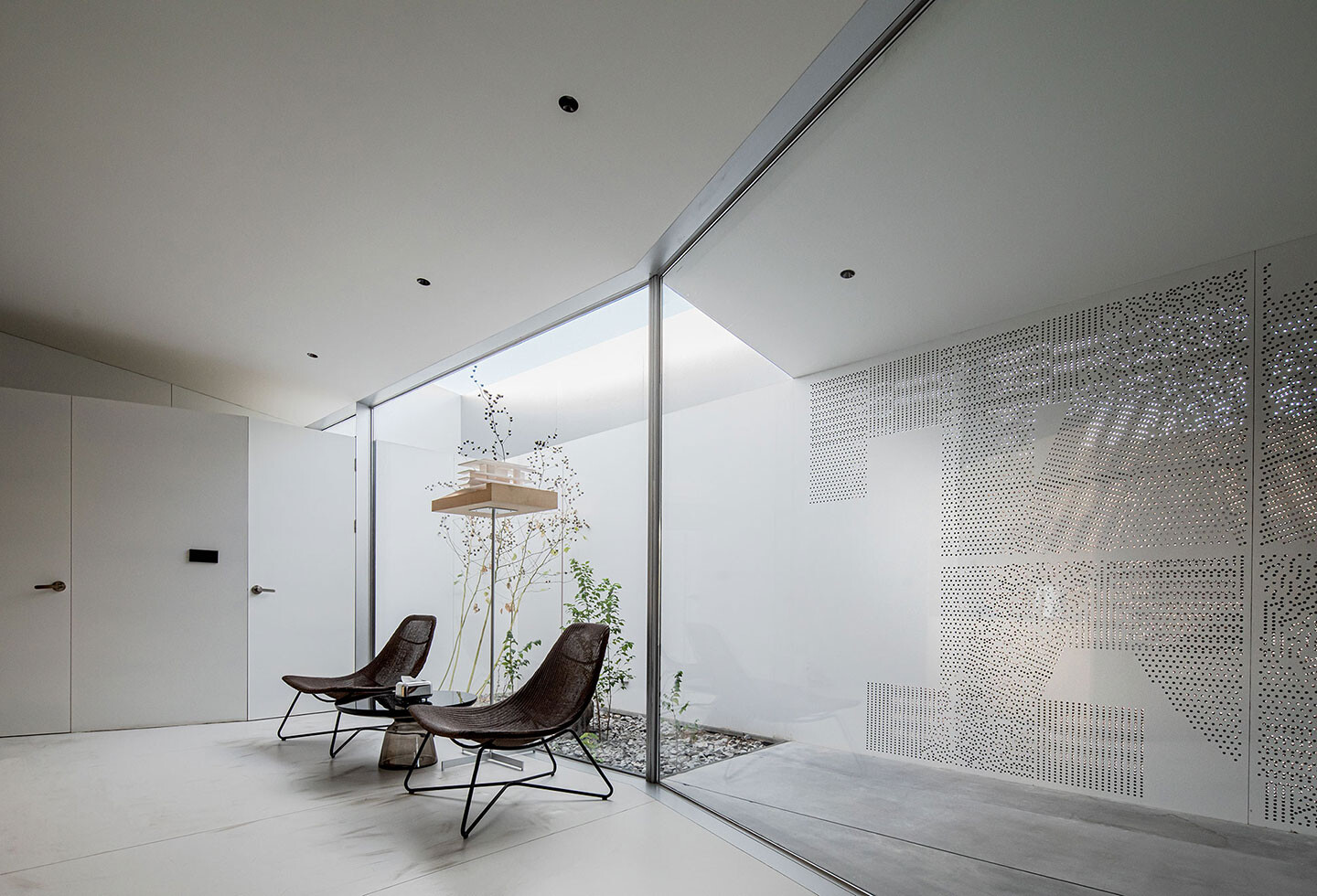
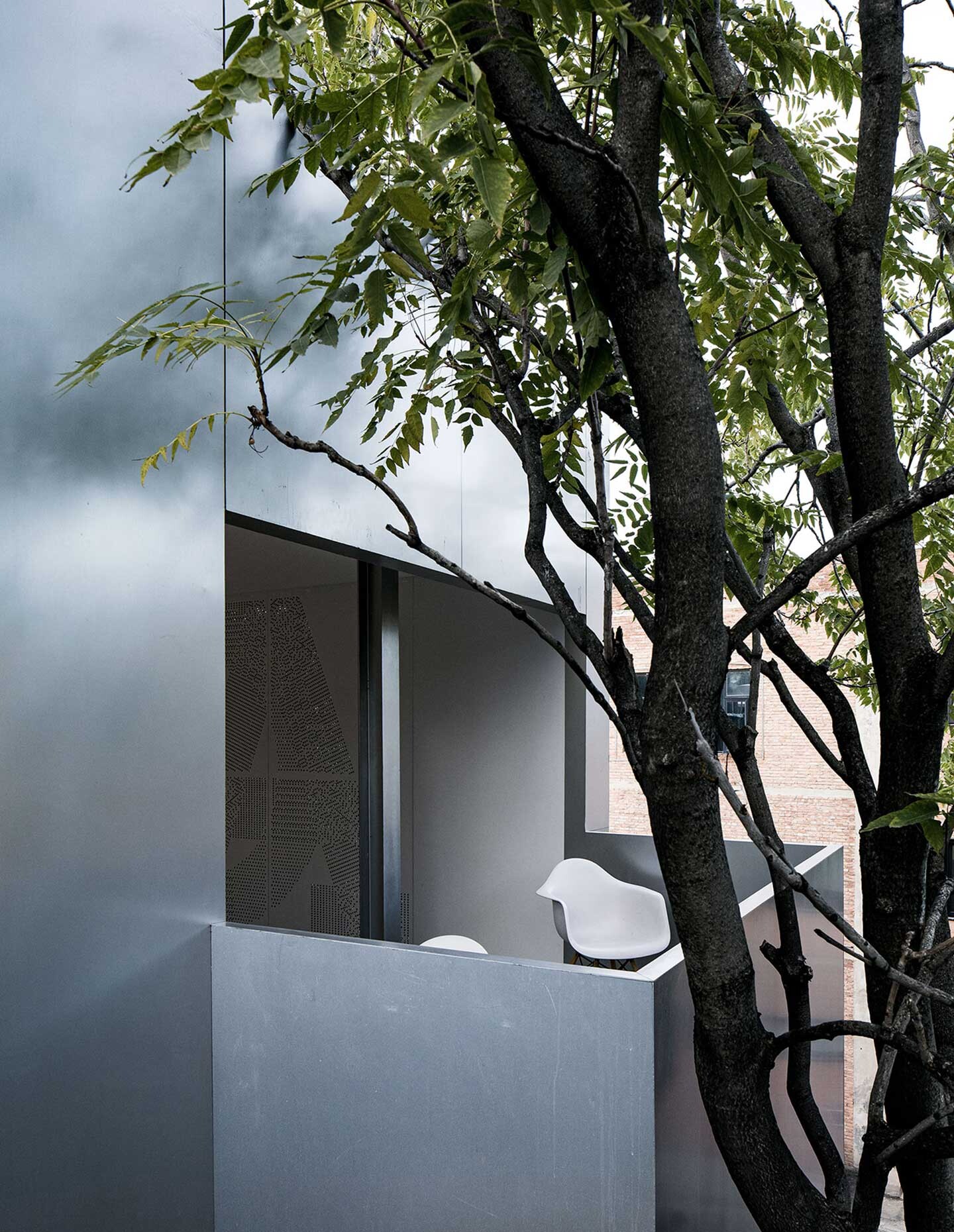
In discovering the gap, the design was suddenly able to engage an additional side, with light and nature invited into the space. Expanding the gap to create a small courtyard, the tree is seen as a series of parts, from the solid trunk on the ground floor to the mass of foliage as the tree ascends. “To further enhance this connection with nature, a balcony was added on the third floor, offering a relaxing space under the tree during breaks,” says Lei, who also opened the upper floors of the rear as a semi-outdoor terrace. “Ascending the stairs from the first floor, the space suddenly opens up, offering a refreshing sense of clarity and freedom,” he says.
Related: Studio Lotus designs Sunita Shekhawat’s Jaipur flagship
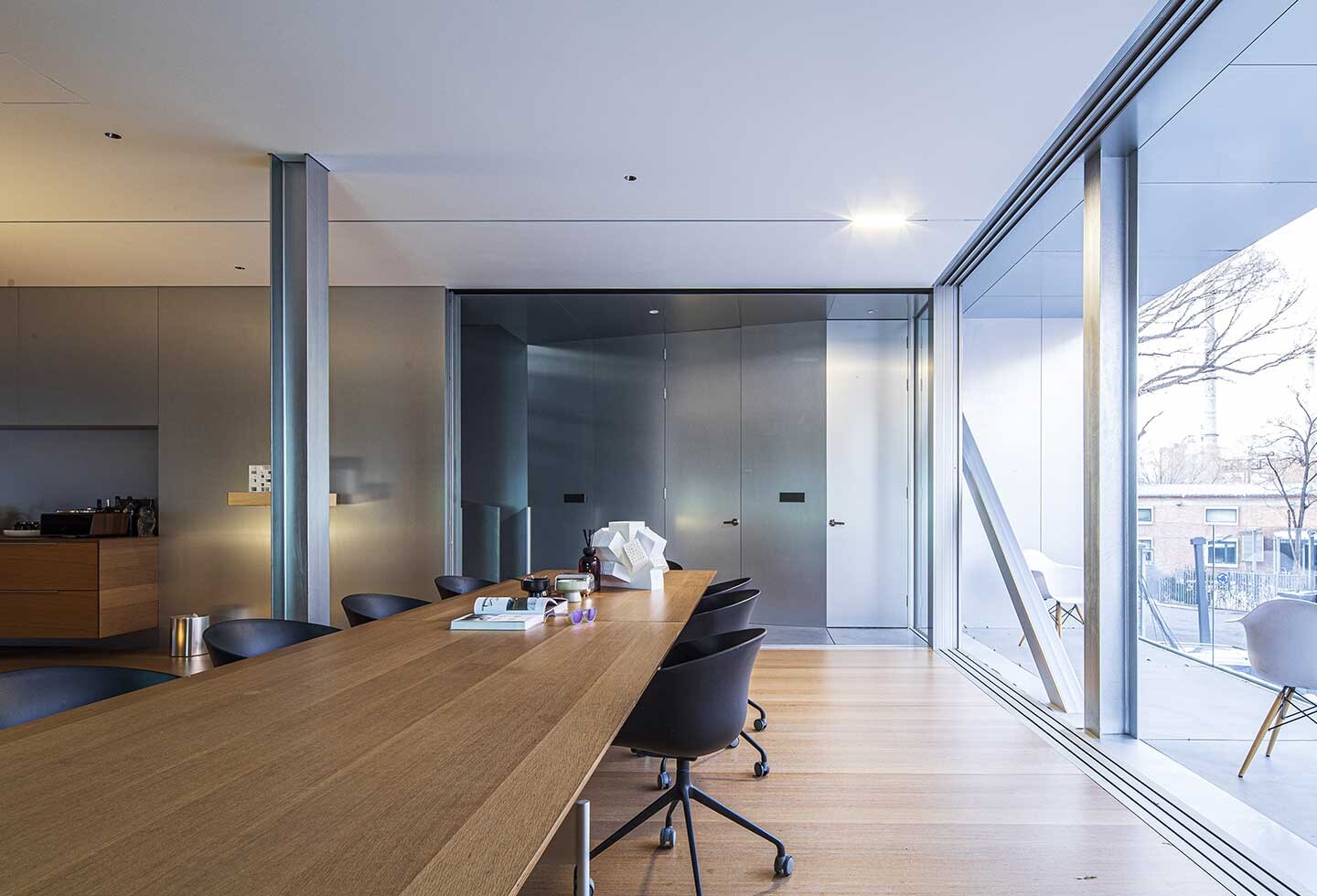
Bringing light into the space was a prime objective for the team, who were tasked with creating their own working space. “The core vision was to design a space that is simple, comfortable, compact yet elegant, and as connected to nature as possible, despite the lack of natural resources in the immediate surroundings,” says Lei.
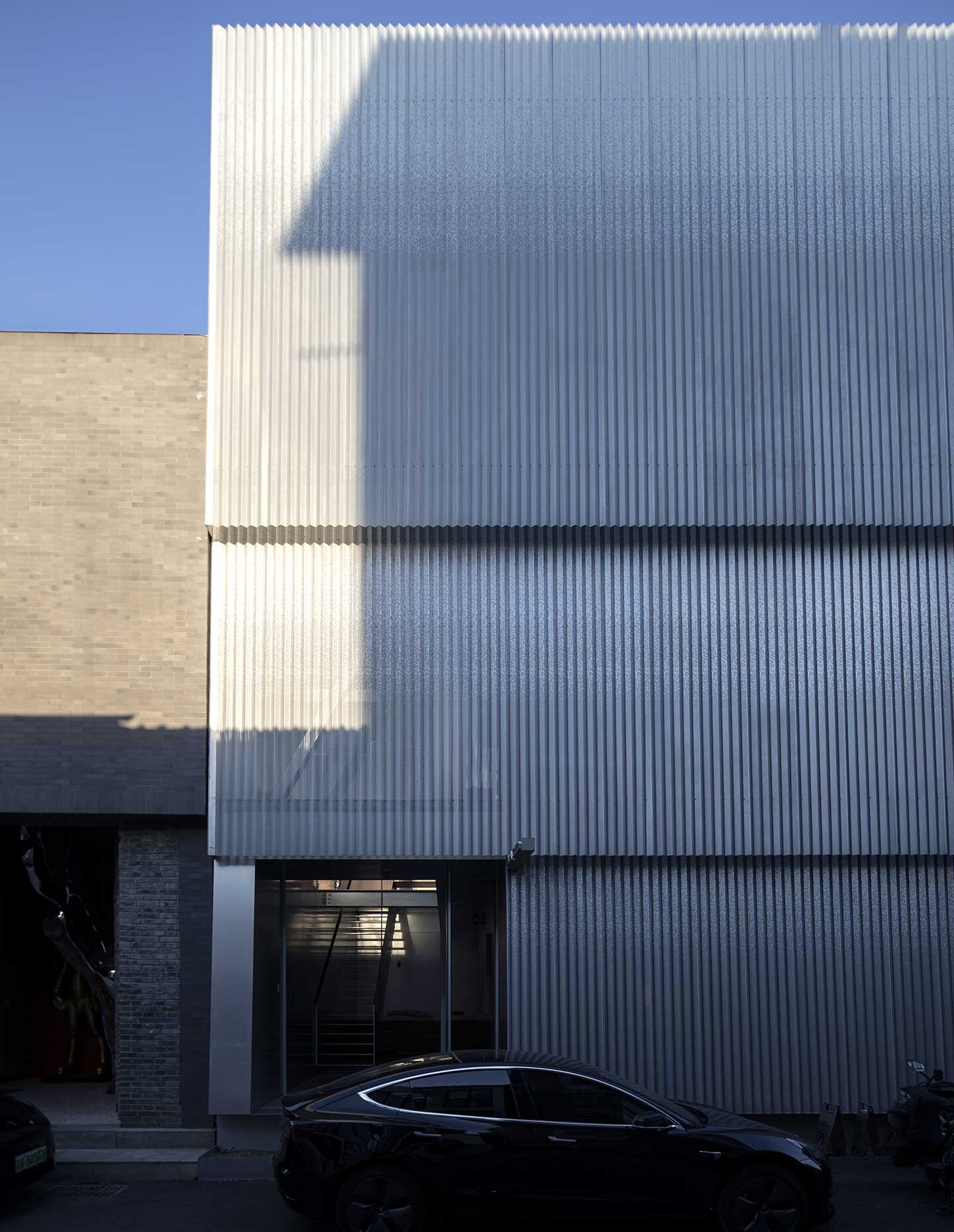
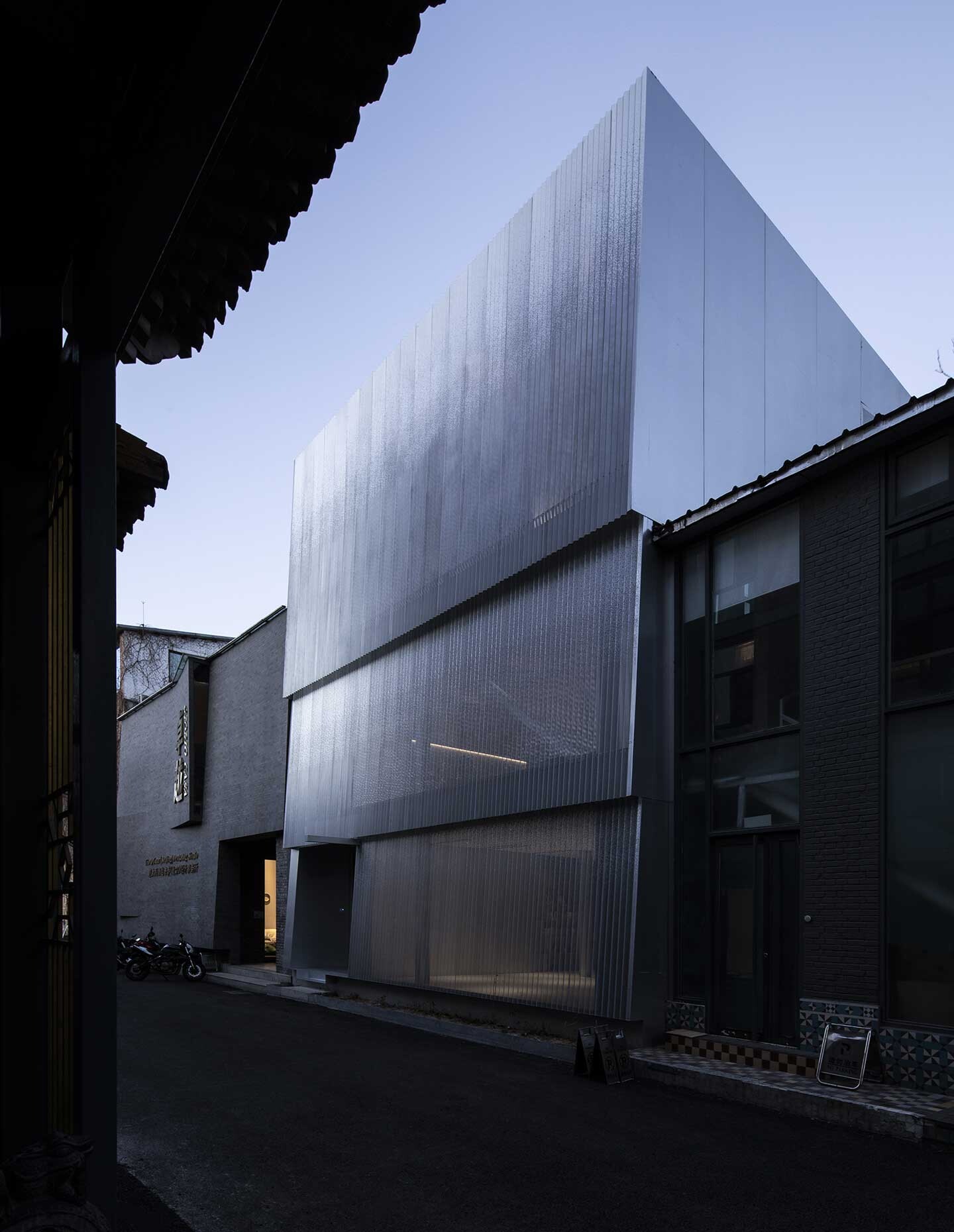
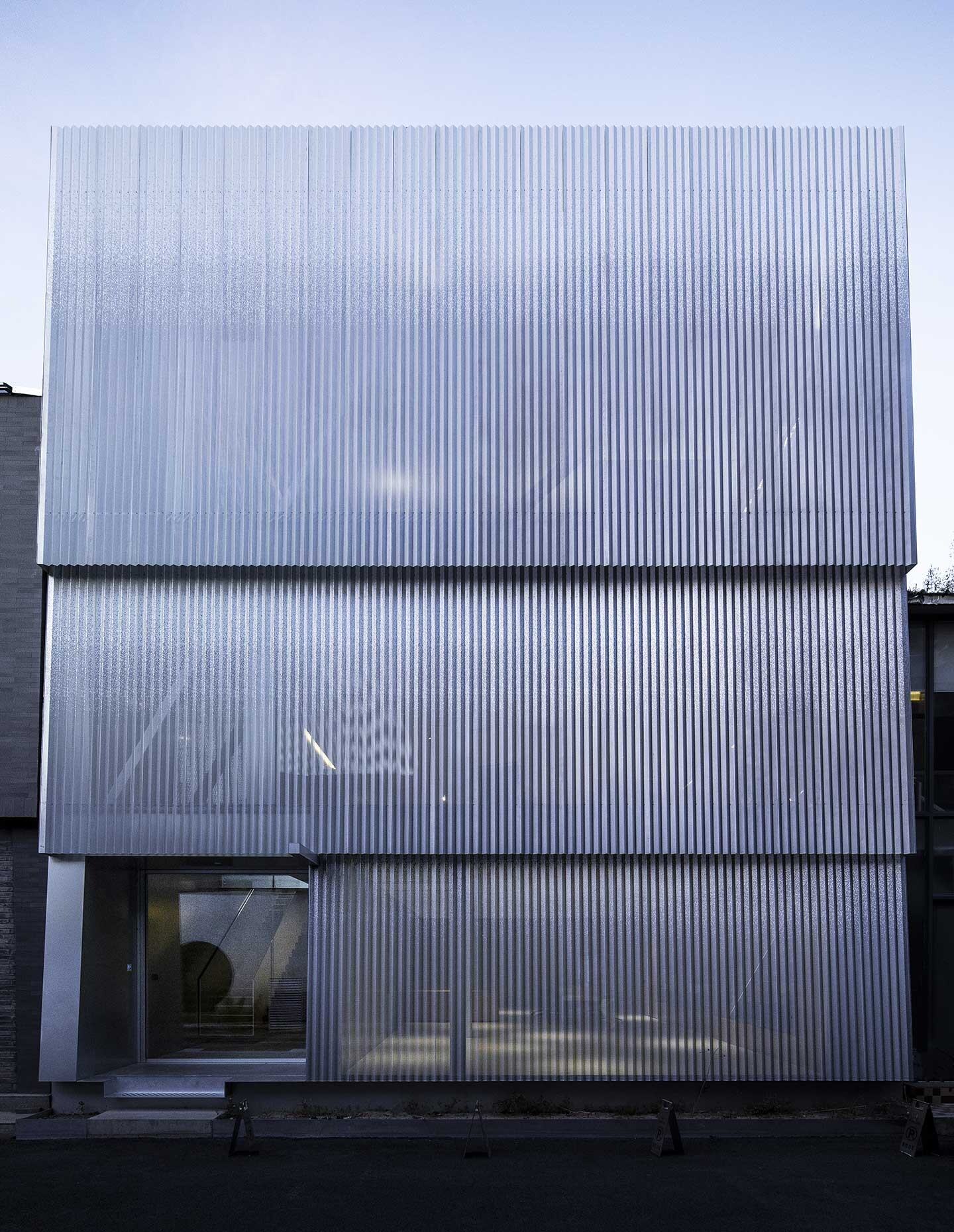
With the side now open to bring light into the space, the front and back were addressed by wrapping the building’s exterior in anodized aluminium. Chosen for its softly reflective properties, the western façade has been entirely perforated. In doing so, any direct sunlight is mitigated while privacy is afforded from the surrounding buildings. The highly contemporary façade sits comfortably with its industrial neighbours and gives the building a sharp contrasting presence akin to the super modern buildings punctuating the streets of Tokyo. “The goal was to create a bright, fresh architectural presence that engages in a unique dialogue with its surroundings, while also injecting new life into the old neighbourhood,” says Lei.
Reading as three large sloping blocks with each floor defined by a slight overlap in the façade, the building form becomes higher at the front. Following this form, and almost counterintuitively, the connection to nature is amplified by an interior that narrows as it rises.
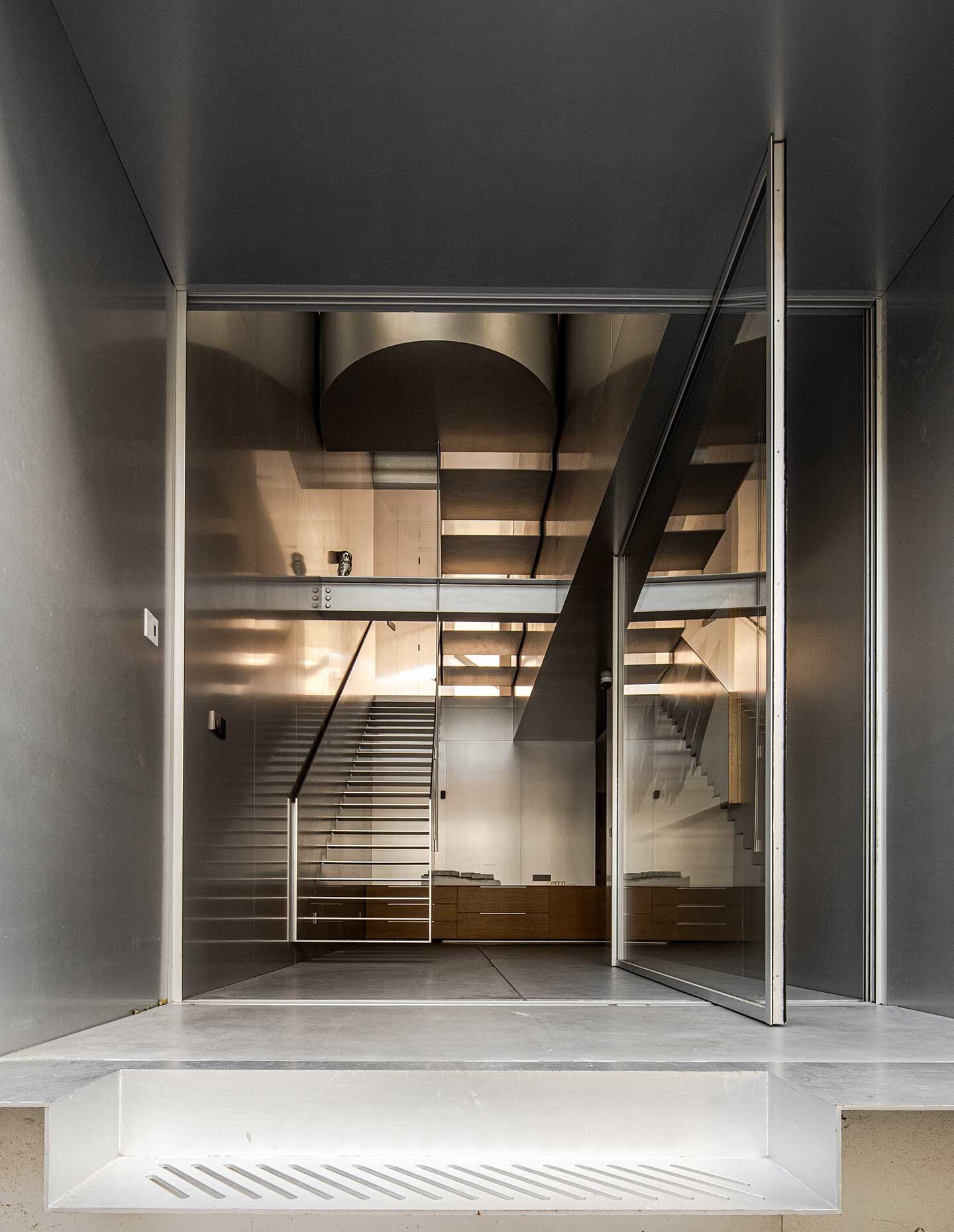
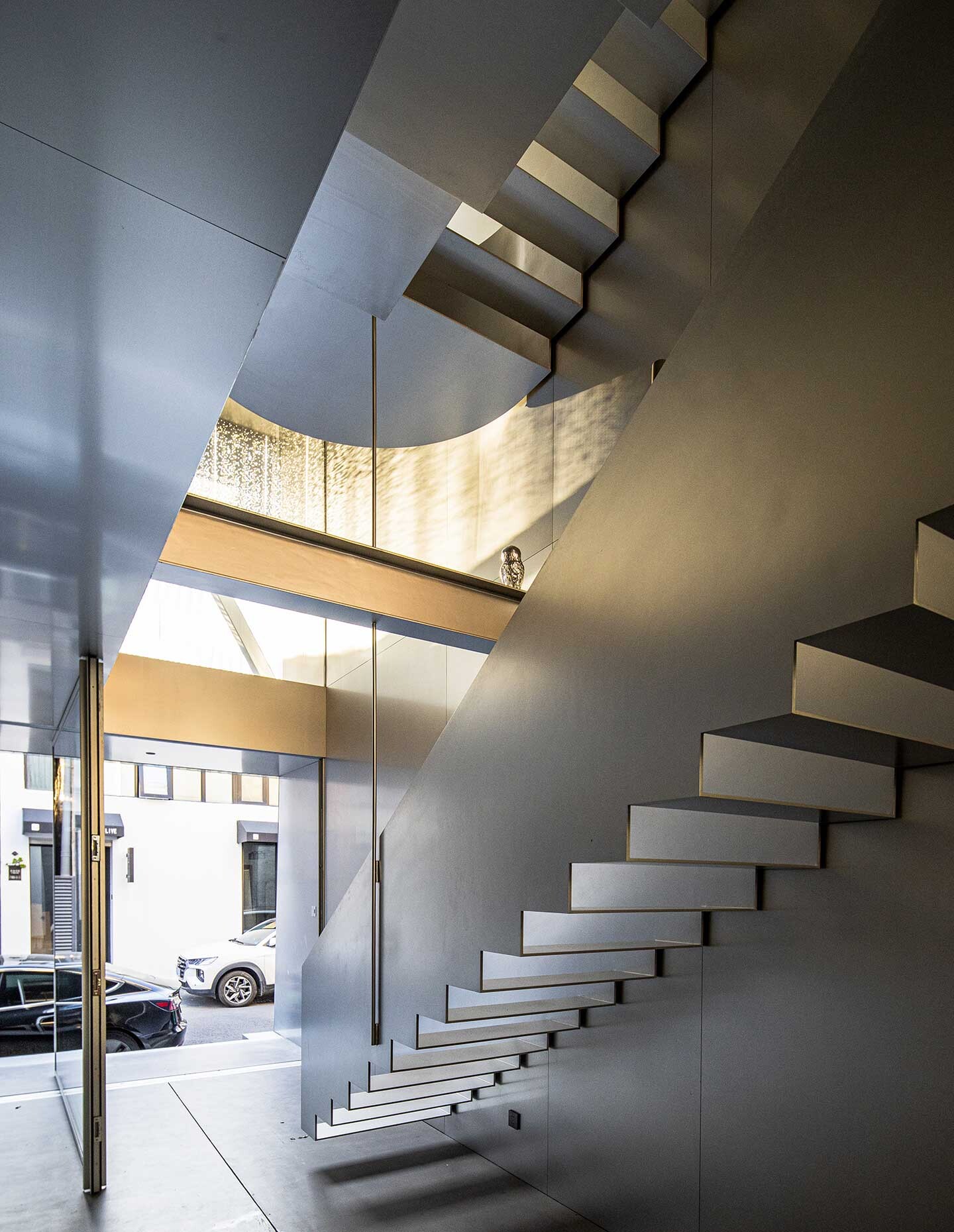
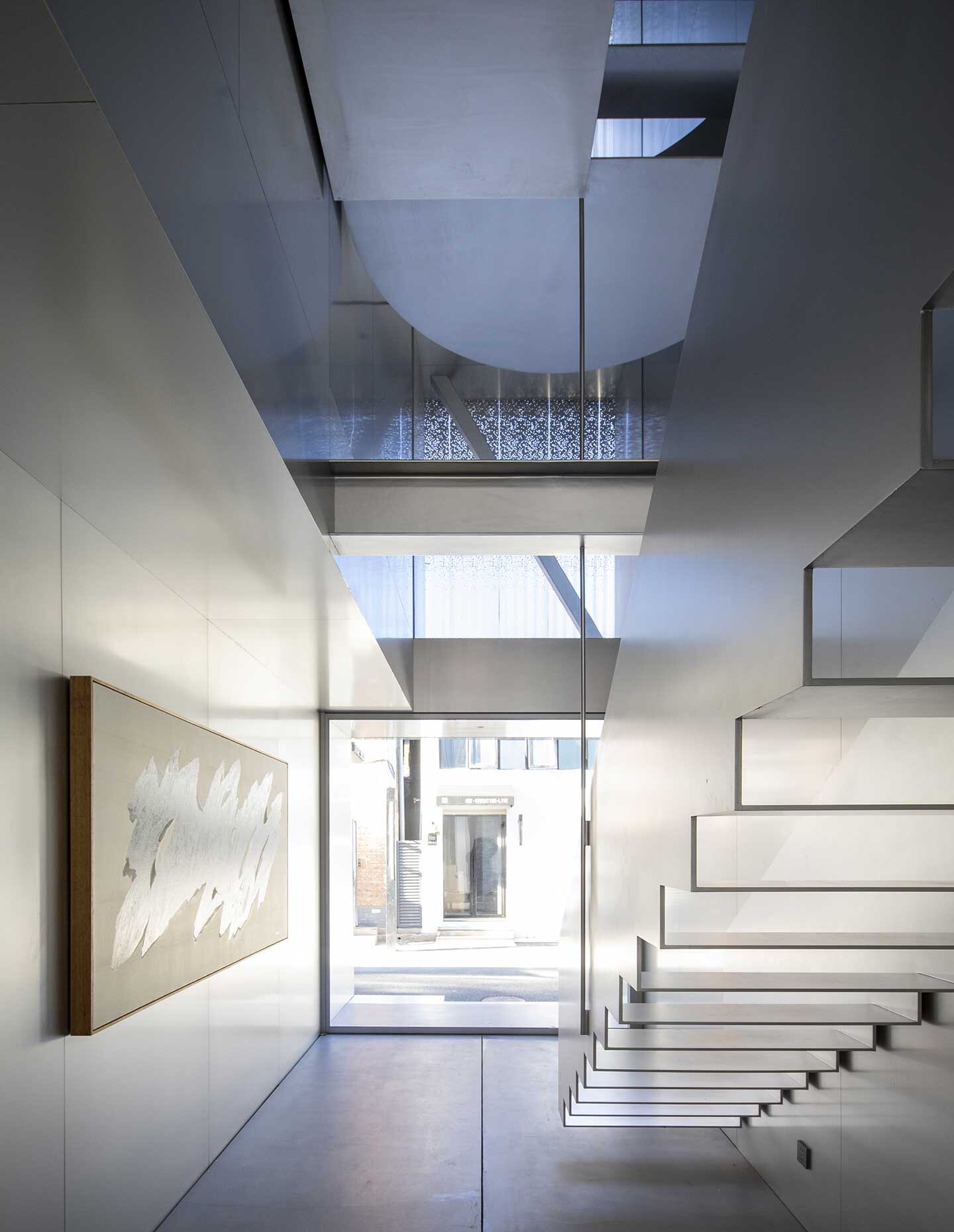
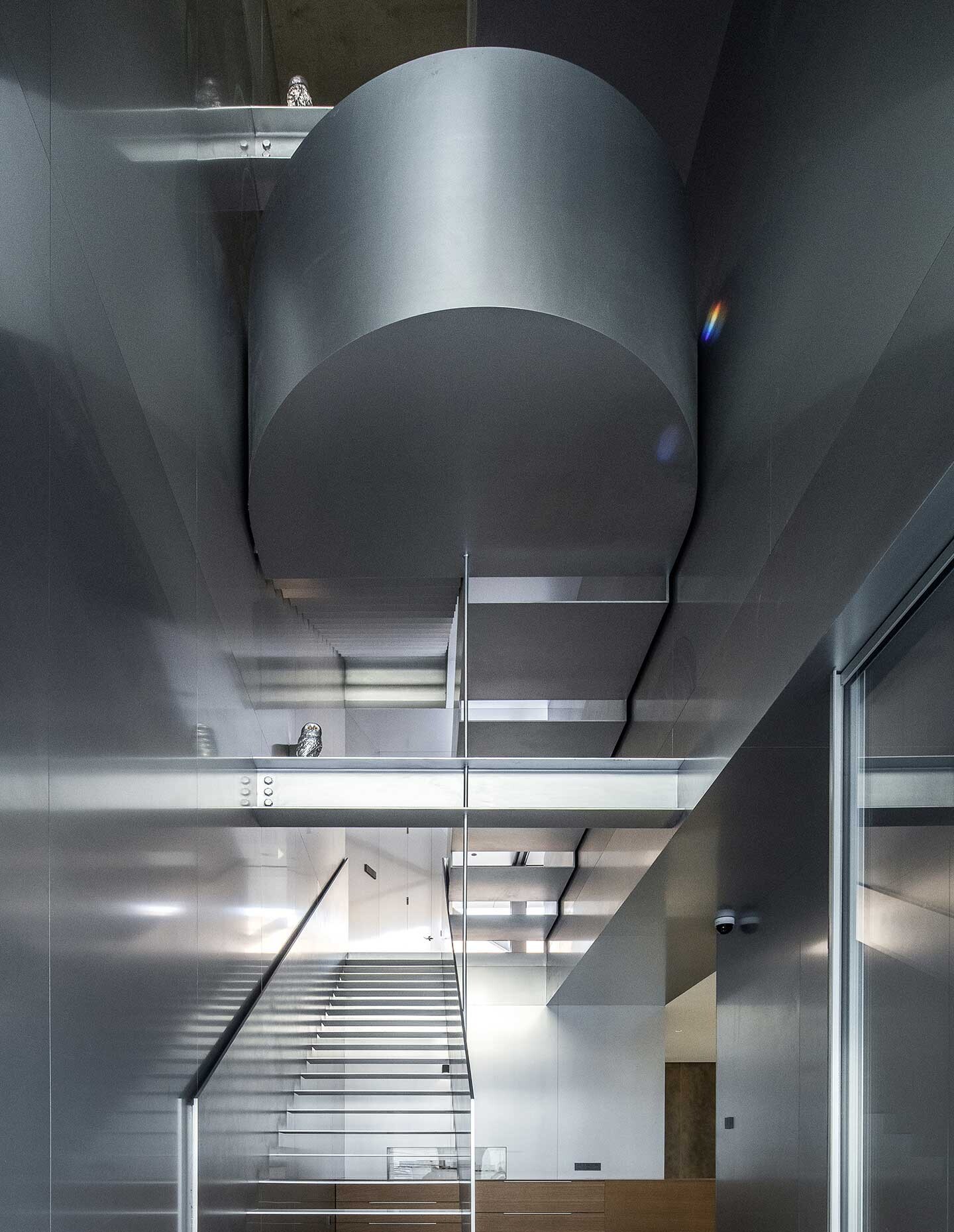
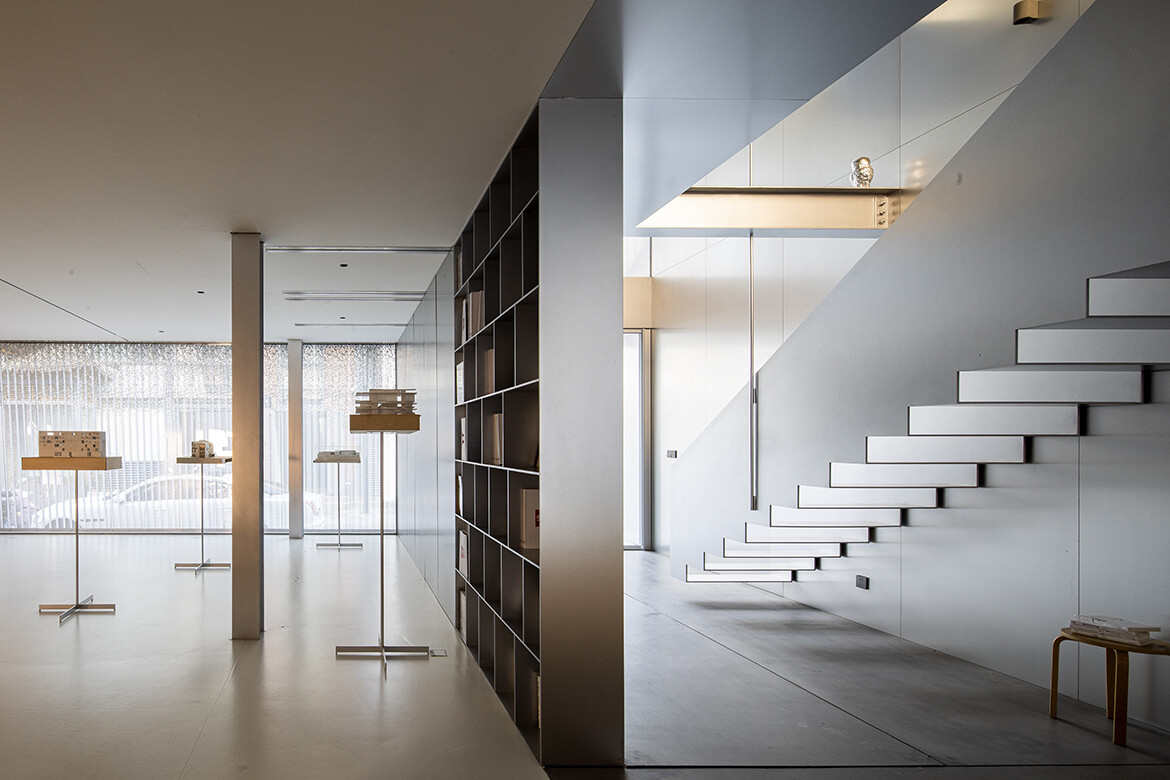
The lowest and largest of the three spaces comprises an exhibition/multi-use space and foyer. Designed for public and studio events, the exhibition floor takes good advantage of the theatricality of the façade, which glows with light and movement at night. It is also where you can get the best view of the staircase that floats a step higher than the floor and is articulated at each floor as an enclosed semicircle.
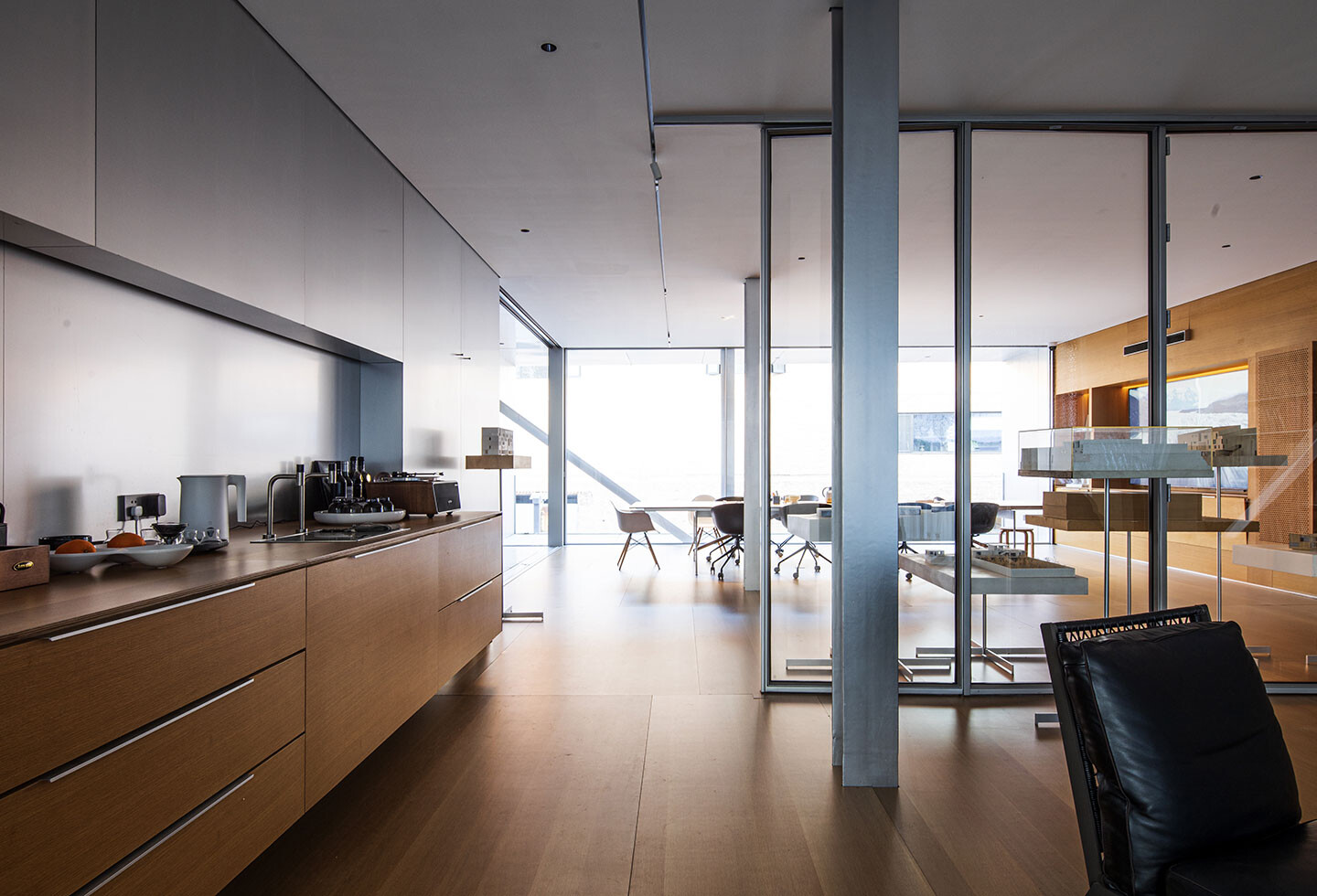
The studio’s reception and meeting rooms are housed on the second floor, where the removal of part of the floor plate allows the stairs to cut through the middle of the build, and while this reduces space, it increases connectivity. Traveling upwards, the upper floor and workspace is featured by floor-to-ceiling glazing behind the perforated façade that allows light to flood the workspace. Higher still, and effectively outside the building, the stairs continue to climb to a rooftop terrace with spectacular district views.
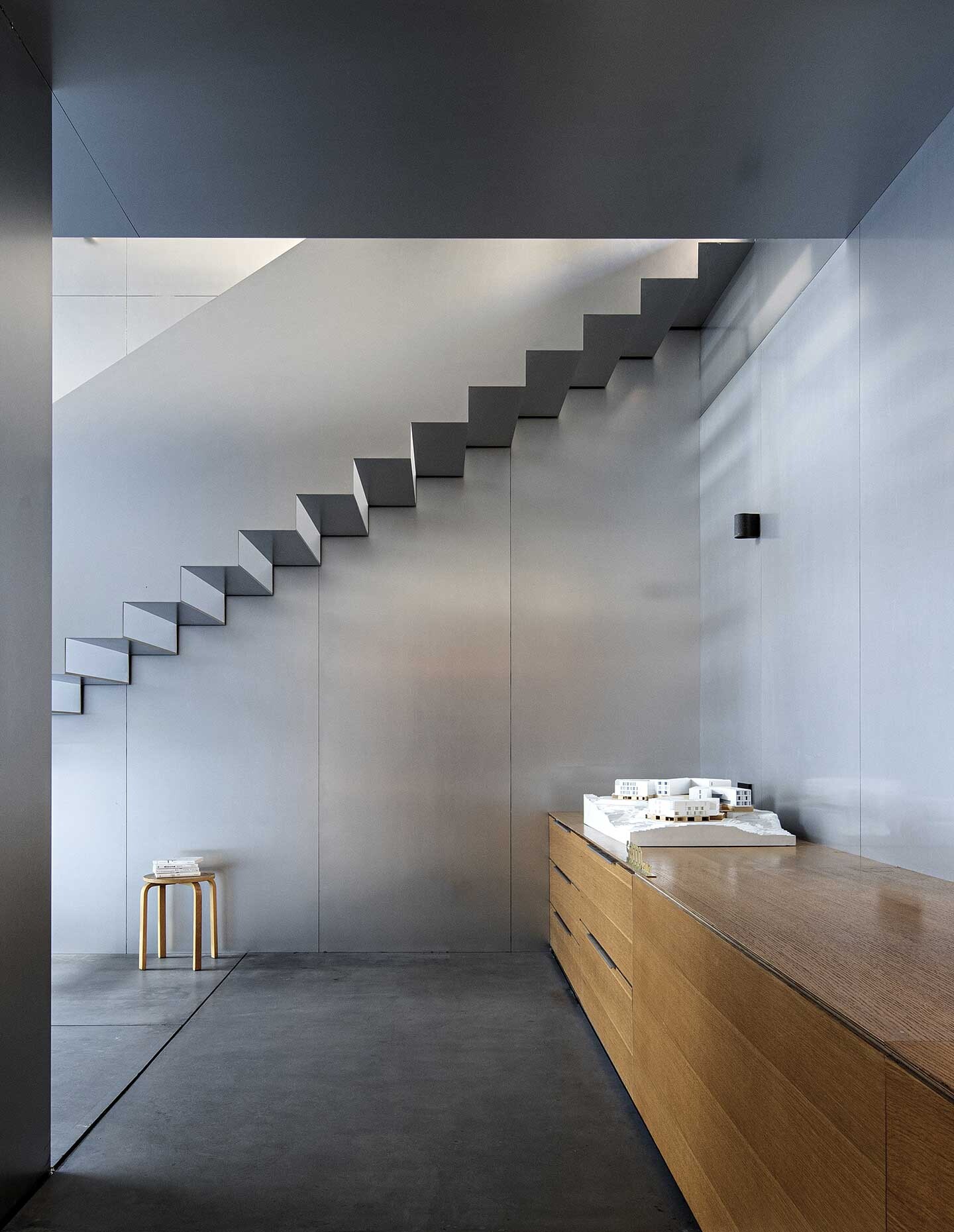
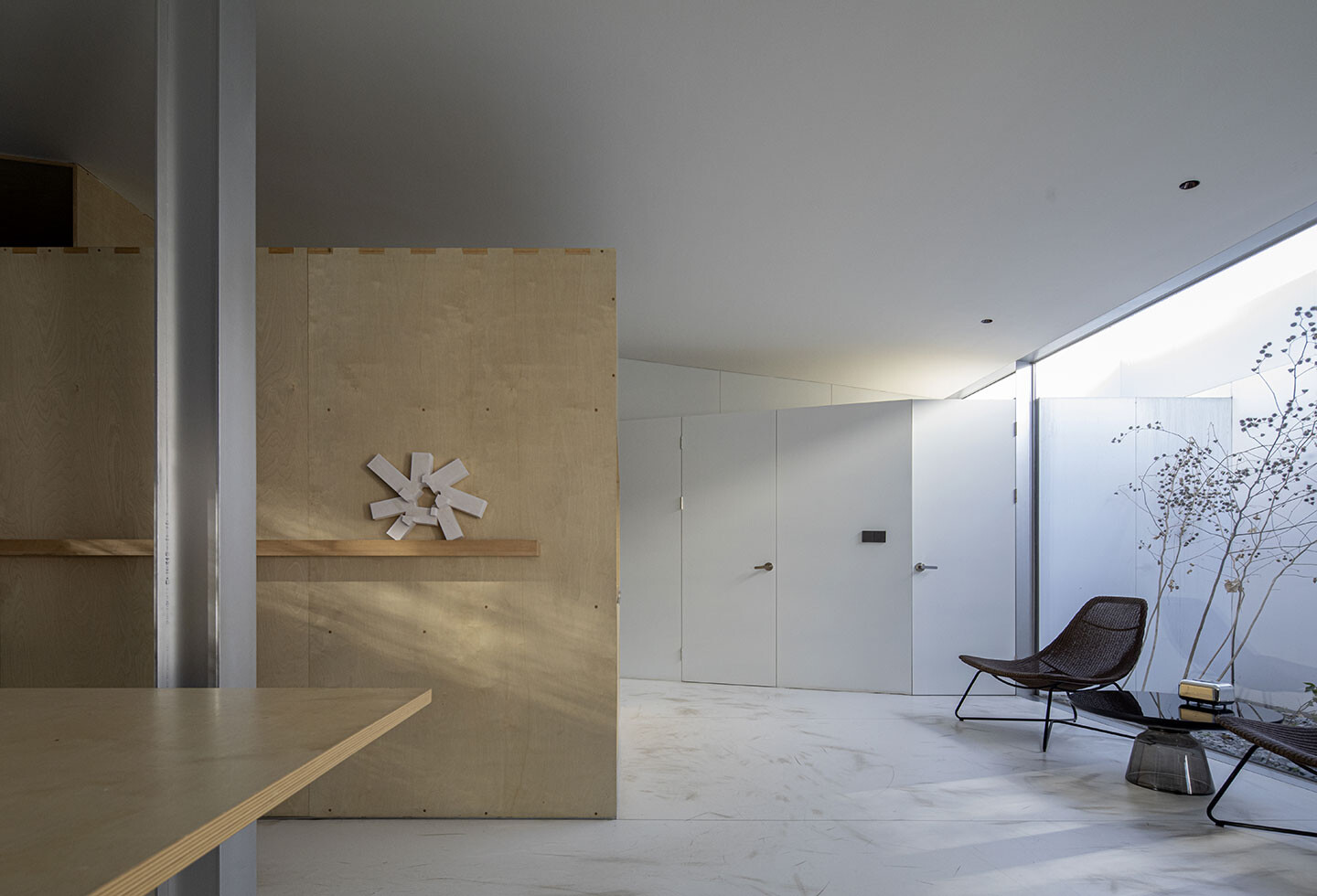
The interiors are minimal in the extreme, with aluminium used to clad the exhibition space walls which transition to bookcases, desks, storage and stairs. A large modern artwork and timber credenza create a visual transition between the foyer and exhibition space, but the whole is otherwise fluidly connected with polished concrete floors unifying the whole. The exhibition plinths are likewise minimal with a single stem supporting each of the small platforms. The second floor is considerably warmer with timber floors, cabinetry and tables, zhuzhed up by an assortment of elegant black chairs. The workshop is far more pragmatic, with ply used for the large desks, an entire wall of open ply shelving, and internal walls. And then, a pair of woven cane chairs sit either side of a ClassiCon Bell coffee table, adjacent to the narrow terrace planted with slender trees, bringing light and nature into the whole.
It is in fact a space entirely attuned to creative needs and exactly as it should be, as Lei states: “This small building has become our team’s base of creation. It stands as a symbol of our spirit, providing a space for independent thought amidst a raw and industrial environment.”
TAOA
i-taoa.com
Photography
TAOA