The home of architecture and design in the Asia-Pacific
Get the latest design news direct to your inbox!

Get the latest design news direct to your inbox!
Internet, eat your heart out: bricks & mortar retail and the post office will live to see another day (and some) in Helinski, Finland, thanks to Posti Box.


Far and wide, the Internet’s existence has wrecked havoc on many things we once couldn’t live without – bricks & mortar retail spaces and the quintessential postal service being two such things. Along with all the digital disruption inflicted upon such previously perceived pillars of society has come a whole new set of consumer behaviours and expectations. With the rise and rise of online shopping, consumers now expect more personally tailored and practical experiences when purchasing products.
In Helsinki, Finnish interior design practice Fyra collaborated with consulting firm Motley to craft Box, a new multi-experiential project for Posti, Finland’s leading postal and logistics company. The inter-practice trifecta team – equal parts design, strategy and service expertise – was assembled by Posti as part of a tactful decision to lean in to, rather than resist, the realities of digital encroaching on its business. The brief at the crux of the collaboration was to create something more than just a row of parcel lockers. Something like a self-service store for online shopping customers.


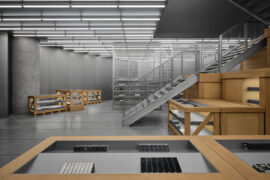
Imagine picking up your packaged delivery at a self-service store equipped with fitting rooms for you to try your online purchases. If the clothes don’t fit, or you don’t love your purchase so much in person, you’re in just the place to return it. Posti Box comes complete with boxing and unboxing zones, as well as fully-fledged recycling facilities. To top it all off, the space features an area, known as Spotlight, dedicated to hosting presentations and events put on by online companies. Culminating in an intuitive store layout, Posti Box provides customers with a coherent workflow as they can quickly make their way to dispose of their waste after unpackaging their goods.
Capitalising on the mass consumer shift towards e-commerce, Posti pronounces loud and clear that it will not succumb to the threats of digital disruption. Instead, in creating Posti Box, puts both the post office and bricks & mortar retail spaces back on the essential services map for shoppers in the Digital Age.


INDESIGN is on instagram
Follow @indesignlive
A searchable and comprehensive guide for specifying leading products and their suppliers
Keep up to date with the latest and greatest from our industry BFF's!
The internet never sleeps! Here's the stuff you might have missed