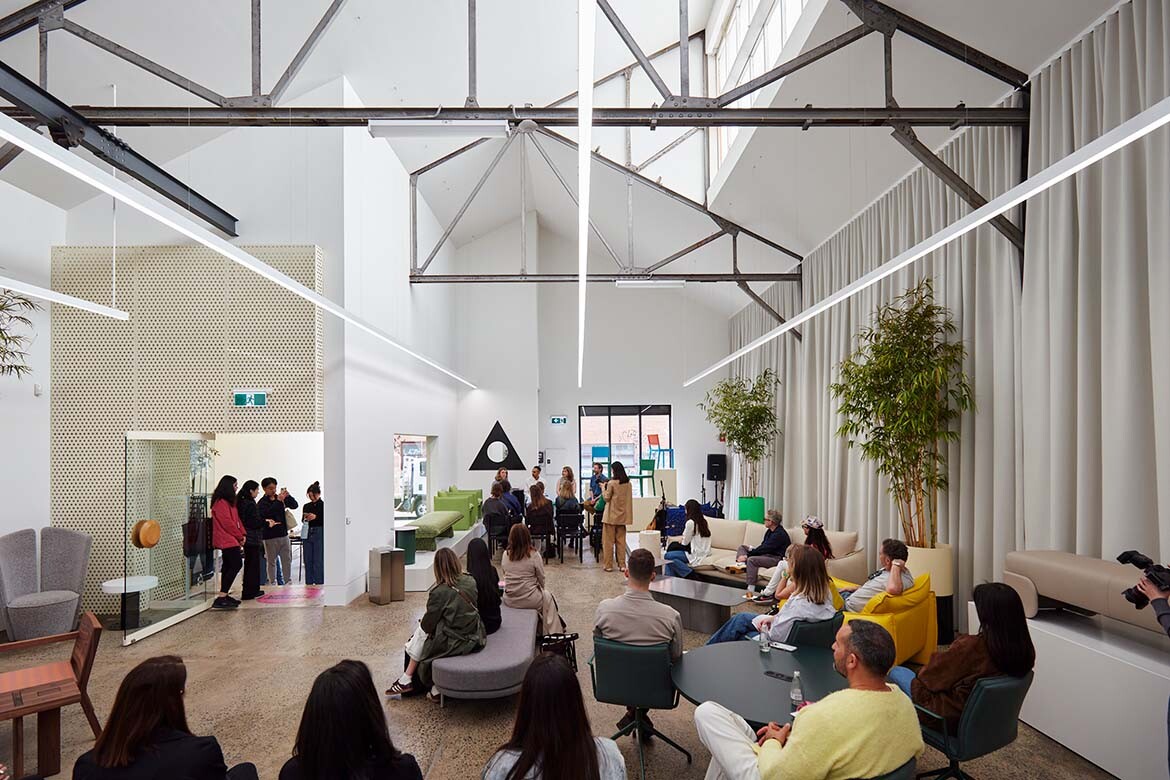
Design events work best when they give the industry something substantial to discuss. New products and polished installations draw people through the door, but the exchange of experience, ideas and disagreement often stays with us longer.
In the lead-up to Saturday Indesign, we asked six practitioners to identify the misconceptions they encounter in their work. Their answers reveal how easily familiar ideas about size, luxury, restraint and heritage can become accepted as rules.
1. Bigger means better
For Ash Roberts, Founder and Architect of Ardo, generosity cannot be measured through floor area alone. “Generosity in a space isn’t always about square metres,” he says. “It can come from volume, natural light, thoughtful proportions and the way spaces connect to one another.”
Amrish Maharaj, Director and Architect at Amrish Maharaj Architecture, agrees that the ambition should be a better house, not simply more house.
“Some of the most enjoyable homes I’ve designed aren’t the biggest – they’re simply the ones where every square metre has a purpose,” he says. “A thoughtful renovation can make a modest home feel generous through light, proportion and connection, without adding unnecessary area.”
Related: The national architecture awards shortlist has dropped!
2. Good design is primarily visual
Architecture is increasingly consumed as a stream of images. Roberts sees a risk in allowing photogenic moments to eclipse the experience of occupation. “The best spaces are also something you feel and experience,” he says. “They’re intuitive to move through, comfortable to inhabit and designed around the way people actually live and interact with them.”
Maharaj points to the ordinary moments that rarely appear in a photograph: knowing where to set down the shopping, morning light reaching the breakfast table, or children remaining within sight while dinner is prepared.
3. Every square metre must have a defined function
Pressure to maximise floor area can leave little room for spatial generosity. David Noordhoff of Freeman Group Architects would willingly surrender part of a room for a courtyard, natural light or a stronger connection to landscape. “Those moments often become the spaces people value most,” he says.
Roberts makes a similar argument for voids and unprogrammed areas. A space does not need an assigned function to contribute to the home; sometimes its value lies in the breathing room it gives everything around it.
At the apartment scale, Mark Aronson of maarch* architects extends the same thinking into shared space. “We’ve had more success making homes feel generous by giving good space to the building’s shared areas – the courtyard, the garden, the entry sequence – instead of cramming every square metre behind a private front door,” he says.
4. More expensive products create better interiors
Beautiful individual selections do not automatically form a coherent home. Emma Elias of Mr and Mrs Elias regularly sees flooring, tiles, paint and joinery chosen separately, without enough consideration for how they will sit together.
“Quality materials and fixtures absolutely are important, but expensive products alone don’t automatically create a beautiful home,” she says. “It’s a cohesive design language, where every element works together, that transforms beautiful products into a home that is enjoyable to live in.”
Noordhoff and Aronson both challenge the related assumption that design improves as more is added. For Noordhoff, the process often involves removing unnecessary elements until the home feels settled. Aronson describes restraint as a skill in itself: some of the quietest projects can be doing the most.
5. Neutral is always the safest choice
The default resale palette remains difficult to dislodge, despite its tendency to produce interchangeable interiors. For Sam Eggleton, Founder and Creative Director of Convict Interiors, neutrality does not automatically equal longevity.
“A beige box isn’t timeless, it’s just undecided,” he says. “Colour and pattern used with intention is what makes a home feel like it belongs to the people in it, and it ages far better than another cookie-cutter renovation.”
The important phrase is “with intention.” Personality does not require excess, but it does require decisions.
6. New work should imitate the old
Heritage projects often prompt anxiety about how visibly an addition should depart from the original building. Maharaj believes the new work should respect the existing architecture without reproducing it.
“Trying to recreate history often results in something less honest than allowing the new work to be confidently contemporary,” he says. “The conversation between old and new is usually more interesting than pretending they were built at the same time.”
Eggleton puts the distinction more bluntly: “The past should be present, not in charge.”
At an urban scale, Aronson challenges the assumption that density itself damages neighbourhoods. Poorly designed density can, but considered infill has the capacity to strengthen a street and support the life around it.
7. The designer delivers a finished object
A house is not complete when the drawings are signed off or the builder leaves. “The best homes continue to evolve through the routines, collections and personalities of the people who live in them,” says Noordhoff. “Architecture should provide the backdrop for life, not compete with it.”
Elias also rejects the belief that engaging a designer means surrendering personal taste. She sees the process as collaborative, with the designer helping clients express their own identity in a more coherent and functional way.
Eggleton warns against beginning construction while decisions remain unresolved, noting that changes which are simple on paper become costly once trades are on site. “The most creative thing you can do is finish deciding before anyone picks up a tool,” he says.
These responses suggest that many persistent design fallacies come from mistaking an easy metric for a meaningful one: area for generosity, expense for quality, neutrality for longevity or visual impact for experience.
They also offer a useful prompt for Saturday Indesign. As the industry gathers across Sydney’s showrooms, a better event is one that leaves room for candid positions and practical knowledge alongside new collections. The conversations around design should be as closely considered as the objects being presented.
Saturday Indesign returns to Sydney on 12th September 2026.
Saturday Indesign
saturdayindesign.com