The home of architecture and design in the Asia-Pacific
Get the latest design news direct to your inbox!

Get the latest design news direct to your inbox!
Unispace’s new Melbourne studio exhibits a built-in fluid and mutable working style that transcends the clunkiness of faddish design trends and wire-driven technology.

Photography by Shannon McGrath

Photography by Shannon McGrath

Photography by Shannon McGrath

Photography by Shannon McGrath

Photography by Shannon McGrath

Photography by Shannon McGrath

Photography by Shannon McGrath

Photography by Shannon McGrath

Photography by Shannon McGrath

Photography by Shannon McGrath

Photography by Shannon McGrath
Have you heard of Unispace? They’re a relatively new design business, having come onto the scene some five-and-a-half years ago. With studios located around Australia and internationally, the company is not what you’d call your traditional design firm, having originated from a triumvirate of strategy, design, project management and construction backgrounds.
“We sit in the middle,” says Simon Pole, Unispace’s global design director. “We offer top tier strategy, design and project management and we can deliver your project for you as well. We found that the typical project methodology can cause conflict [between designer, project manager and construction]. So we set out to create a team that understands the whole process and empathises with each phase. Its about breaking down the egos within the disciplines to ensure that we are all working in synchronicity – everyone’s at the table at the same time.”
Unispace’s recently completed Melbourne studio is, as Pole describes it, a physical manifestation of Unispace’s unique methodology. Located at the ‘Paris end’ of Collins Street in Melbourne’s CBD, the studio exudes a fluidity in both floor plan and fit-out that challenges your expectations – right from the proverbial front door.
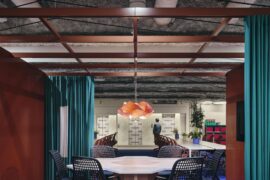
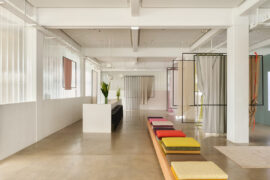
To walk out of the lift is to wander right into Unispace’s communal kitchen, where a team member comes forward to greet you and direct you where necessary. The space is exceedingly open plan and fluid, the eye drawn towards the long, snaking length of a custom-made work bench that runs through the space. Perhaps the most static elements are the island benches that float across the kitchen and entrance.
In arriving at the right solution for Unispace, Pole and team considered the realities of agile working. “A lot of design firms talk about flexible working but live in a paper-driven architectural icon of a space. With the scale of projects we work on you need to be more agile as the teams and project types are moving quickly.”
The long, central work bench exists as a manifestation of this agile working idea allowing project teams to metamorphose with utmost ease. “It’s like a travel agent selling you a beautiful holiday spot without understanding what it’s like being there,” says Pole, “It’s necessary for us to work this way in order to [properly understand it] and advise our clients.”
To the very rear of the bench is a project lab which supports rapid interchange between lab-users and a desk-based task force. Pole also points out a series of grey felt project display panels which can be moved from wall-to-wall, allowing for quick visual ideation that can literally be carried across into a formal boardroom setting.
“It’s all about making things as efficient as possible and maximising collaboration,” says Pole. “We love to collaborate and it comes back to the ego thing. We have no ego, we’re about disrupting traditional methods of working and embracing different points of view, everyone’s encouraged to contribute and co-create.
“We found our culture is our biggest differentiator compared to other firms and we constantly look for ways to maintain this as we grow.” This differentiation extends right through to materiality. “So much design out there is pop-y, fashionable and ‘follow-me’. We said, ‘Let’s go back to quality design, minimal finishes and bespoke setting variances.’ ” This was expressed through a simple execution of epoxy terrazzo flooring, solid timber benching and woven stainless steel ceilings. Nothing overly fashionable, the focus being on longevity.
In embracing change and agility as their constant, Unispace has cemented a brand ethos and working style that offers them opportunity for growth and the ability to embrace whatever comes their way.
Want more? Grab a copy of Indesign #68 – on sale now!
INDESIGN is on instagram
Follow @indesignlive
A searchable and comprehensive guide for specifying leading products and their suppliers
Keep up to date with the latest and greatest from our industry BFF's!
The internet never sleeps! Here's the stuff you might have missed