The home of architecture and design in the Asia-Pacific
Get the latest design news direct to your inbox!

Get the latest design news direct to your inbox!
In the Yuk Tong Avenue House, MAKK Architects combine pattern making with climate control using humble, robust brick.

February 22nd, 2019
The Yuk Tong Avenue House by MAKK Architects was designed in reverse. The rear view of the inter-terrace house in Singapore – an unblocked, picturesque vista toward Bukit Timah Hill – was more attractive than that at the front, which faces a walk-up apartment across a one-way street. As the client desired utmost privacy, the most important rooms thus open up toward the back while circulation, services and less private spaces take the front.
The house’s reticent brick facade reflects this internal arrangement. The material clothes the front elevation from the second storey all the way up to the roof tip, punctuated only by miniature windows and an indentation on the second storey that allows access onto the car porch roof.
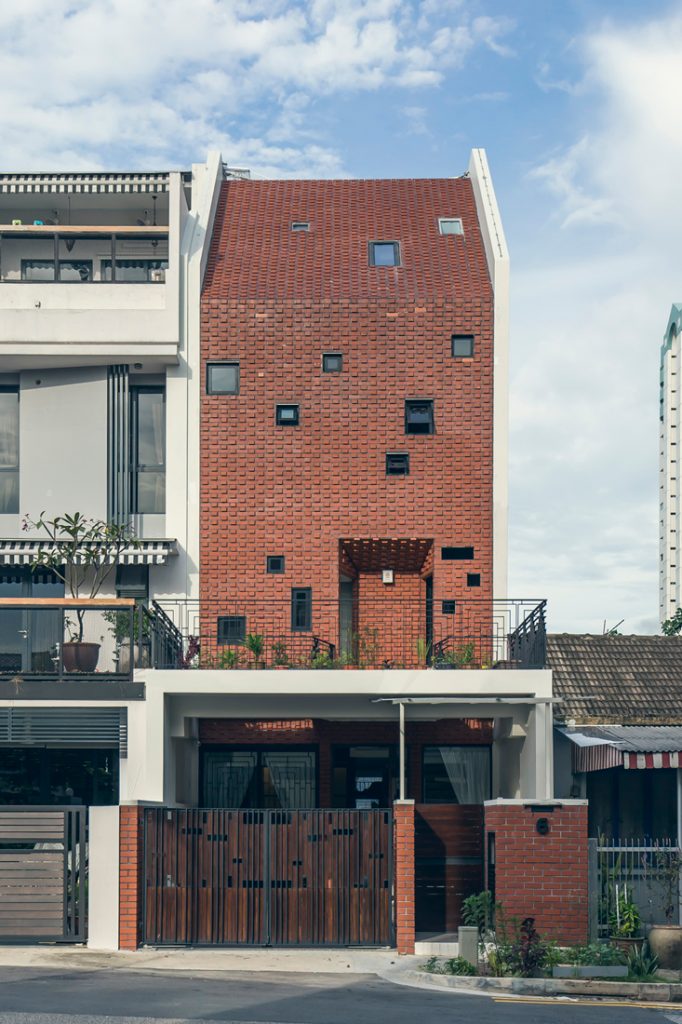
The material was the client’s choice. Its usage here melds form with function. “As the site’s front faces west and the rear faces east, the brick cavity-wall facade was used as a heat – and also water – barrier, other than just for design purposes,” says Lee May Anne, Principal at MAKK Architects. She patterned the brick to mitigate views and allow some light and ventilation in while giving three-dimensionality to the wide area it covers.
Special care was taken to give the brick wall a lightweight appearance despite the material’s inherent heaviness and sturdiness, with hollow red brick used instead of solid brick for its nicer fair-face finish. “I wanted a homogeneous material to complete the entire front facade to eliminate the typical [composition] of a house, which is usually divided by the datum of a roof in one material – usually clay tiles – and a plastered wall facade. By gliding the red brick throughout the front facade all the way to the roof, this datum is hence diffused and the homogeneity of the ‘wrap’ becomes obvious,” explains Lee.
This approach of using a singular material or gesture to define a project has come to define Lee’s oeuvre. “To me, architecture is an amalgamation and integrated outcome of both structure and spaces. Hence, I like to see architecture as not just skin,” she explains. Thus here, the brick wall not just superficial cladding; it is also visible from the inside.
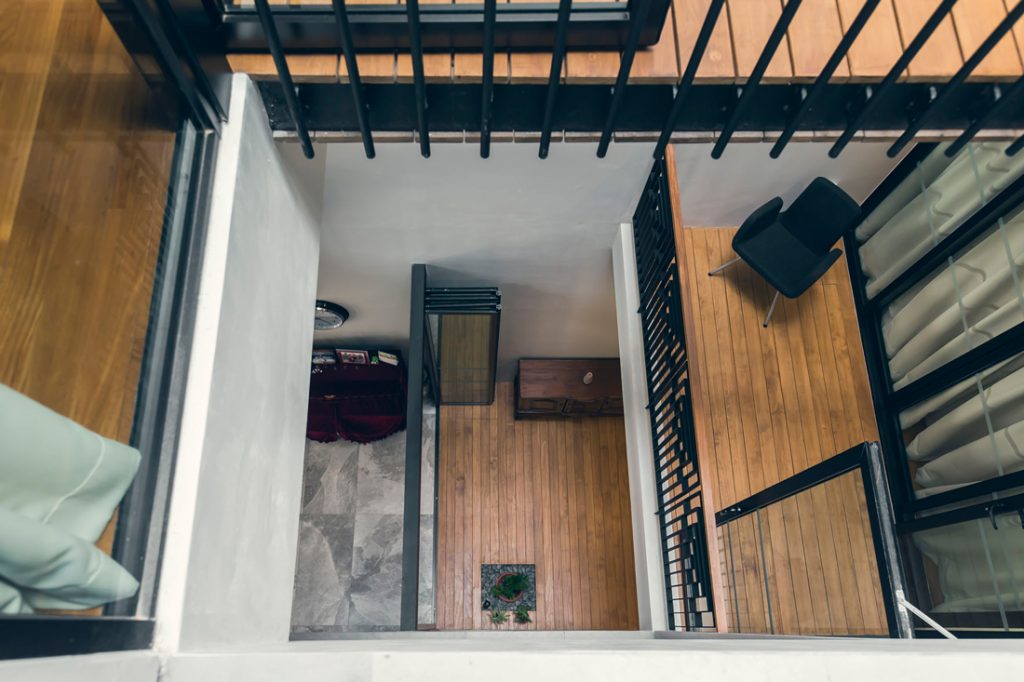
The porous brick wall allows cool breezes into the house. This is also aided by an internal airwell. Its design is unusual, as the bedrooms looking into this void have staggered balconies and a bridge connects two rooms on the third floor.
Lee designed the courtyard in this way as a response to the client’s request for individual bedrooms for his three children. In a likely scenario, this would reduce contact among members of the three-generational home. “This staggered, vertical connection across the void space was designed to provide cross ventilation to the house’s interior, while serving as a visual, [aural and physical] connector for the family members within the house,” says Lee.
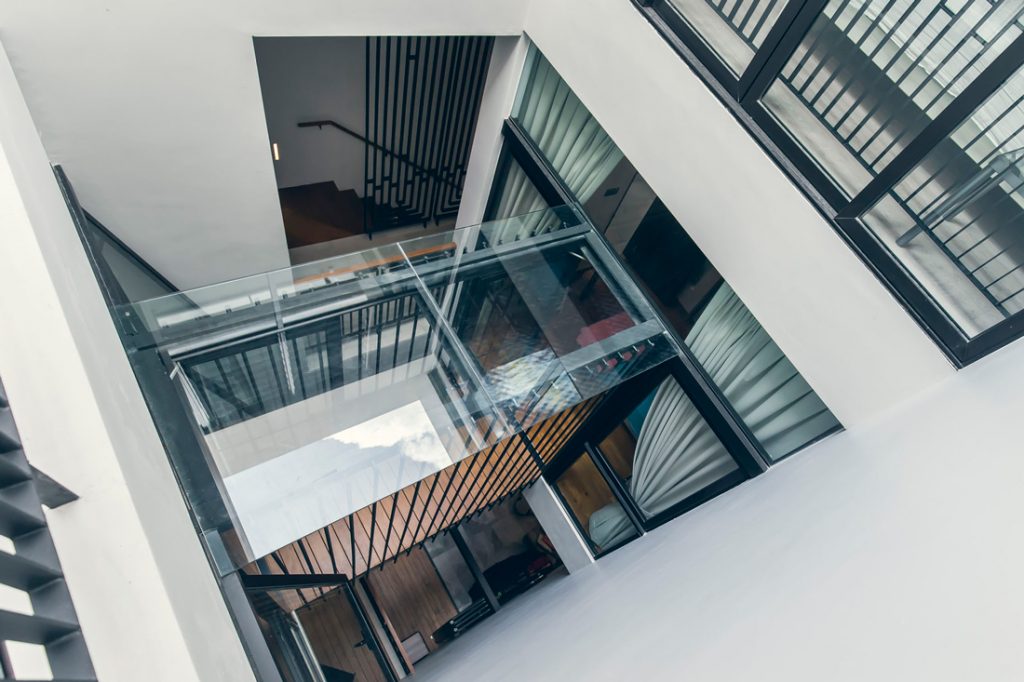
Aside from the red brick, another motif Lee applies throughout is a graphic black steel frame. This features as staircase balustrades, and also handrails at the courtyard, car porch roof and front gate. The intent was to create a sense of movement, Lee shares. Together with the red brick, the materiality of the house conjures a vintage flavour that is refreshing in a neighbourhood of white walls and pinstripe awnings.
INDESIGN is on instagram
Follow @indesignlive
A searchable and comprehensive guide for specifying leading products and their suppliers
Keep up to date with the latest and greatest from our industry BFF's!
The internet never sleeps! Here's the stuff you might have missed