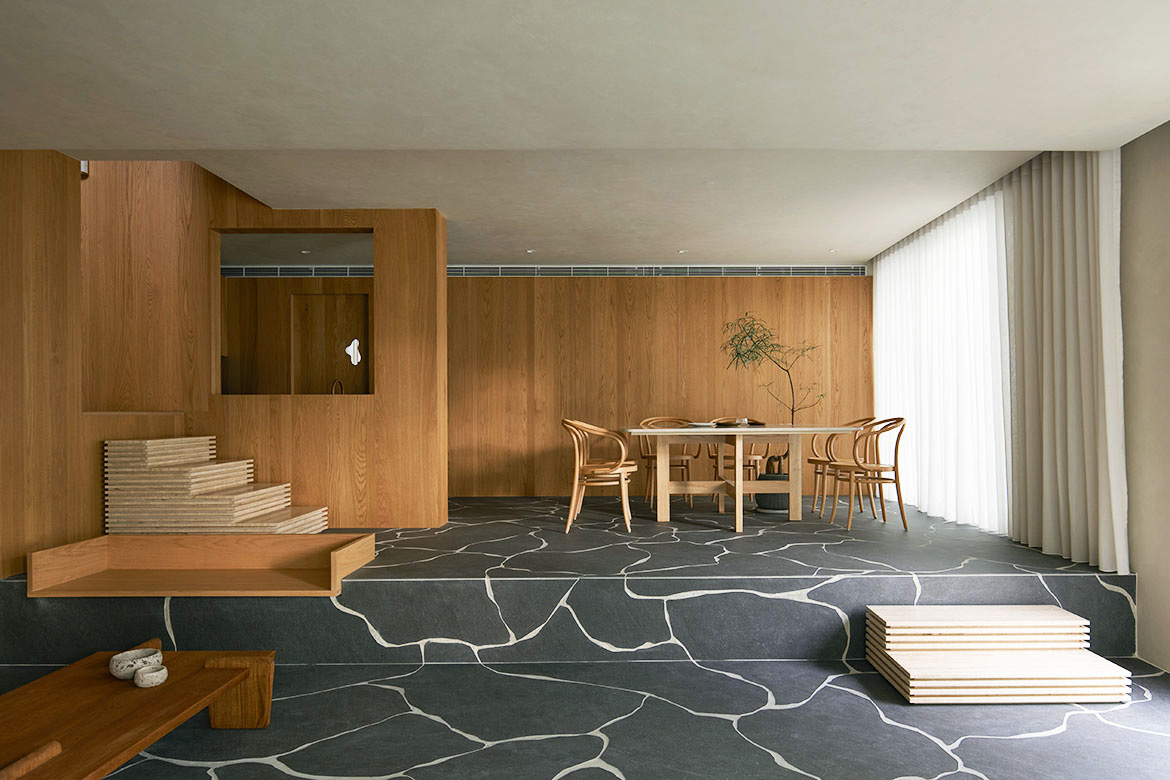
House of Parts is a fitting name for this three-storey corner terrace house designed by L Architects. It spotlights the many distinctive interior and architectural elements that the firm’s founder Lim Shing Hui has reinterpreted into pieces of functional artwork to be discovered as one traverses and uses the home. “We feel that for small houses, instead of adding more elements, we can redesign existing ones to give them more character within the space. That is more meaningful,” she explains.
One example is the steps that divide the living and dining room split levels, as well as another at the bottom of the main staircase. “We delineated the latter from the main staircase, expressing it with natural travertine and articulating it with linear strips,” Lim describes.
Another is a curved kitchen. “The client very much wanted an island counter but there was simply no space for it. So we designed a kitchen with a curved geometry to emphasise the round sink, making it stand out. Thus, the kitchen turned out to be quite a unique space featuring a round sink and curved cabinetry. The curves also help soften the space,” Lim highlights.

With this strategy, the architect, who worked on House of Parts together with architectural assistant Tse Lee Shing, has given a sense of importance and delight to something quotidian. A house is not just a functional space, she seems to suggest; it is also a canvas for beauty and craft.
There is, at the customised dining table, a subtle rotund cut-out in the brushed Olivo Grolla limestone top, where a small tree trunk slots in. Its lithe branches rise up umbrella-like to bring the experience of the outdoors right to the table. “Nature has a seat in this composition too,” Lim comments.

In the study room on the second floor, she designed a study lamp made of corrugated zinc material. “People used the humble material for their roofs in the old days,” says Lim on paying homage to the cheap yet utilitarian material.
Related: L Architects: Led By Simple Questions

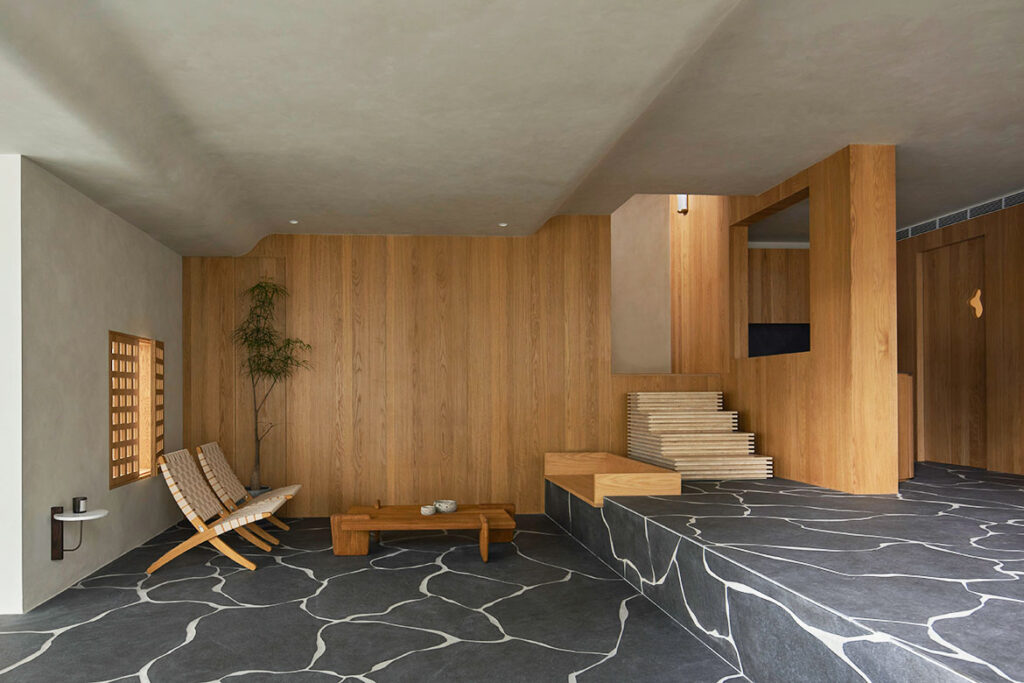
The first storey flooring is another element that Lim has chosen to use as a canvas by cutting up a large-format engineered ceramic tile into a variety of organic shapes separated with different grout spacing. “This flooring is also used for the upturn to negotiate the split levels on the ground floor,” Lim points out.
This flooring treatment was inspired by Lim’s childhood memories. “We used to have small, crinkled, dark brown ceramic floor tiles with a lot of grout lines. I was only about four years old but every time I think back to my childhood home, I recall this image,” she recounts. “I wanted to create a floor with a tactile quality and a lot of flowing grout lines – something unique and memorable for the two young children of this household. I think having a strong memory of your first home is very comforting and precious, and will eventually form an integral part of the family’s collective memory.”

Timber perforated windows filter the light, washing a part of this floor in comforting shadows. In another corner of the living room, full-height glass windows nourish a miniature indoor garden, complete with a custom bench on a bed of pebbles. The gallery-like character of House of Parts is accentuated with a curved ceiling, which is actually an architectural device used to mitigate the inherently different ceiling levels on the first storey.
Related: Living Grid House uses window boxes and plants as a clever solution to heat and privacy

Contemplates Lim on the general scheme, “We wanted to create a calming and cocooning interior that balances a muted palette with moments of material intensities, such as huge sedimentary rock in the master bathroom or the travertine step that has a porous texture.”
On the master bathroom, she has crafted a contemplative atmosphere with the provision of a tree and the thoughtful composition of various textured components. A timber panel placed in front of a window lets the occupants orchestrate their desired light intensity while another window offers a view of landscaping.

“I have always believed that light and material are mutually dependent. Materials are key to understanding light in architecture, we need to see it through the lens of materials because light is the medium that allows us to see and appreciate textures, gradients and colours.” It is as this home showcases – both the material and the immaterial are for Lim great sources of spatial poetry.