The home of architecture and design in the Asia-Pacific
Get the latest design news direct to your inbox!

Get the latest design news direct to your inbox!
In an ongoing investigation into protected outdoor spaces, HYLA Architects adapts the traditional courtyard with a terrace house fit for Singapore’s climate .

August 23rd, 2018
The houses by HYLA Architects are often designed with courtyards – calm centres around which interior living spaces are planned. The courtyard offers the house light, air and other enjoyments of the outdoors, while its enclosing structures afford privacy and a wonderful sense of refuge. HYLA Architects’ latest build, given the name ‘A Tale of Two Courts’, is a two-storey corner terrace house that sits on a long site. A high-rise and high-density public housing development, when completed, will overlook the house from the rear. A public footpath runs alongside its side boundary. Privacy is therefore one of the chief concerns for the occupants who are a small family consisting of a couple, their daughter and their domestic helper.
The family had one other request when they met with Han Loke Kwang, Principal of HYLA Architects. Han shares, “The client gave a functional brief with one important criterion – each of the three occupants are to have their own study attached to their bedrooms, and all three studies are to face each other. The client accepted our design proposal and there has been almost no or minimal change to the design, save the usual refinement of details and selection of fittings and finishes.”
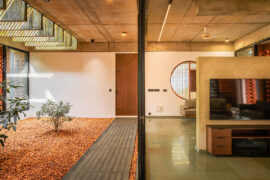
The design proposed two courtyards in the terrace house. The first is open to the sky and enclosed on three sides. The main living, dining and dry kitchen look into this courtyard in which a willow tree was planted. The second courtyard is a more private and fully enclosed to keep it dry and useable under all weather conditions. Around this courtyard are arranged the requested private studies and other ancillary spaces for the family.
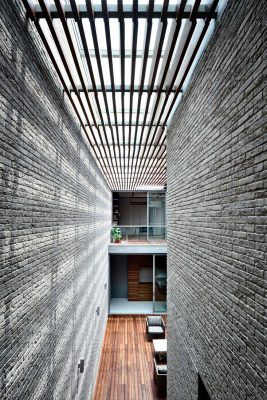
Han shares, “The two courtyards show the evolution of courtyards. The first is a traditional courtyard, open to the sky and elements and enclosed on three sides. The second is the adaptation of the courtyard to our climate and culture. It is enclosed, covered on the top with a glass roof with timber pergola. However it is ventilated; there is a one-metre gap between the glass roof and the pergola so that air flows through the sides. It is totally private and becomes an outdoor space that is well lit, naturally ventilated, private and protected from the elements.” In addition, a high-volume, low-speed fan is mounted in the middle of the courtyard to provide a calm and steady breeze.
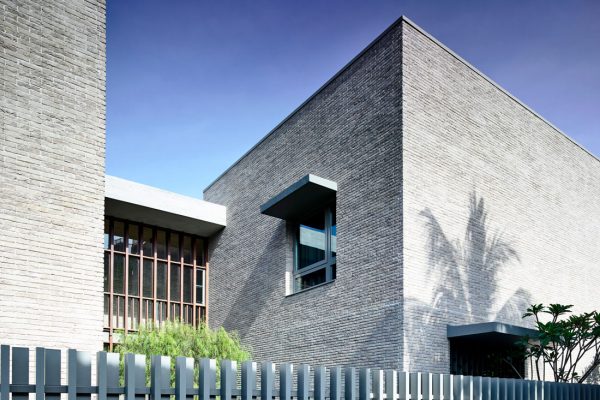
Designed to perform beautifully, the whole terrace house is also clad in a sand-coloured face brick that pairs very nicely with the off-form concrete used for the beams and ceiling soffit.
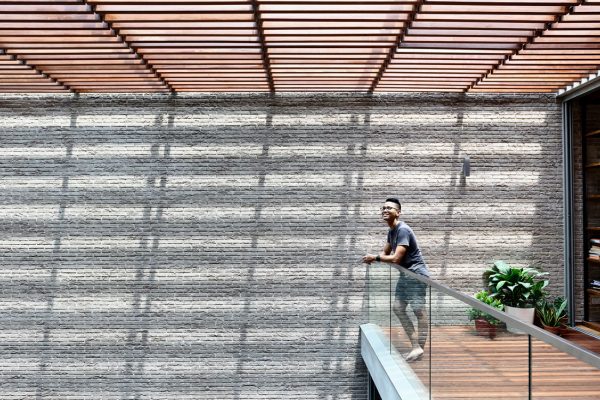
Han adds, “Light and space is a key element in my design composition and the plan is an unfolding drama of how spaces are illuminated by sunlight. For example, the timber-framed windows along the corridor leading from the first courtyard to the second courtyard act also as a secondary screen and relate to the timber pergola in the second courtyard. The size and spacing of the timber elements was also carefully chosen after several mockups done to ensure the right balance of light and shade.”
Photography by Derek Swalwell (courtesy of HYLA Architects).
Another house in HYLA Architects’ ‘courtyard’ series, Room Without Roof, won The Living Space category at the INDE.Awards 2018. Read about it here and here. And catch up on more courtyard houses by HYLA here, here and here.
INDESIGN is on instagram
Follow @indesignlive
A searchable and comprehensive guide for specifying leading products and their suppliers
Keep up to date with the latest and greatest from our industry BFF's!
The internet never sleeps! Here's the stuff you might have missed