The home of architecture and design in the Asia-Pacific
Get the latest design news direct to your inbox!

Get the latest design news direct to your inbox!
ipli Architects continue their introspective approach to residential architecture; Safdie Architects and DCA Architects reinvent high-density living at Sky Habitat; UNStudio and DP Architects support SUTD’s cross-disciplinary pedagogy with spaces of constant connection; A discussion about the tides of practice in Singapore; All the happenings from Singapore Indesign Intimate 2015, and more to be found in this issue.

August 13th, 2015
It is appropriate that this issue of Cubes Indesign – our 75th – happens to coincide with the nation’s 50th birthday. The projects featured in this issue can be looked upon as a snapshot of tendencies in Singapore today. We do not have a habit of theming our issues, but if we did, this one may well have been centred on the notion of time and progress, and Singapore’s ever-impressive habit of energetically testing new models, transforming its built fabric and pushing toward new horizons.

House at 7 Namly Hill by ipli Architects. Photo by Jaume Albert Marti (courtesy of ipli Architects)
Our cover feature is an immaculate semi-detached house at Namly Hill forged with the quiet vocabulary of ipli Architects. With this dual-skinned abode, ipli continues its investigation of an inward-focused tropical residential architecture, making use of the interstitial gap as a zone of sheltered outdoor spaces, shielded openings and indirect natural lighting.

Sky Habitat by Safdie Architects and DCA Architects. Photo by Edward Hendricks
In Bishan, we find a very different mode of living at Sky Habitat. Working with DCA Architects, Safdie Architects adapts the principles of Safdie’s Habitat 67 scheme to the realities of living in a high-density modern Asian city. This new residential matrix furthers Safdie’s vision of fusing the suburban home and the apartment block with garden terraces, plentiful access to fresh air and light, and privacy. Read more about Sky Habitat in our Cubes Extra article on Indesignlive.sg, out soon.

Singapore University of Technology and Design academic buildings by UNStudio and DP Architects. Photo by Hufton+Crow© (courtesy of UNStudio)
Over at Singapore’s newest university, the Singapore University of Technology and Design (SUTD), we take a walk through the new academic buildings designed by UNStudio and DP Architects. We discover a mix of disciplines and spaces, and an architectural emphasis on lateral and vertical links. The result is an environment that nurtures the pedestrian with the sense of an ongoing journey.

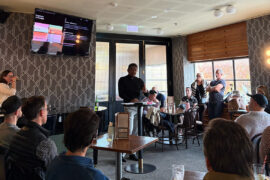
From left: Mark Wee, Wu Yen Yen and Sonny Chan are featured in ‘In Conversation’. Photo by Tawan Conchonnet
It seemed an appropriate time to focus our regular ‘In Conversation’ article on how the practice of architecture has changed over the years in Singapore. We brought together three architects with very different approaches to and experiences of practice here – Sonny Chan (CSYA), Mark Wee (ONG&ONG Experience Design) and Wu Yen Yen (Genome Architects) – to reflect on how the profession and its opportunities have changed over fifty years. And in our ‘Portfolio’ feature, we survey 20 years of work by award-winning Singapore-based firm Forum Architects.

From left: Tan Kok Hiang, Shaun Phua, Wong Chin Wah, Ho Sweet Woon and Lye Yi-Shan of Forum Architects. Photo by Justin Loh
And alongside project features from the likes of FARM, Ministry of Design, Zarch Collaboratives with Hatterwan Architects, Joey Ho, Benoy and Wynk Collaborative, we recap all the action from Singapore Indesign Intimate 2015. This, our first ever staging of our popular event in an ‘intimate’ format, brought our design community together over two power-packed days in July. For the attendees (who numbered over 1,000), exhibitors, sponsors and partners, it was an opportunity to meet, talk and listen – to pause and connect. Our special review article recaps the event with insights into each aspect of the programming.

A view of the exhibits at the National Design Centre atrium during Singapore Indesign Intimate 2015. Photo by Wilson Pang
As the Indesign Media team turns its sights to its next events in Sydney and Hong Kong, we extend our thanks to the many sponsors and supporters who made Sinagpore Indesign Intimate 2015 possible.
Note by Editor Narelle Yabuka.
INDESIGN is on instagram
Follow @indesignlive
A searchable and comprehensive guide for specifying leading products and their suppliers
Keep up to date with the latest and greatest from our industry BFF's!
The internet never sleeps! Here's the stuff you might have missed