Multipurpose function rooms belong to the realm of interior design straddling event and back-of-house. Like stage sets, they are expected to be dressed to the finest and put on a show when called upon, but after the curtains have come down, they lie in a transitory state of quiet, unconsidered and random.
Shanghai-based architecture and design studio Neri&Hu have come up with a solution that relooks at the design of such a space. Like a jewel, it is resplendent when worn, and intriguing still when put into storage. The firm was tasked with refurbishing the former BEI restaurant, also designed by Neri&Hu and housed within The Opposite House hotel designed by Kengo Kuma, which is located in Beijing’s Sanlitun Village. This function change addresses the increasing demand for meeting and event spaces in the cosmopolitan city.
.
Like a jewel, [the space] is resplendent when worn, and intriguing still when put into storage.
.
Previously a darkened and cosy F&B space surrounded by timber screens, its reincarnation comes in the form of a luminous glass box lit from above by a graphical layout of glass globes in stately rhythm. As the space is housed in the hotel’s basement, the challenge was how to introduce as much light as possible and counter any subterranean feel. The result is a “landscape zone that is bathed in light.”

Light-toned, speckled terrazzo lines this landscape, used as the flooring and turned upwards to clothe the outer walls. A wall of cast glass bricks laid in typical bond brick pattern encloses the main function space, its translucency taking advantage of an existing skylight along the room’s southern side to let natural light penetrate. The use of bricks references the grey brick constructions ubiquitous in Beijing’s urbanscape.
.
The result is a “landscape zone that is bathed in light.”
.
Every single brick was painstakingly laid piece-by-piece, and tied in structurally to a vertical wall system. This construction is made all the more prominent due to the bricks’ transparency. Concrete columns and black metal framing continue the neutral palette while adding a touch of the industrial to the glamour the glass bricks afford.
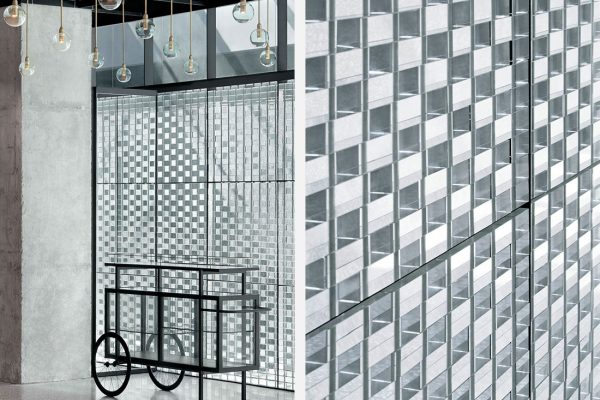
Functionally, the room can be subdivided into two function spaces while an outer corridor allows for a coatroom and pre-function lounge space. A witty addition comes in the form of custom-designed moveable food and beverage stations in black metal and glass modelled after traditional street vendor carts.
Neri&Hu has a knack for marrying conceptual rigour with surprising material manipulation, particularly by appropriating historical elements in an inventive manner. Edgy yet refined, BEI Space is another example of how they work a charming brand of magic, weaving an alluring spatial narrative into something as prosaic as a multipurpose space.
Read our interview with Neri&Hu about the studio’s work for Moooi.