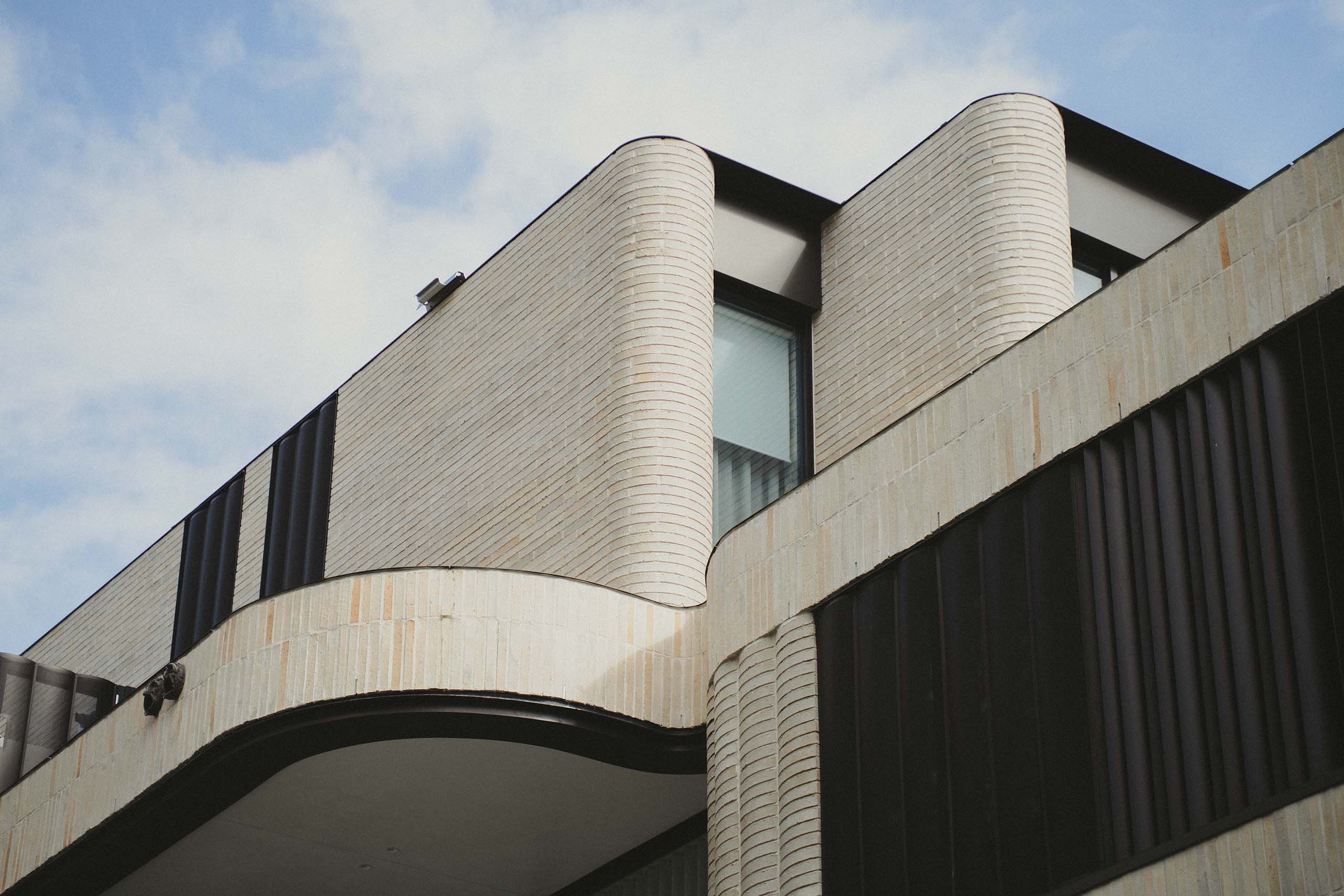
As a practitioner, John Wardle is in a league of his own. His work encapsulates the best of architecture through form, connection to people and sensitivity to site. His many projects have made an indelible imprint on the built landscape of Australia and beyond, and he and his practice have been justly recognised for this immense contribution.
Wardle was born in Geelong, Victoria, where he enjoyed a carefree childhood. At the time, Geelong was an agricultural hub on the Barwon River. His interest in architecture was piqued through family friend Neil Everist, partner in the renowned practice McGlashan Everist. Everist’s home, just across the road from the Wardle’s, left a lasting impression.

Life changed in 1967 when Wardle’s family moved to the UK for a year. Weekend travel throughout Britain and Europe, and voyages through the Suez and Panama Canals, exposed him to new cultures and historic architecture. Returning home, his interest was re-ignited by Everist’s new house, Leggett House. A pivotal moment with a lasting impression, John was captivated with the house of “walls without windows and windows spanning between the walls”.
Wardle “bounced” into architecture at RMIT in 1975. Entry to the new architecture course relied less on academic scores and more on the candidate’s potential, and John excelled as a curious and observant student. With Graeme Gunn as Dean, and names like Peter Corrigan, Michael Jorgenson and Ann Rado involved, it was an exciting, hands-on experience. Students explored innovative techniques, including manual work on a Ken Borland house, and were introduced to leading architects.

After graduating, Wardle joined Cocks Carmichael in 1981 before travelling for a year, returning to stay on for three years. There, he learnt the intricacies of residential design and space planning, building skills that would prove vital to his future, and meeting other young bright minds. In July 1986, he founded his own studio in Melbourne – John Wardle Architects (JWA).
The early years involved small commissions, but a project for the CSIRO Atmospheric Research division marked a turning point for the practice. Wardle credits many generous clients, particularly through government work, for supporting young practices like his. Over a decade, JWA designed six Ministry of Housing projects and the Flagstaff Centre for the Salvation Army. JWA went on to cover many architectural genres and large-scale projects, but residential work has cemented its place as a pillar of the practice.

While JWA has grown significantly, Wardle always acknowledges those who helped shape his career, including Leon van Schaik AO, Professor Emeritus of RMIT, Khai Liew, Rufus Black at the University of Tasmania, Denise Bradley from the University of South Australia, and many more names recalled by John.
In 2023, the studio rebranded as Wardle and continues to evolve, with John describing it as “a building that is constantly being renovated”. From Phoenix Central Park to the Ian Potter Southbank Centre, Wardle’s breadth of work demonstrates a seamless transfer of knowledge across genres. His installation Somewhere Other at the 2018 Venice Biennale explored interior connection to the world outside. Awarded the RAIA Gold Medal in 2020, John remains humble. He is the inspiration behind Wardle but leads alongside an exceptional group of partners.
John Wardle is an exemplar; a visionary, generous, and passionate with inherent talent, and it is these qualities that are embedded into the DNA of Wardle. It takes a certain leader to accomplish everything yet still strive for more, and this is what makes Wardle an exceptional architect and person.
The Luminary category at the 2025 INDE.Awards is proudly partnered by Woven Image.