The home of architecture and design in the Asia-Pacific
Get the latest design news direct to your inbox!

Get the latest design news direct to your inbox!
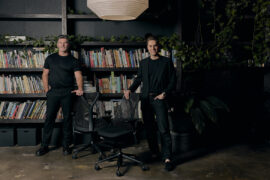
In Benjamin Hubert’s world, having talent and vision is one thing, but to have empathy – that’s where the hard work begins. Hubert has devoted his practice and studio, Layer, to intimately understanding what users really need.

Benjamin Hubert

AXYL chair

The Cradle chair for Moroso uses a digital knitting technique to create a mesh back.

Cradle chair, designed by Hubert for Moroso.

The complete Nolii collection

Nolii Couple

Sketch for Nolii Couple

Nolii Keep

Collection of protoypes for Nolii.
Benjamin Hubert is by no means a new player in design, having established his eponymous studio almost 20 years ago. Within this time the London-based industrial designer has built an impressive portfolio peppered with collaborations alongside industry giants including Herman Miller, Nike and BMW.

Sketches for the Nolii collection.
When he re-branded to become Layer in 2015 it was more than just a name change. The new identity signalled a consolidation of the multi-disciplinary practice’s many arms, all of which is underscored by an experience-based design methodology.
Hubert and his 21-member team are people-focused and their projects are developed with a view to improving the end user’s life.
“We want to understand the way people are living now and how they’ll be living in the future because we want to make people feel happy and healthy, both mentally and physically. So everything we do is lifestyle-driven rather than performance-driven,” he says.

The AXYL Chair, stacked.
This genuinely human-centric approach allows Hubert to personalise market research to get the best design outcome possible. He’s dismayed that so many of the tools and instruments used in everyday life aren’t fit for purpose and he’s on a mission to change that.
By conducting extensive interviews, workshops and brainstorming sessions on a project-by-project basis, Hubert gathers insights into what the end user needs and how best to accommodate it.
Collection of prototypes for Nolii.
The process was particularly effective in determining products that make up the recently launched electronic accessories brand Nolii by Layer (in collaboration with entrepreneur Asad Hamir).
Each of the collection’s five items is designed to streamline the use of personal devices, effectively ridding the need for numerous plugs and cables, which can become messy. Stack, for example, provides power for a smartphone, laptop and tablet simultaneously. Couple is a phone case with a clip section to which other electronic accessories can be attached.
Couple by Nolii.
The products are slick and sophisticated in appearance and their intuitive functionality makes the experience of using technology that much easier.
As Hubert explains, “We’re interested in making sure design is a really powerful tool for people who use it and for business too. You can do that with a single product; you can do that with a piece of branding, but the most meaningful way of doing it is by creating a whole experience.”
Along with designing the actual products, Layer was also responsible for creating Nolii’s digital platform, branding and art direction. The resulting solution is a holistic one and makes for strong market impact because the user experience is cohesive from beginning to end.
Hubert doesn’t overlook anything and his attention to detail is acute. It’s a standard he applies across all collaborations, including the recent update to Layer’s existing Cradle range for Moroso.
Cradle chair, designed by Hubert for Moroso.
New chairs and a room-divider feature a stretch mesh material – made using digital knitting techniques – that extends across a lightweight, easy-to-manufacture metal framework. The material’s functionality is programmed into the three-dimensionality of the knit and while it offers good support, its elasticity means the level of comfort achieved is akin to relaxing in a hammock.
Utilising innovative digital techniques appeals to Hubert because it’s a no-waste process, in keeping with Layer’s ethos of delivering intelligently designed objects and products with minimal environmental impact.
Axyl for Allermuir – available throughout Asia Pacific thanks to Zenith – is the studio’s latest collection, comprising furniture made from recycled materials. Each piece is characteristically clean and bold in form and by choosing to use say, recycled aluminium over new aluminium for the chair’s Y-frame, the amount of energy expended during production is dramatically reduced.
AXYL Chair
Hubert and his team are currently working on a number of major projects that promise to improve their respective sectors. These include using digital platforms to change the future of sports information, addressing transport issues by rethinking the experience for airline passengers and evolving the mobile communication experience.
Most importantly, Hubert continues to ensure all disciplines within his studio are working well together to deliver outstanding results. “We’re not interested in being a Jack-of-all-trades,” he says. “We’re interested in making the complete experience the best it can be.”
This article originally appeared in issue #72 of Indesign magazine, The Work/Life issue.
–
To catch other stories like this, sign up for our newsletter.
INDESIGN is on instagram
Follow @indesignlive
A searchable and comprehensive guide for specifying leading products and their suppliers
Keep up to date with the latest and greatest from our industry BFF's!
The internet never sleeps! Here's the stuff you might have missed