The home of architecture and design in the Asia-Pacific
Get the latest design news direct to your inbox!

Get the latest design news direct to your inbox!
Michael Lam talks about changing attitudes and behaviours in the workplace, and their impact on spatial design.

September 15th, 2016
Artlink Design Associates have been in Hong Kong since 1988, focusing on creating commercial spaces for corporates and retail companies. The design firm aims to provide the requirements to accommodate logistics companies, law firms and trading companies, creating different layouts and planning space for a variety of different industries.
Designer Michael Lam is a Director at the studio, with more than a decade of experience in working on commercial projects in Hong Kong and Greater China. He fills us in on Artlink Design’s recent work, and what clients are looking for in a workspace.
As well as designing and project managing, Artlink Design also advises on spatial requirements. How many square feet does one person need in a workspace?
As a rule of thumb, about 100 square foot per person. So for 25 staff, you need roughly 2,500 square feet. But nowadays, we’re seeing more open offices, so that requirement is changing.
What do your clients want from a workspace?
Rents are high right now, so people are looking for smaller spaces than before. But also they want their staff to enjoy their work, because we all spend so much time at work. They’re looking for solutions to how to work together, and how to create a space that’s efficient and collaborative. Plus how to improve their space, so that people work better, alone and together.
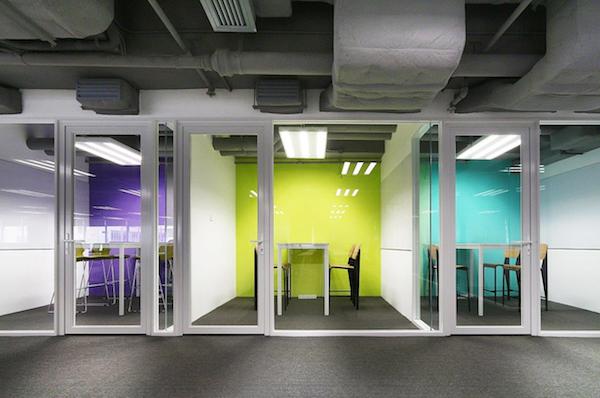
At Logitech, different meeting spaces encourage collaboration
How do you use space to inspire collaboration?
You might have a co-working area where staff can feel at liberty to mingle and collaborate in an area adjacent to a pantry or breakout area. Where they can have something to drink, goof around on their smartphone and discuss business deals. Where they are relaxed, where there’s banter, and then you’ll get more collaboration. You also need to accommodate sound attenuation so that they’re not disturbing other people.
What have you worked on recently?
We recently did this office for Logitech. They are merging two offices together, and they will now fit about 80 people. They don’t have enclosed offices even for senior management – nowadays people are working in a more mobile way.
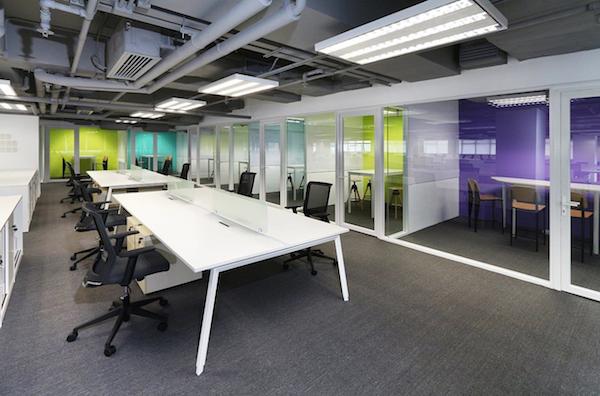
Glass partitions at Logitech keep communications open
In that office, people tend to work in small groups: discussions for about half an hour, one hour. Two to three people meetings. So we created a lot of meeting pods. They wanted high tables and high chairs, so that staff wouldn’t sit there for a long time. If the chair is too comfortable, people will tend to stay there! We also used a lot of glass partitions – it’s about more transparency these days.
Another office we’ve worked on is one for China-based company DJI, which makes drones. They wanted us to create a big cafe area where they provide food for their staff. They have about 160 people working there so they tend not to meet each other. The cafe is therefore a place staff can meet up and talk to each other – and even their suppliers can come in and meet with staff here. It’s a really colourful space.
Next to the reception we created a cyber look for the display area. That’s for all the drones.
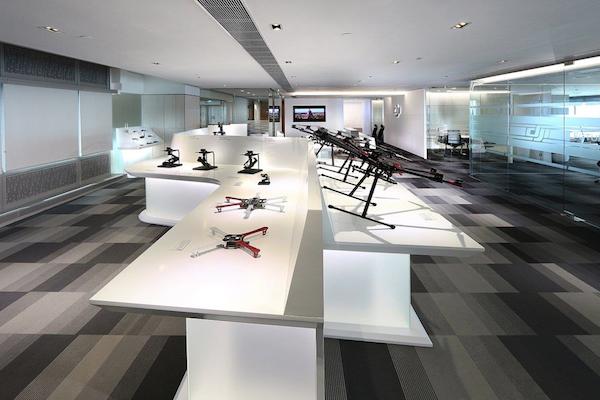
Drones on display in DJI’s reception area
In your view, what will ‘work’ look like in future?
Mobilisation is the next step – people tend not to sit at their desks. It’s so easy to connect – Facetime, Skype… technology makes us do more. Management has to look after more and more countries, for example. We’re seeing a trend towards mobile management.
Artlink Design Associates
artlinkdesign.com
INDESIGN is on instagram
Follow @indesignlive
A searchable and comprehensive guide for specifying leading products and their suppliers
Keep up to date with the latest and greatest from our industry BFF's!
The internet never sleeps! Here's the stuff you might have missed