The home of architecture and design in the Asia-Pacific
Get the latest design news direct to your inbox!

Get the latest design news direct to your inbox!
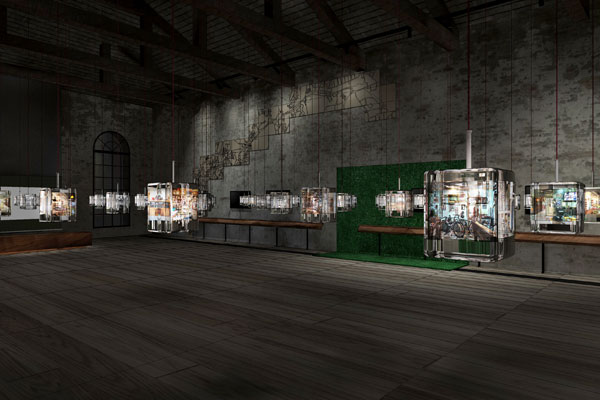
A total of 81 lanterns displaying 243 photographs that candidly portray life in Singapore will form a key part of the country’s pavilion at the 15th International Architecture Exhibition, held from 28 May to 27 November 2016.
May 18th, 2016
Top image: Impression of the Singapore Pavilion, courtesy of Red Bean Architects
Space to Imagine, Room for Everyone is the title of the Singapore Pavilion at the upcoming 15th International Architecture Exhibition (Biennale Architettura 2016) of the La Biennale di Venezia, in Venice, Italy.
This year’s pavilion, which marks the country’s fifth appearance at the exhibition since 2004, is commissioned by the DesignSingapore Council of the Ministry of Communications and Information and curated by the Department of Architecture of the National University of Singapore (NUS).
In response to the main exhibition theme, Reporting from the Front, which was put forth by the Biennale Director, 2016 Pritzker Architecture Prize Laureate Alejandro Aravena, the organisers say that this year’s pavilion will focus on the “small ‘battles’ fought on the home-front which are contributing to the emergence of an invigorating Singapore.”
“People outside of Singapore will see Singapore as a very modern city. It is a model city in a way; it might inspire other cities to look at it. What we are trying to show [however], is that behind the modern look and clear infrastructure are the people, and it is actually the way people live, the way they co-create and do things that really matter,” says Jeffrey Ho, Executive Director of DesignSingapore Council and Commissioner of the Singapore Pavilion.
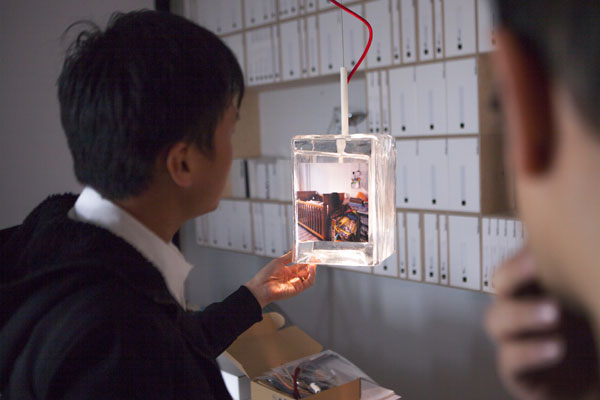
Close-up of the lantern to be displayed at the Singapore Pavilion
“Space to Imagine, Room for Everyone shares with the global audience, the challenges in Singapore’s next stage of development; especially how individuals, enterprises and ground-up actions are making a palpable difference. As small ‘battles’ in this home-front, the selections provide a poignant account on how design improves the quality of the built environment and people’s lives,” says Associate Professor Wong Yunn Chii, Lead Curator of Singapore Pavilion 2016, and Head of Architecture at NUS.

Daily life – a still from the film 03-FLATS. Credit: Lei Yuanbin and Chee Lilian
The exhibition is laid out in a grid, which is meant to signify the rationality with which Singapore is planned. However, as Teo Yee Chin, Co-Curator of the Singapore Pavilion and Principal of Red Bean Architects points out, the grid also provides openness and freedom, and in the context of the exhibition, it allows everyone to move freely and to take in the diversity of stories that are held within the space. The curatorial team has sought to create an atmosphere and an emotionally charged experience using hundreds of illuminated interior scenes from everyday life in public housing estates that offer insight into how ordinary Singaporeans have imaginatively created a space to call their own.
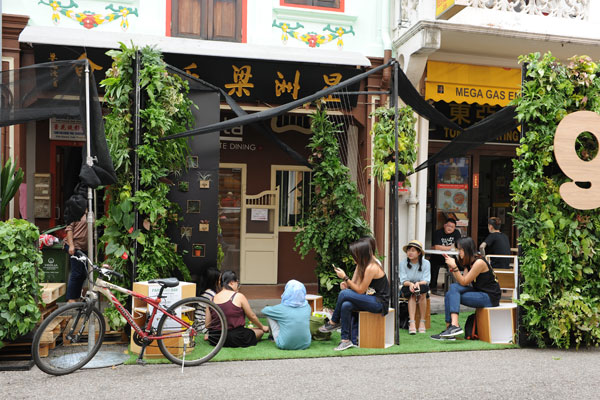
Parking day. Photo courtesy of URA
These photographs are mounted on three sides of 81 suspended, specially cast illuminated glass lanterns – a nod to the rich history of glass craftsmanship of nearby Murano – with the fourth side left vacant so viewers can peer inside to see a miniature model of the HDB block in which the interior shown in the photographs are sited. Complementing these lanterns are display of artefacts and interview footages which will tell the stories of how citizens are stepping out and taking actions to adopt and own their environment – initiative such as mud-bricks made by volunteers for the walls of the new Ground-Up Initiative (GUI) campus, for example.

Site visit to gather feedback from the community on the rail corridor. Photo courtesy of Creatures Studio
Even though this is an architecture exhibition, the pavilion’s focus is not on buildings but rather, as Teo puts it, “the relationship that people form with their place.” He explains, “We believe this is the origin of all building activity – to find meaning first in the space [one occupies], and then to make something physical.” In all, the Pavilion comprises three segments: People and their Homes, People working the Land, and People Engaging the City.
Summing up the approach to the design of this exhibition, Teo says, “It is really to take a step back, not to let design take a front seat, but to present all the stories [of our small ‘battles’] in an honest manner.”
Space to Imagine, Room for Everyone will be held as part of the 15th International Architecture Exhibition, from 28 May to 27 November 2016 at Sale d’Armi building, Arsenale, Campo della Tana 2169/F, Venice, Italy.
Space to Imagine, Room for Everyone
roomforeveryone.sg
For ticketing details, go to labiennale.org/en/architecture/tickets
INDESIGN is on instagram
Follow @indesignlive
A searchable and comprehensive guide for specifying leading products and their suppliers
Keep up to date with the latest and greatest from our industry BFF's!
The internet never sleeps! Here's the stuff you might have missed