The home of architecture and design in the Asia-Pacific
Get the latest design news direct to your inbox!

Get the latest design news direct to your inbox!
London-based Woods Bagot CEO and Indesign Luminary Nik Karalis is still that curious boy from South Australia – always looking to qualify his understanding of design’s purpose and intent, and ultimately, search for its meaning in the most unlikely of places.
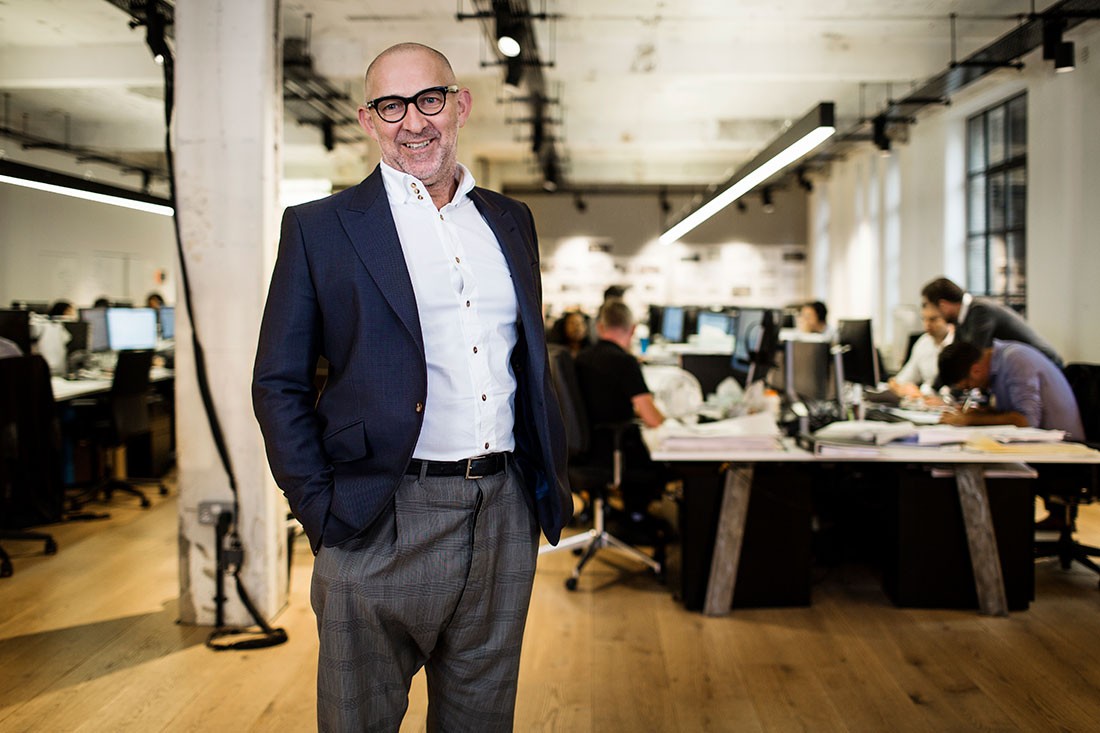

“I grew up in Adelaide and initially studied mechanical engineering at the South Australia Institute of Technology. I found Physics and Chemistry fascinating as the subjects allow you to discover how the world functions, down to its fundamental elements and governing laws.
During my studies, I worked as a house painter to fund my education. In doing so, I found I was attracted to architecture because of a deprivation of spatial and environmental sensitivities at an early age; I suppose you could say it was a form of escapism. I spent 10 years as an interior designer and then went back to night school to complete my studies in architecture.
Now that I can look back on the last 30-odd years, there was not a single person who influenced my early career – there were many. The first practice I actually worked for was Carr Design; together we invented minimalism in Melbourne.
At that time, Melbourne did not have the design culture that you see today. After that, I moved on to work with Nonda Katsalidis. He was the opposite of minimalism, so I was able to be quite dextrous and occupy a lot of that design territory between the two scales. Then, I joined Woods Bagot in Melbourne 27 years ago around 1990. And here I am.
Various worldly artists and authors were also significant along the way. What I search for in literature is authors who connect with your thoughts and the way you see the world, so you try and find semblances of those influences, to inspire ones perceptive qualities: Gerhard Richter, Salman Rushdie, Haruki Murakami, they all deal with magical realism – a territory that great architecture always responds to. Currently under construction for example, is 405 Bourke Street Tower, which is inspired by Richter’s glass sculpture, which I saw recently at the Tate Modern.
All of this experience taught me the power of combining interiors, architecture and global knowledge. My education really began in this realm of apprenticeship. It was an addiction and I’ve never really recovered, and though I’m well past my formal education years, I’m certainly still learning. And that’s really because my design approach is about the search for meaning, which is inherently about discovery and self-education.
Every project needs a description of why it exists, not what exemplar it came from. We need to understand project relevance and how this really contributes to the ongoing discourse of design and society.
Many designers will probably find this the hardest question to answer: ‘What is the purpose of the design for this specific issue? Why have you approached this project in this way? What is its conceptual response to site or programmatic references? What is the response to a brief and how is it explained as a narrative or story? If it is just about appearance then you should say that. Aestheticism could be a form of meaning. And meaning is valuable.
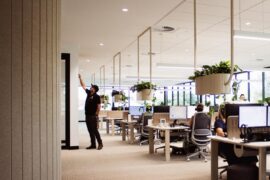
NAB HQ at 700 Bourke Street, for example, is saturated in meaning. Every time I visit this space I am transformed. I believe this to be one of our great interior volumes of the world, and this is recognised by many locals and visitors from overseas. A whole organisation exposed to the community, a building that designs itself around the structure of an organisation, a building that is built at market construction rate. It transforms workplace activity based on continual learning; it creates micro-climates for human wellbeing. It an idealised kind of Corbusian vision.
But this quest for meaning doesn’t just start and end with the projects we work on. It’s a philosophy that permeates our entire network and organisation. In my role as CEO, I have spent the last year transforming every business interface away from management leadership toward a creatively-led organisation with management acumen. We need to value our profession and ensure we are rewarded for our gargantuan efforts, late nights and ever-changing deadlines.
There has been a total focus on empowering and career-developing all of our employees. We have expanded our ownership model and associate programme. We have shifted reward more evenly through the organisation and made transparent all our governing entities towards a representational body based on competencies and away from the hierarchical entitlement model, that most architects and designers believe is their right.
Outside of the world of Woods Bagot, (is there such a place?) general further industry involvement occurs with social time spent with affiliated creatives, chefs, artists, developers, builders, graphic designers and other dreamers. My preference is to be refuelled by solitary and normalcy.
We used to spend a lot of time at St Andrews on the Mornington Peninsula (Victoria) surrounded by the inspiring and dramatic landscape. Now in the UK, it is simply walking the streets, digesting the richness of history and the ever-stimulating megalopolises. Two directly opposed landscapes; the landscape of nature versus the landscape of the city.”
Woods Bagot and Diller Scofidio + Renfro recently won the Adelaide Contemporary architecture competition.
–
INDESIGN is on instagram
Follow @indesignlive
A searchable and comprehensive guide for specifying leading products and their suppliers
Keep up to date with the latest and greatest from our industry BFF's!
The internet never sleeps! Here's the stuff you might have missed