The home of architecture and design in the Asia-Pacific
Get the latest design news direct to your inbox!

Get the latest design news direct to your inbox!
Sea views sell. RT+Q Architects maximised them on a rare site in George Town with a sea-oriented apartment complex that’s also sensitive to its neighbours.

July 12th, 2018
One of the last seafront development plots in George Town, Penang was also one of the most charged and challenging, as RT+Q Architects discovered when commissioned to design a luxury apartment complex there. The site on which Shorefront Penang now stands is immediately adjacent to the famous Eastern & Oriental (E&O) Hotel – a colonial-style property developed in the 1880s by the Sarkies Brothers (who are famous in Singapore for the Raffles Hotel).
The weight of such a prominent neighbour, in conjunction with the stringent planning guidelines that come with George Town’s UNESCO World Heritage City status (such as an 18-metre height limit and requisite setbacks from roads and sea), created a particular development and design challenge: how to strike a balance between good architecture and economic viability. Add to that mix the request of the developer YTL that every unit should have a sea view.
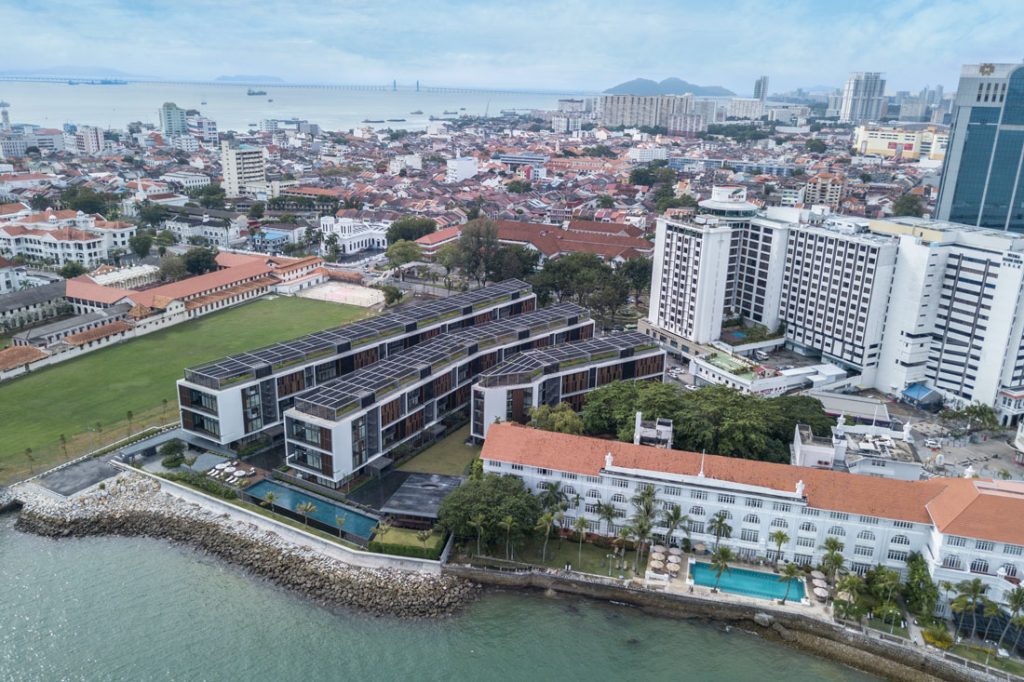
Working with George Town-based S.M. OOI Architect, RT+Q devised an elegant solution consisting of an ensemble of slender low-rise blocks that unfurl toward the sea and preserve view corridors between them. The blocks were designed in a double-faced manner to capitalise on sea and city views as well as breezes. To enhance privacy, units are positioned in an alternating fashion such that the front of one unit faces the rear of its opposite neighbour in the adjacent block. Duplex units enjoy the best views at the sea end of each block.
Between the blocks, RT+Q curated neutral and quiet spaces of shallow water and landscaping – creating “a sense of formality, but not a noisy atmosphere,” explains RT+Q Design Director Rene Tan. These spaces also create internal views to complement the more dramatic views to the sea. Bolstering the value of the refined ambient setting, private lift lobbies bring greater exclusivity to the development.
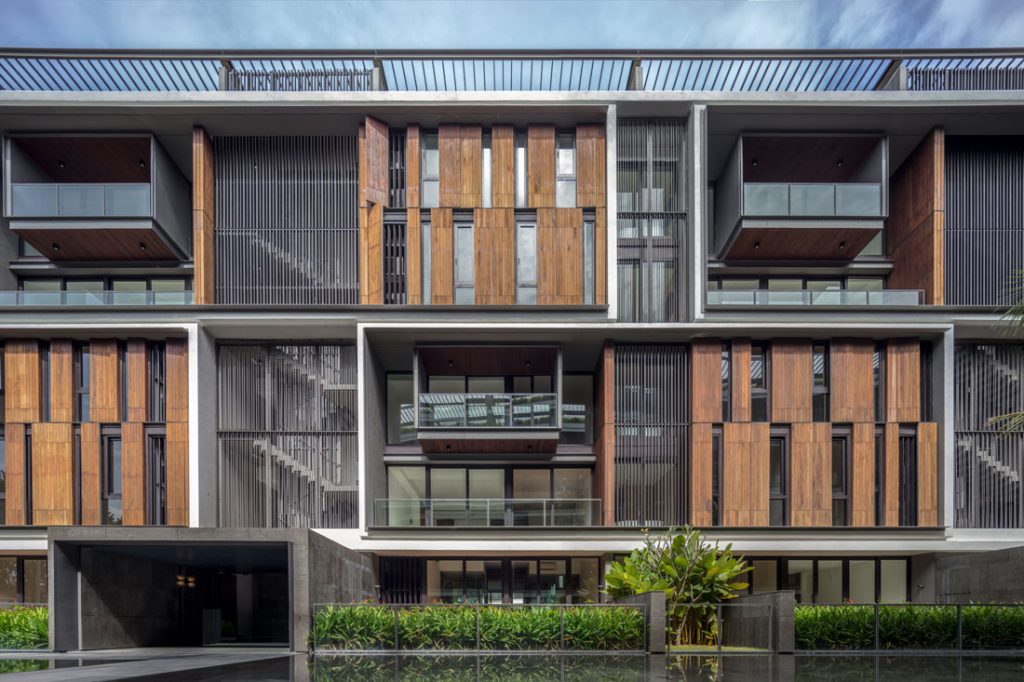
Overall, the architectural language and proportion is sensitive to the scale of the surroundings, but is “as different as possible” (says Tan) to the mock-classical style of the E&O. It’s a stylistic breath of fresh air in George Town, but not one that alienates itself from its heritage-rich context.
“The brief asked for something exclusive,” says Tan, “We wanted to make multi-residential an attractive option in Penang,” says Tan.
Photography by Masano Kawana and Albert Lim, courtesy of RT+Q Architects.
INDESIGN is on instagram
Follow @indesignlive
A searchable and comprehensive guide for specifying leading products and their suppliers
Keep up to date with the latest and greatest from our industry BFF's!
The internet never sleeps! Here's the stuff you might have missed