The home of architecture and design in the Asia-Pacific
Get the latest design news direct to your inbox!

Get the latest design news direct to your inbox!
The founder of award-winning lighting design consultancy Limelight Atelier talks about lighting design in Asia and his expectations for architectural lighting into the future.

Ascent at Science Park I Singapore (architecture jointly designed by S333 architecture + Urbanism and SAA Architects). Photo by Aaron Pocock
May 23rd, 2017
For lighting designer Melvyn Law, light is to a space what oxygen is to a human being. Light fills up a space during the day and reveals it at night; it sets the ambience and shapes the user experience.
An interior designer by training, Law pursued a lighting design education in the UK before returning to Singapore and establishing lighting design consultancy Limelight Atelier in 2012. Just five years into operation, the atelier has amassed a brilliant portfolio filled with notable projects and awards.
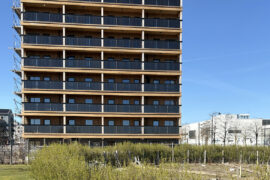
Recently, the studio won a Gold Award in the Architecture Lighting category of the International Design Award 2017 in Los Angeles for Ascent. Limelight Atelier created a glowing ribbon of spandrel lighting that wraps around the facade of the Singapore Science Park I building (). And just last week Limelight took home the Best Residential Lighting award for the Decorative category from a UK-based international lighting design award programme, the Darc Awards. This accolade was for House X (designed by Redbean Architects).
We quizzed Law on lighting design and being a lighting designer in Asia.
What’s the biggest challenge in practising as a lighting designer in Singapore and the Asian region?
Lighting design is still a relatively young industry in Asia and Singapore. It is still widely considered as a want rather than a need.
What do you think this region needs in terms of lighting design?
Better awareness and demonstration by professional lighting designers to the wider public on the full values and benefits of both day lighting and artificial lighting – this is definitely needed. And informing clients and users that we add multiple values to the spaces we illuminate.
What are your thoughts on the role of lighting in architecture now and in the near future?
Lighting designers will be further challenged by various tech disruptions. Such is the complexity that we have to keep up with the knowledge and know-hows. Having said that, guidelines, codes and methods of lighting engineering calculations have to be re-assessed and possibly re-written to accommodate the present and future. It is never about numeric values alone. Our eyes don’t perceive numbers. Lighting design is both science and art.
What direction do you think lighting design is moving toward? How will we interact with light in the future?
It is probably moving toward full integration of everyday products, with the push for near net-zero energy. Roads that glow and charge vehicles, building materials that absorb daylight and radiate at dusk, AI that detects and predicts the amount of illumination needed – it’s an exciting future ahead! However, we must not forget the basics of building science – to optimise user experience and comfort.
Your work on Ascent was lauded for rethinking the fundamentals of lighting to save energy. Can you share a bit more about this project?
Because of Ascent’s size, the conventional method of using rows of lighting fixtures to illuminate the panels was not feasible. Our team experimented and came up with a low tech, highly engineered solution using math and mirrors. By tilting the back panel and placing reflective materials, we could achieve a brilliant facade illumination using minimal light fixtures. We achieved huge energy savings of more than 60 per cent.
Can you share a little bit about the projects you are working on right now?
We are very fortunate to be undertaking some fantastic projects at the moment such as Northpoint City, the facade illumination for Bukit Jalil Stadium, and two other arenas as part of the mega Kuala Lumpur Sports City that is to be inaugurated for the SEA Games 2017 in Malaysia. We’re also working on an 800-room five-star hotel in Sri Lanka and a couple of intimately scaled projects both in Singapore and around the region.
INDESIGN is on instagram
Follow @indesignlive
A searchable and comprehensive guide for specifying leading products and their suppliers
Keep up to date with the latest and greatest from our industry BFF's!
The internet never sleeps! Here's the stuff you might have missed