The home of architecture and design in the Asia-Pacific
Get the latest design news direct to your inbox!

Get the latest design news direct to your inbox!
What are the most important sites for retail today – the physical store, the online store, the pop-up, social media, or a mix? We investigated with a Design Conversation about retail design at W. Atelier.

October 27th, 2017
How do you shop these days? Do you buy everything online? Do you still savour the experience of visiting the mall, showroom or specialty store? What makes it worthwhile? And are you consuming more than merchandise in these spaces?
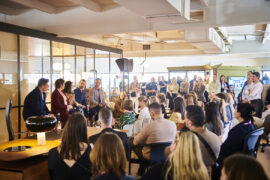
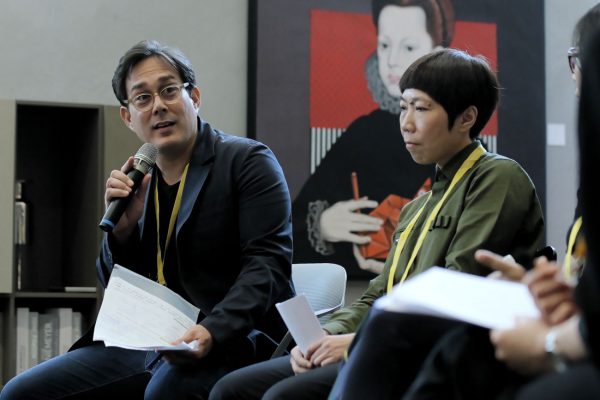
This year at Singapore Indesign on 7 October our programme of Design Conversations extended to the topic of shopping with the session ‘Bricks to Clicks and Back Again: What Matters in Retail Design’. The well-attended session was held at W. Atelier’s new Henderson showroom, with arcs of gorgeous Fritz Hansen Series 7 chairs set out for the audience.
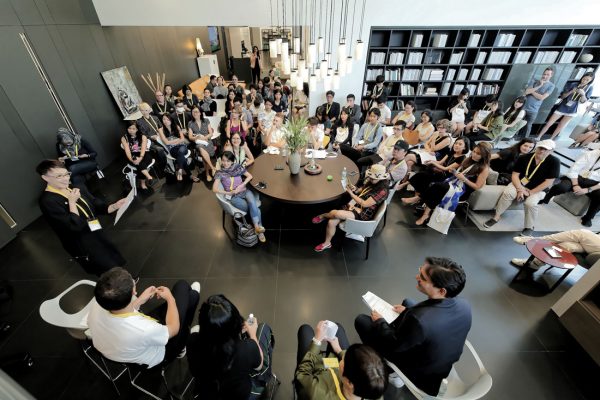
Our panel was diverse and therefore able to offer a variety of insights on a variety of aspects of today’s retail experiences. Lim Wenhui, a Partner at SPARK’s Singapore studio, drew on her experience of designing malls for developers around Asia. Dario Reicherl, the CEO Asia at Republic of Fritz Hansen, offered his personal experience of creating ‘House of Fritz Hansen’ spaces in
Korea and Thailand. Matthew Shang, a Principal at HASSELL’s Singapore studio, brought his experience of interior design for luxury brands. And Yah-Leng Yu, Founding Partner and Creative Director of Foreign Policy Design Group, reflected on the creation of retail strategy, as well as brand and retail design, for Gallery & Co at the National Gallery Singapore.
We started the conversation by asking what’s not working in Singapore’s premier retail belt Orchard Road. There’s a lack of expertise in curating stores, and a lack of understanding among retailers of demographic shifts and how demand has changes, said Yu. Luxury retailers have started investing in suburban malls, said Shang, reducing the appeal of Orchard Road – which is also difficult to access due to its heavy traffic.
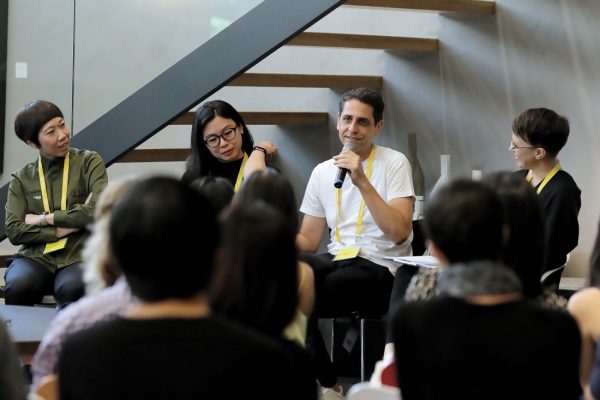
“It’s boring,” said Reicherl, “because the same shops are repeated over and over.” He added that there’s a lack of ideas and crazy rental costs (which make it difficult to take creative risks). Lim cited problems such as the dominance of car traffic, the lack of relationship between mall interiors and the urban realm, and theimpact of online shopping. She’s started to see the splitting of large older retail units (such as those in Tanglin Mall) into smaller units catering to services such as education.
She also discussed SPARK’s self-funded design research proposal ‘Orchard 2065’, which reimagined Orchard Road as a public space for people’s enjoyment at ground level and underground. The concept suggested multiple types of programming for these spaces to return Orchard Road to the people.

Naturally the pluses and minuses of e-commerce were discussed. Reicherl sees no place for e-commerce in the retailing of design, art and fashion products.
Is there still a need for generalist retail entities like department stores? Yes, according to Shang, who sees their potential for variety and generating the effect of pop-up ventures.
Reicherl recounted his efforts in Bangkok to create a unique experience of Fritz Hansen with the ‘House of Fritz Hansen’ concept. He has transformed a 1950s-era house into a space for the serene and personalised experience of the brand’s furniture and objects. “You feel like it’s someone’s house,” he said. “I see the future of retail focusing on people, and giving them inspiration again.”
Yu recounted her attempts to gain a foothold in the hearts of Singaporeans with Gallery & Co – something that members of the audience felt she and her team had succeeded in doing. The goal of Foreign Policy was to encourage connection and a sense of community (with F&B offerings as a critical component), and to ready people to experience the arts. She sees the future of retail stores as spaces for people to come and experience products before making purchases through e-commerce. Storytelling is a critical aspect of retail space design, she suggested.
Before closing, we turned to the architectre of shopping malls. Lim described how a small proportion of developers’ project briefs call for elements such as social spaces (for mall members, for example) or sports courts (which may encourage spectators). Shang suggested that there will be a future for the blending of online and physical worlds and communities in malls.
Will developers and brands take on more of a civic role in future, by providing spaces for the community to interact independently of consumption? “Yes,” said Lim, “but only if it serves their self interest.”
Photography by Wilson Pang.
INDESIGN is on instagram
Follow @indesignlive
A searchable and comprehensive guide for specifying leading products and their suppliers
Keep up to date with the latest and greatest from our industry BFF's!
The internet never sleeps! Here's the stuff you might have missed