The home of architecture and design in the Asia-Pacific
Get the latest design news direct to your inbox!

Get the latest design news direct to your inbox!
Milliken-Ontera’s Water Yuludarla – a carpet collection based on the work of Gumbaynggirr artist, Brentyn Lugnan – has helped transform the Yarpa Hub into a welcoming place of connection and cultural strength.

June 25th, 2021
Located at Liverpool in Sydney’s southwest, the Yarpa Indigenous Business and Employment Hub (the Yarpa Hub) is a one-stop-shop dedicated to improving the employment prospects of Indigenous job seekers and providing support for Indigenous businesses.
Sensing it was time to refurbish its 400m² workspace, the Yarpa Hub recently enlisted the services of BVN, a Sydney-based architectural firm with a 90-year history and a broad portfolio of (local and international) built work. The work was overseen by Kevin O’Brien, a principal at BVN. Understanding that the Hub is all about facilitating connections and fostering a sense of community, the architects sought to imbue it with a sense of welcoming. And recognising the potential difficulties associated with responding to ever-evolving community needs, they sought to deliver a space that prioritises choice and autonomy.
They achieved both. Now refurbished, the Yarpa Hub is a place in which all visitors – whether they are seeking work, attending a business meeting, or looking for networking opportunities – can feel comfortable and connected. And it is a place that can transform, at short notice, from typical working mode to formal training mode, then into a space suitable for an event.
In the same vein, and conscious of the Hub’s connection to the NSW Aboriginal Land Council architects, the architects were fixed upon Connection to Country as a key. Thus, the finished Hub includes earth-coloured wall renderings that bring warmth to its existing concrete shell; cave-like retreat spaces that reference significant local rock art; and a ‘rainforest edge’ that surrounds its flexible inner workings and invites visitors to celebrate views to the Blue Mountains and Sydney city.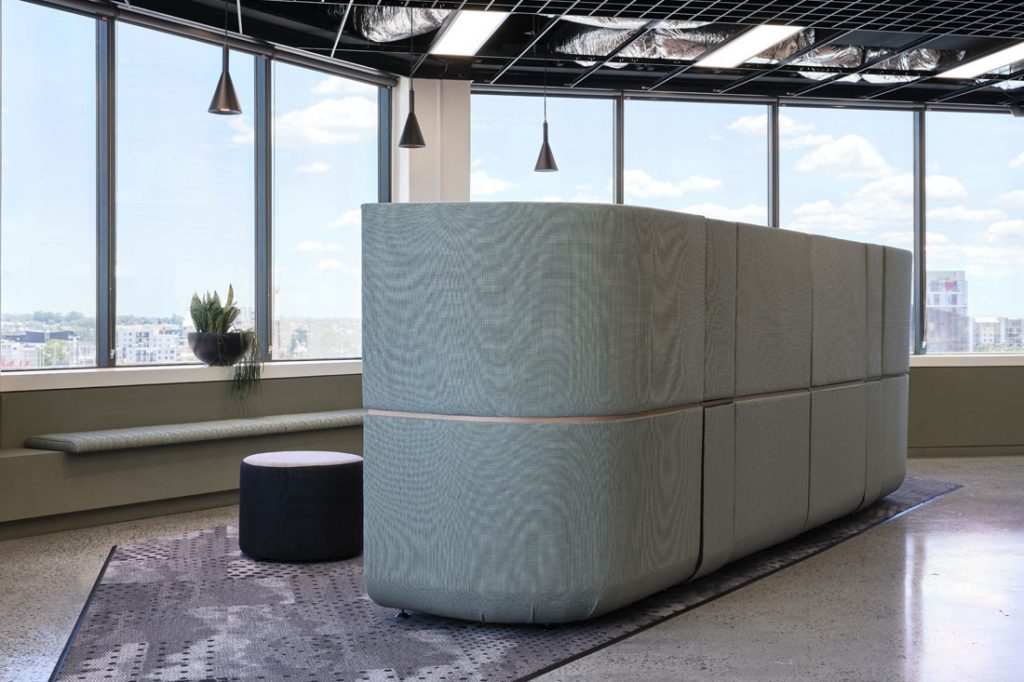
The theme of Connection to Country even extends to the joinery. Subverting its traditional function, it becomes a key element. At the entrance, for example, a family of multi-legged tables softly references nearby native blackwood forests, while a hot desk/locker piece, featuring native timber and a transparent polycarbonate skin, provides workers with privacy and views to country beyond.
Within this newly built environment, Milliken-Ontera’s Water Yuludarla collection was a natural choice for the Hub’s flooring. The result of collaboration between Milliken-Ontera, the Saltwater Freshwater Arts Alliance, and the National Aboriginal Design Agency, the collection is based on the original work of Gumbaynggirr artist, Brentyn Lugnan.
The Gumbaynggirr people, known as saltwater freshwater people, have occupied the NSW Mid-North Coast from Nambucca to Clarence River and west to the Great Dividing Range. According to Lugnan, Urunga and the Bellinger Valley region is where the inspiration for his work lies as this is his home country and where his family is from. His work is about people and place; it’s about relationship to the water and connection to country.
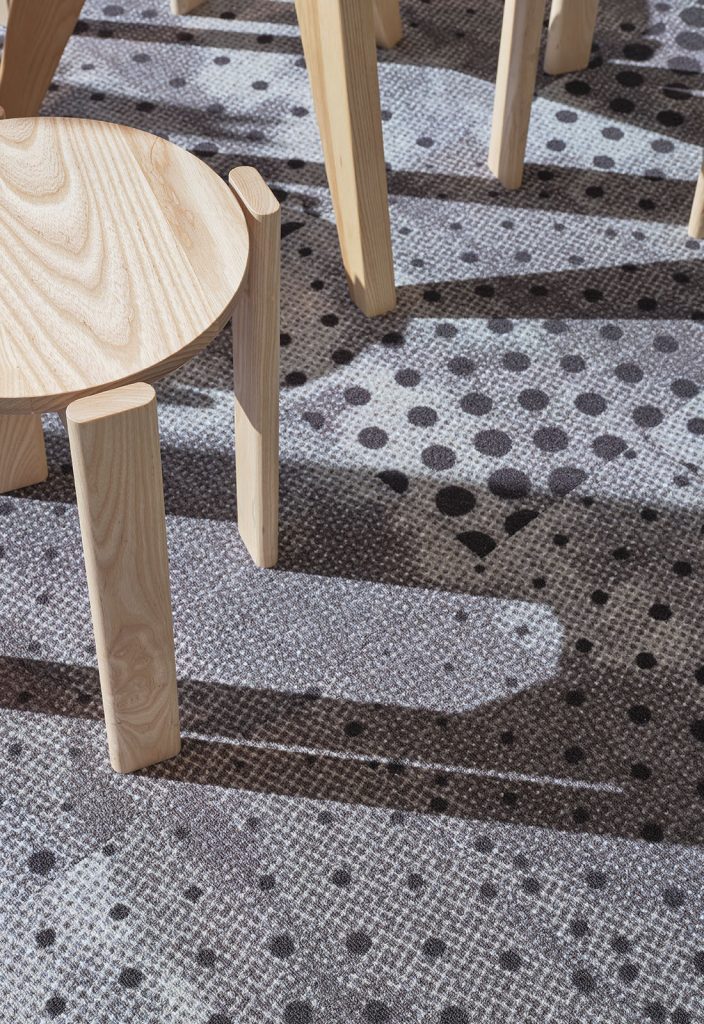
It’s there throughout Lugnan’s work of Water Yuludarla (Water Dreaming) – representations of the river, the people it sustains, the culture it fosters; and references to families, past and present, are all embodied and spread out, yet maintaining connections to place.
As Lugnan explains, circles and dots have special significance for his people. They have long used them in the contexts of body ornamentation, corroboree, and initiation. Taking a cue from this tradition, he uses them liberally throughout his own work, specifically to signify sacred connection to land.
The architects chose to use two of the six Water Yuludarla designs, namely Jagun (Birthplace) and Yildan (Dreaming Track) at the Yarpa Hub. (The other four designs in the collection are Guunu, Bindarray, Guluuna, and Mayala).


They positioned Jagun – a layered pattern that incorporates the dot elements from Lugnan’s artwork in its foreground, as well as elements of the Mayala (Moving) design in its background – in the Hub’s insert zoning areas. The key here was to create definition of space, which it does perfectly. Meanwhile, their choice of Yildaan – a more contemporary design, and the reverse of Guunu (Life) design, is inspired by aerial photography of the Northern Regions of NSW and references the textures of land and water – imparts a soft ambience and a sense of movement to the space with a traditional take on “dot paintings”.
Water Yuludarla has proven an inspired choice for the Yarpa Hub. Specified in the earthy colourways of blush and bark, the carpet complements its broader aesthetics and furnishings perfectly. And it has helped create a welcoming workplace that fosters connection, and champions individual success and collective strength.

The Water Yuludarla collection was created as part of Milliken-Ontera’s “Reconciliation Through Design” initiative. Marking the flooring design and manufacturer’s commitment to reconciliation as one of its core values, this is focussed on providing a platform for collaboration between Australia’s Indigenous artists and designers and the commercial interiors industry. In doing so, the rich heritage of Indigenous art and their artists are magnified on the largest canvas possible, the floor.
The creation of the Water Yuludarla collection, as used successfully at the Yarpa Hub and elsewhere, is just one of many such ventures that the Milliken-Ontera intends to become involved with. Its hope for “Reconciliation Through Design” is that it helps shift the conversation and leads to the inclusion of Indigenous design into the mainstream of commercial interior design.
Milliken
floors.milliken.com
INDESIGN is on instagram
Follow @indesignlive
A searchable and comprehensive guide for specifying leading products and their suppliers
Keep up to date with the latest and greatest from our industry BFF's!
The internet never sleeps! Here's the stuff you might have missed