A simple oyster served as the design impetus for Margaret, Neil Perry’s newest restaurant in Double Bay.
The oyster, says Perry, was one of the items he showed to David Caon of CAON Studio, and Vince Alafaci and Caroline Choker of ACME, as inspiration for the finesse he was looking for at Margaret.

“That was really what we’d hoped to achieve at Margaret – simplicity and sophistication through true beautiful ingredients and great craft,” says Perry, “whether it was making a fantastic drink with native Australian ingredients, the craft of service, beautiful wine, or indeed cooking.”
When Perry and I talk, it’s just before his second lunch service at the newly opened restaurant. He tells me about his history of working with Caon at Qantas, most recently on the Qantas Singapore First Class lounge, which led to his decision to bring Caon on board for Margaret.

From there, Caon recommended a collaboration with Alafaci and Choker from ACME, which Perry agreed to, having been an admirer of their work since seeing Merivale’s Oxford Street establishment, Fred’s. “When I met Vincent and Caroline, what cemented my view was the fact that I really liked them as people,” says Perry. “I think the most important thing in any kind of design collaboration is that you all get each other. I think we all got each other and I think that’s really very visible in the restaurant.”
CAON Studio and ACME’s collaborative design of the space is a true testament to the oyster-inspired vision, and their ability to “get” each other. The oyster became an analogy for the approachable yet complex nature of the neighbourhood restaurant, “paring it back to simplicity and sophistication without being grandiose,” says Alafaci.

The restaurant sits on the ground floor of Double Bay’s Pallas House, a new property by boutique developer Fortis. Named after Perry’s late mother Margaret, the restaurant is a tri-generational family affair, with Perry’s daughter Josephine making up part of the team. “This project was going to be a family restaurant, not just for the clientele but also for himself,” says Caon, and this family ethos played into the “sophisticated but still relaxed” atmosphere.
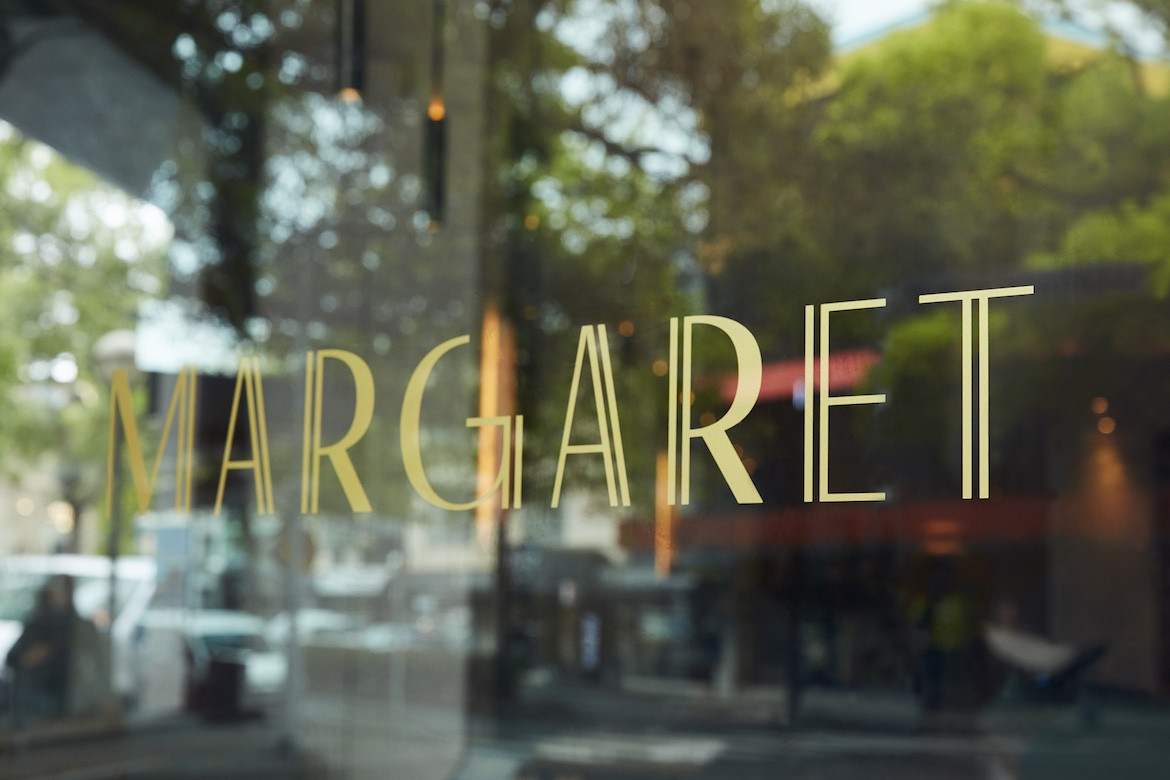
Each element of the restaurant is crafted to give it both local and artisan personality, says Perry. The restaurant exudes a composed Art Deco charm with its 20th century typeface and curved corner windows. Tan leather seating and pops of deep green are subtly lit by warm, golden Pallas Lights designed by CAON, which feature handmade porcelain perfected by Mascot-based Studio Enti.

Textured walls mirror “the inner lining of the oyster,” while tiles and burnt sienna tones through the design and the branding are references to Perry’s penchant for cooking with fire. The result is an amalgamation of tactility that comes together “in a really subtle way between all elements, materials, branding and offerings,” says Choker.
Custom artworks by Gabrielle Penfold adorn the soft white walls, depicting shucked oysters and sardines, a tantalising taste of what to expect on the menu. Images shot by Petrina Tinslay of seafood from one of Perry’s Melbourne-based suppliers were “just so gorgeous” that he and Caon decided they would be perfect for the space.

Craftsmanship and collaboration are two words that keep coming up around this project. Alafaci and Choker recommended a range of boutique craftspeople and builders who they had worked with before and knew their caliber, which “makes it easy, it makes it fun, and it makes for a seamless project,” says Alafaci.
“It’s amazing in terms of its location, its proximity and its geography in Sydney and Double Bay. I think it’s a real game changer for that whole area,” says Alafaci.
Design
David Caon
caonstudio.com
ACME
acme-co.com.au
Construction
Calida Projects
Photography
Petrina Tinslay