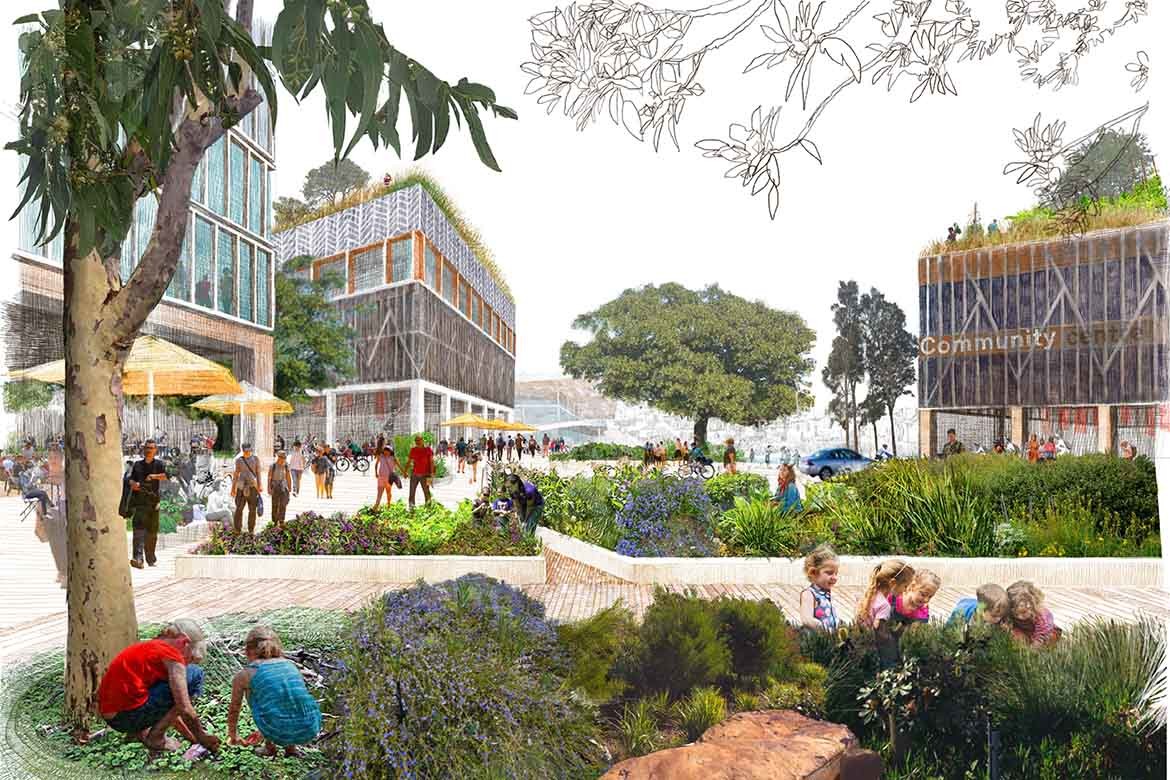
One of the largest Infrastructure NSW (INSW) projects to be developed, the Blackwattle Bay site of some 8.4 hectares is also one of the first major precinct developments under the NSW Government Connecting with Country Framework.
Connecting with Country was brought in as a priority early in the masterplan development with fjmtstudio and Bangawarra working towards mutually positive outcomes. “Engaging with local First Nations communities and working with Bangawarra have been very positive parts of the design process for Blackwattle Bay. Bangawarra have an engaging way of revealing Country and sharing stories and significant elements that come from the place and how these might present opportunities for the renewal of the area in a way that doesn’t limit opportunities but opens more,” says David Haseler, fjmtstudio principal and head of fjmturban.
For Bangawarra, the engagement was similarly positive: “We were brought in to facilitate a meaningful connection to Country through the stories and knowledges of this unique place. This then created a foundation to develop the vision and principles for the project and the key design moves naturally evolved from there. Working with fjmtstudio was a really positive process for us. They eagerly embraced the stories we shared and together we were able to create really special spaces that prioritise and respect Country,” says Shannon Foster, D’harawal eora Knowledge Keeper and Bangawarra partner.
As to the process, the development has been in the consultation phase since 2013. Effectively the site and home of the Sydney Fish Markets was rundown and no longer providing the amenity suited to this central position. In 2017 fjmtstudio was announced as the successful tender candidate to develop the Blackwattle Bay masterplan. First Nations consultancy Bangawarra became involved in 2019.
Collaboration is one of those words that gets used a lot – often with no meaning other than to tick a box. Here, collaboration is pursued in the true sense of each party being respected, heard and appreciated, with the outcome being a far greater sum of the parts. “Bangawarra’s Connecting with Country Framework becomes the place-specific exploration for what the broader framework is establishing. It allows others to come into the detail phase of the design process to work within that framework to deliver great outcomes,” says Haseler.
Effectively Bangawarra posited a foundational layer for conceptual exploration, whereby Connecting with Country principles shape and inform outcomes. “Country is often misunderstood as being synonymous with land, but it goes far beyond that. It comprises ecologies of plants, animals, water, sky, air and every aspect of the ‘natural’ environment. Country is a spiritual entity: she is mother. She is not separate to you: all things are connected, everything is interrelated,” writes Foster in a chapter* co-authored by Jo Kinniburgh, Bangawarra partner and lecturer, UTS School of Architecture.
In extrapolating this understanding of Country, knowledge and culture specific to the area are returned to as imperative guiding principles.
Related: Powerhouse for change, Jefa Greenaway
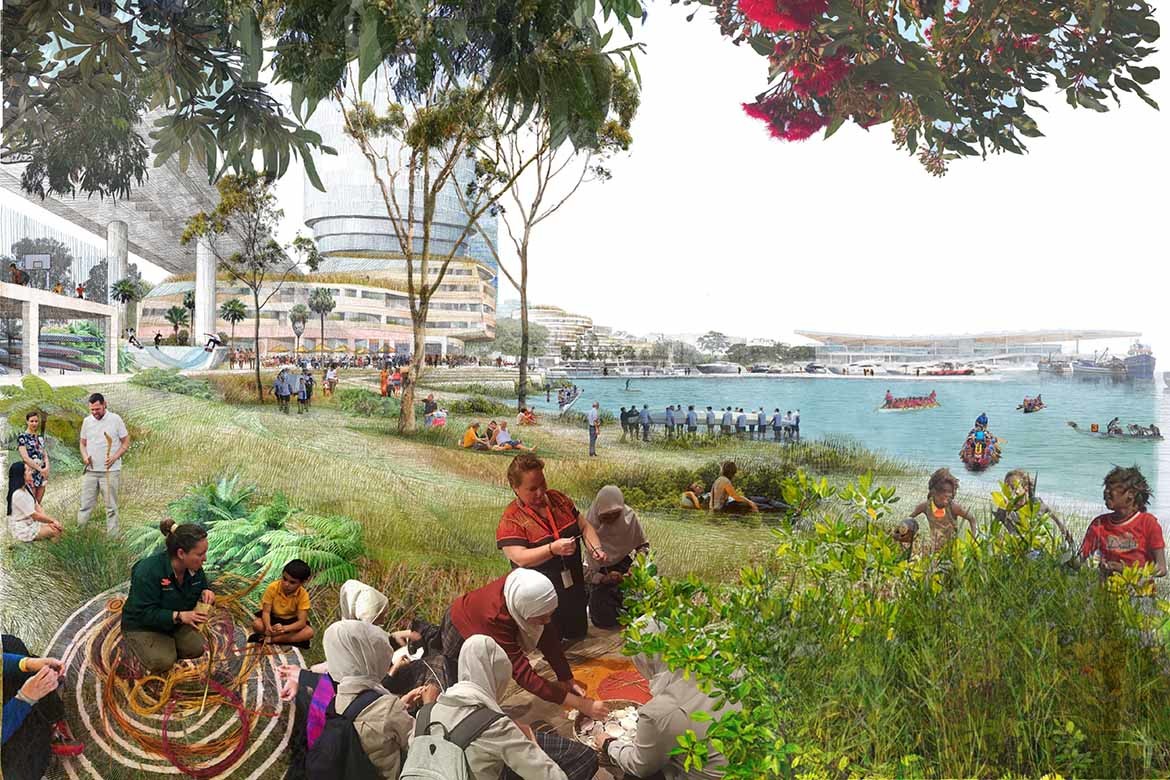
Key to this collaboration was Bangawarra’s unique understanding of the site’s Indigenous culture and heritage: “This Country is tucoerah/tuggorah, where two waters and their unique environments meet. It is here that nattaigalo (fresh or sweet water) rises from underground springs and travels in streams across the land.
Thick forests of Tjerruing (Callicoma serratifolia mistaken for blackwattle in the early colonial naming of the bay) protect the freshwater as it flows into garigalo (saltwater) Country on the rocky sandstone shorelines of what is now known as Blackwattle Bay. These two diverse environments create the fertile wetlands and swamps of biddigalo (bitter or sour water) that are home to Dahl’wah (casuarina) and the stories of our women,” says Foster.
In March of 2020 three scenarios were put forward by fjmtstudio and Bangawarra for community and stakeholder consideration. Each of the scenarios offered similar amounts of open space, but had different engagements with the city. A combination of feedback from community and stakeholder submissions informed the design further and the precinct plan taken to exhibition in 2021. The precinct plan now overlays the organic influences with the street grid whereby both natural form and industrial past are recognised.
Integrated within the whole are influences of First Nations community: “The Connecting with Country Framework isn’t just physical but relates to stories of Country and the significance of this place as a healing place and meeting of fresh and salt water. It’s the interaction of the water systems and the way the Songlines overlay on this place. Through the three scenarios we were exploring ideas including the casuarina which is significant to the bay and how it might have representation in the precinct,” says Haseler.
How those stories and aspects of cultural significance will be realised is yet to be determined, but INSW, fjmtstudio and Bangawarra have put the foundations in place for something truly extraordinary, accessible and culturally apt.
* Country, Wann (2020): There’s No Place Like (Without) Country, in Placemaking Fundamentals for the Built Environment (pg 63-82). Palgrave Macmillan, Singapore, pg 68.
fjmtstudio
fjmtstudio.com
Bangawarra
instagram.com/bangawarra
Images
Mark Gerada
This article featured in Indesign magazine issue 86. Purchase your issue here.