The home of architecture and design in the Asia-Pacific
Get the latest design news direct to your inbox!

Get the latest design news direct to your inbox!
Let’s find out what’s in store for design in 2025 from Gensler.

Jane Byrne Park (proposed, render).

December 16th, 2024
Since 2013, renowned architecture and design practice, Gensler, has highlighted trends that shape the future through their annual design forecast. The latest report for 2025 spotlights five transformative forces that are set to shape the future of design and urban life worldwide.
The publication identifies the top global design trends that will impact the real estate and the built environment in 2025, emphasising human-centred, adaptable spaces and a shift toward resilient urban environments. Through forward-thinking research and strategic advice, the trend report provides knowledge to tackle today’s critical challenges and create positive impact in communities.
Jordan Goldstein and Elizabeth Brink, Gensler Co-CEOs comment: “This year’s Design Forecast shows how bold, imaginative design can respond to global challenges and drive real-world impact. We are in a truly transformative moment for our industry, one that calls for breakthrough ideas and innovative solutions that transform the human experience. Looking ahead, we’re optimistic about design’s ability to create a more sustainable future that inspires and supports people in meaningful ways.”

In essence, the trends identify five key dynamics driving the future of cities, from the reimagining of urban centres as community-centric hubs to the global surge in sustainable design and these are:
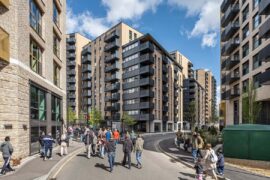
Experience-Driven Lifestyle Districts Reignite Global Cities: Mixed-use lifestyle and entertainment districts will take centre stage in 2025 as the new anchors for cities looking to drive community engagement and bring people together around visceral shared experiences. Hospitality, retail, sports and residential spaces make up the mix of these experience-driven areas, whose rise is also driving demand for safe streets and reliable transit options.
Demand for Sustainable Design Supercharges Innovation and Values: With organisations everywhere increasingly wary of climate risk, buildings designed with resilient and sustainable strategies are trading at premium values. This sustainable surge is also driving demand for game-changing innovations in construction processes and the materials industry. Adaptive reuse of old buildings, energy-efficient designs, weather-scenario planning and other green techniques are anticipating local climate challenges while lowering waste and carbon. Solutions such as mass timber, low- or no-carbon interior finishes and furnishings, and zero-carbon cement are leading a materials revolution.
Deeply Discounted Buildings Drive a Conversion Boom: With ageing office buildings and other devalued assets trading at deeply discounted rates, the adaptive reuse boom is poised to create valuable new real estate beyond just office to residential conversion. As the cost of capital comes down, 2025 will usher in a new financial environment that will inspire developers to seek out creative conversions of all types, including retail to healthcare, retail to sports, office to senior living, office to science labs, and more.
Related: Gensler’s 2024 workplace survey

Talk Turns to Action on Attainable Housing: Attainable market-rate housing becomes the number one priority for cities around the world in 2025 as new financial incentives and lowering interest rates converge with changes to zoning laws and building codes to create an attractive market for housing developments of all types.
The Workplace of the Future Has Arrived: The future workplace is here now, and it’s all about employee experience, inspiration, and the value proposition realised by building owners and developers. In 2025, tenants will continue their flight to quality in search of workplace experiences that motivate employees and meet their professional aspirations. Landlords looking to compete must be laser-focused on transforming their spaces into fully amenitised, Class A buildings close to transit and within the 20-minute lifestyle mix.
Download the full report HERE.
We welcome back Sarah Bader, Executive Director and Co-Regional Client Relationship Leader, Principal, Gensler, Japan as a juror for the 2025 INDE.Awards.
Gensler
gensler.com
Photography
Courtesy of Gensler
INDESIGN is on instagram
Follow @indesignlive
A searchable and comprehensive guide for specifying leading products and their suppliers
Keep up to date with the latest and greatest from our industry BFF's!
The internet never sleeps! Here's the stuff you might have missed