The home of architecture and design in the Asia-Pacific
Get the latest design news direct to your inbox!

Get the latest design news direct to your inbox!
The new Sanya Integrated Commercial and Transportation Hub offers plenty of shopping, dining and entertainment options without ever leaving the station.
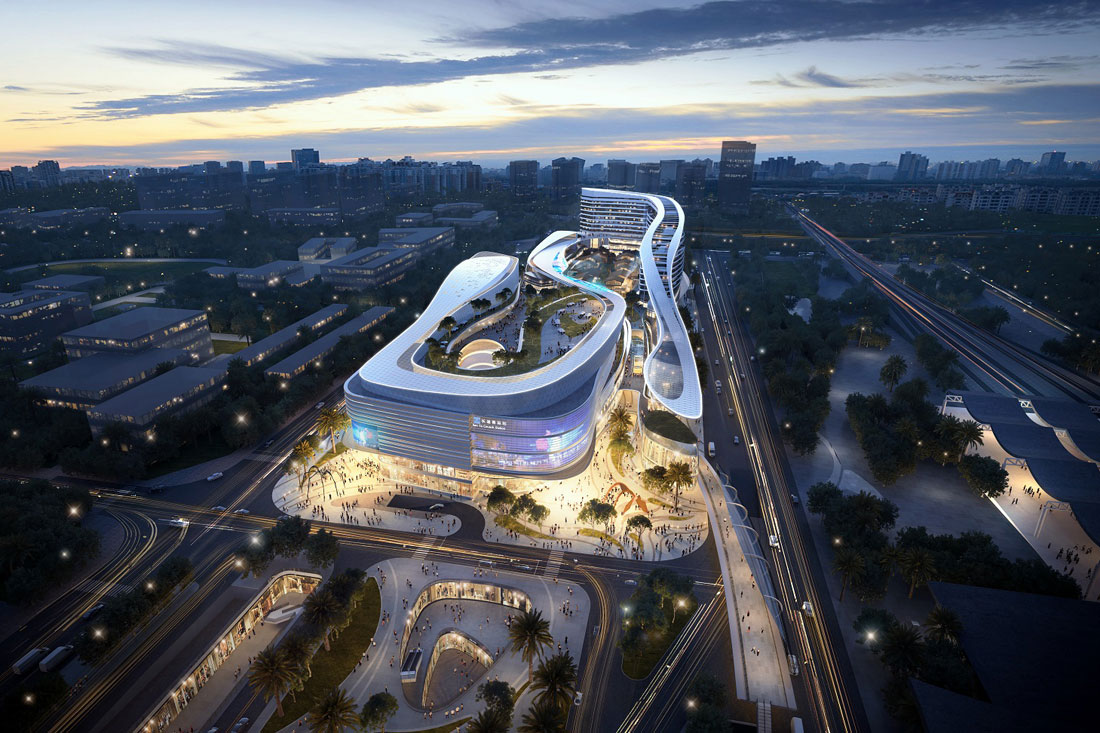
White sand beaches and crystal clear waters don’t immediately come to mind when most people think of travelling in Mainland China. But it’s precisely Sanya’s natural beauty that’s attracting millions of tourists annually to the popular island paradise, leading to its rapid development. Among the new buildings is the Sanya Integrated Commercial and Transportation Hub – a mega complex that ties together retail and residential developments with a high-speed rail and tram station as well as a bus terminus.
The light and elegant complex is constructed entirely in metal and glass with horizontal metal plates on the façade that provide shade and add an element of weightlessness to the futuristic design. International architecture firm Aedas drew inspiration from classic Chinese symbols – the dragon and phoenix – at the request of their client. “This project is located in Sanya, a beautiful coastal city with international, modern architecture and a strong southern Chinese culture; and our client is an overseas Chinese. We were looking for a culturally representative icon to integrate into the design. Ultimately the dragon and phoenix couple was selected to represent the Chinese culture and inspire a bold architectural form,” explains Kevin Wang, Executive Director of Aedas.
The design also makes the most of the warm, tropical climate by choosing natural ventilation and incorporating many outdoor features. “Natural ventilation is important to enhance users’ comfort in a tropical city,” explains Wang. The team also incorporated elements that maximise sustainability including rainwater collection, façade and rooftop shading to minimise the need for air conditioning and the use of natural light and energy-efficient electrical equipment. The open-air shopping arcade was central to the design, whereby Aedas created a series of shopping streets leading to a central public plaza.
One major challenge Aedas faced was designing a space that could efficiently handle the logistics of such a complex, high-volume transportation hub. They carefully planned the ground and underground floors to link both retail and commuting stations in order to diversify the flow of people and ensure that crowd circulation was efficient and smooth.
When completed, the Sanya Integrated Commercial and Transportation Hub is set to be a tourist attraction, a place where visitors will be able to shop, stay at hotels onsite and also enjoy the events venues, cinema, children’s playground and gardens immediately upon arriving by train, tram or bus.
INDESIGN is on instagram
Follow @indesignlive
A searchable and comprehensive guide for specifying leading products and their suppliers
Keep up to date with the latest and greatest from our industry BFF's!
The internet never sleeps! Here's the stuff you might have missed