With the Xingchuang International Center, Aedas architects take what could have been a busy city district and instead create a beautiful green space ‘brimming with openness and connectivity’
June 18th, 2020
Located in the heart of the Xihongmen business district along Beijing’s South Fifth Road the Xinchuang International Center by Aedas architects combines Grade-A office spaces, hotels and upscale retail. With ample greenery to cultivate a feeling of serenity and openness it is a carefully designed district. Expected to be finally complete in 2023, the first phase is already finished as of last year.
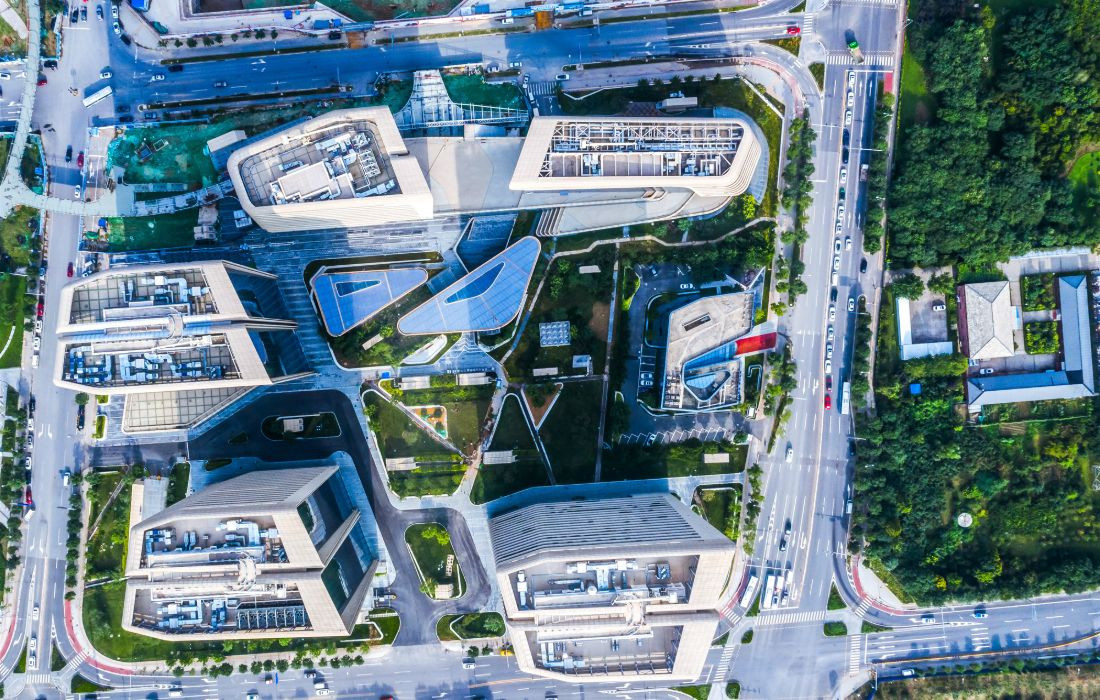
An urban park borders the south boundary of the site while the north encounters the entrance to a retail and commercial centre. The western plot of the project is designated for commercial offices while the eastern plot is occupied by retail, office space and a five-star hotel. The challenge for Aedas was ensuring that the overall design was unified and harmonious with these substantial differences in urban texture.
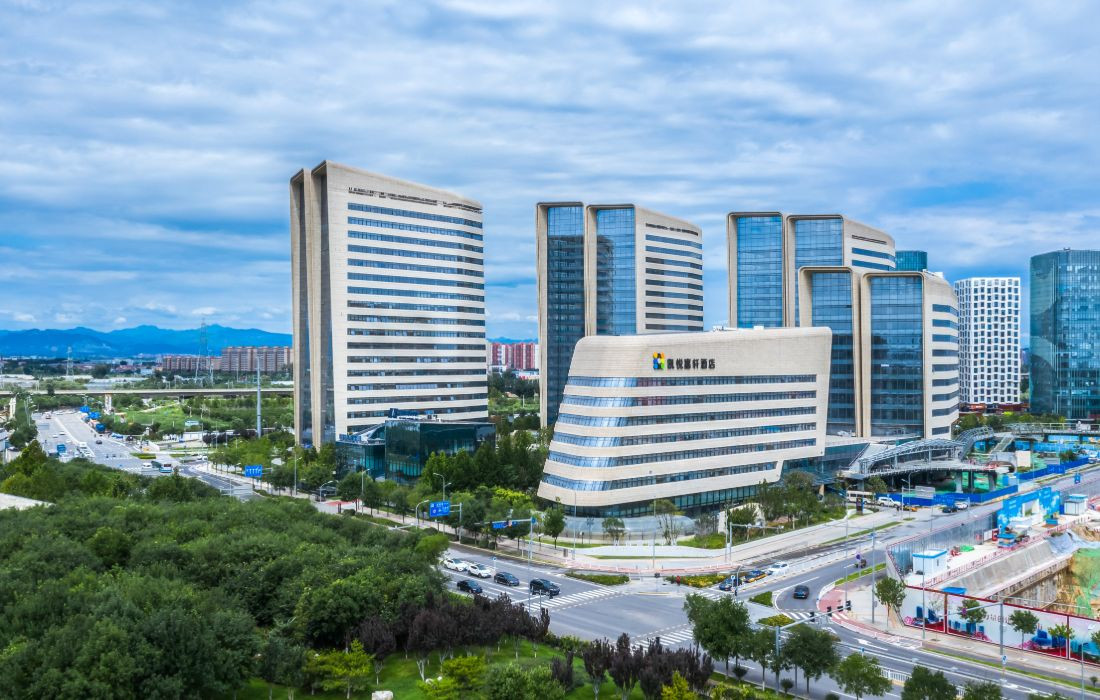
West and East share a consistent architectural language and, when the project is complete, will be connected by aerial bridges that will allow visitors to commute easily. Adopting a people-centric design approach, The development integrates public and functional spaces through the use of uniquely scaled blocks. By sensibly placing the scaled blocks, the design reduces any sense of oppression and reduces blockage of natural light by the larger building blocks while creating open greenery to generate an ambience to the entire development.
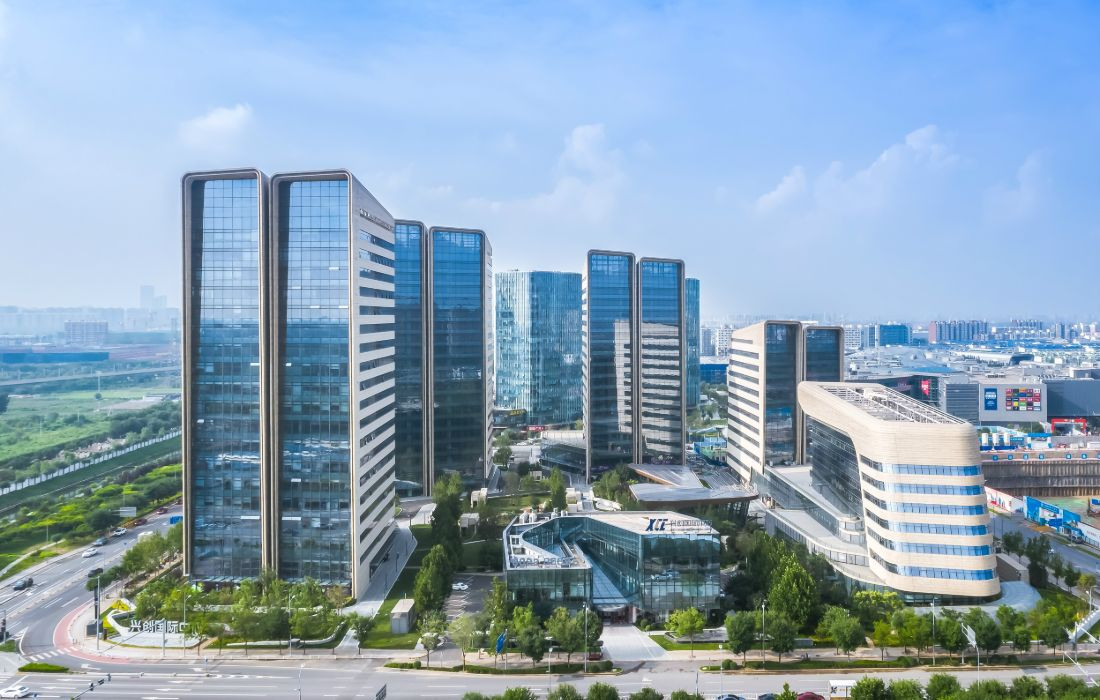
The building outline adopts a geometrically linear form, tracking a north-south directional line to optimize natural light intake. The strong directional lines gradually transforms into a sloping form along the south boundary conjuring images of the natural erosion of stones in a riverbed. As the edges of the development smooth out to embrace the southerly urban park, the boundaries between inside and outside are blurred to create a peaceful atmosphere.

A part of the city that could have easily sprung up as another busy city district. Instead, Aedas have and will continue to create a tranquil, beautiful and more sustainable space. One we look forward to seeing completed.
INDESIGN is on instagram
Follow @indesignlive
A searchable and comprehensive guide for specifying leading products and their suppliers
Keep up to date with the latest and greatest from our industry BFF's!
The newest brand to emerge from Cosentino’s creative crucible is Ēclos, a next-generation mineral surface that embodies the organic beauty and tactility of marble in a precision-mineral surface or material.
Developed by bangdesign for Stylecraft, Kinn is an Australian-made collection of seating and occasional tables, shaped by modest proportions, practical detail and the changing demands of shared interiors.
In the last instalment of our three-part performance seating series, Alex Bain from Architectus explains why sitting well shouldn’t feel like sitting at all and explores an unexpected success metric of the hybrid workplace: the grounding power of emotional support.
Suzhou MixC World draws on the city’s historic streets and gardens to create a retail precinct that feels less like a shopping centre and more like an extension of the public realm.
M Moser Associates has reimagined DuPont’s Shanghai R&D Centre as a network of connected neighbourhoods, using local references and workplace strategy to support collaboration, flexibility and future growth.
The internet never sleeps! Here's the stuff you might have missed
HDR’s Factory of the Future at Western Sydney University turns an awkward slice of Bankstown City Campus into a hands-on learning environment for robotics, digital fabrication and advanced manufacturing.
Ahead of Saturday Indesign, six architects and interior designers consider the assumptions that continue to shape homes, apartments and neighbourhoods – and the conversations the industry could be having more often.
At Paddington Town Hall, the Australian rug studio reflected on two decades of bespoke design with an event that brought its archives, collaborations and making processes into motion.
After two decades of creative partnership, Kim Colin and Sam Hecht of Industrial Facility step into a joint role as Herman Miller’s Global Creative Directors – a reminder that the brand’s ethos isn’t defined solely by their products, but also by the quiet thread of thought that shapes the space in-between, crafting a purposeful, human-centric and enduring trajectory.