The home of architecture and design in the Asia-Pacific
Get the latest design news direct to your inbox!

Get the latest design news direct to your inbox!
Expanding on his published collection of essays, Richard Francis-Jones curated a stimulating discussion about what elicits an architectural response.

(L-R): Richard Francis-Jones, Anna O'Gorman, Aaron Peters, Chris Saines and Tahlia Steadman.
November 1st, 2024
If I were to ask three architects a question about light and architecture, I would likely hear three completely different answers. One might tell me about natural and artificial light and efficient ways to calculate lux levels in apartment buildings. Another could respond with the lightness or heaviness of materials – say, masonry verse aluminium – and, maybe, they will tell me just how much Mr Foster’s buildings weigh. A third response may well address the origins of all this measurement and logic in architecture, referring to 18th century enlightenment and neo-classicism in European architecture. Perhaps, though, the more insightful answer would emerge if I were to ask light for its thoughts about architecture. This is the sort of question that Richard Francis-Jones encourages us to engage with in his book, Truth and Lies in Architecture.
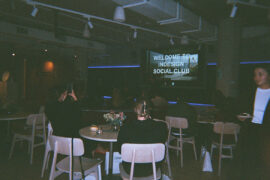
Expanding on his published collection of essays, Francis-Jones curated a stimulating discussion about what elicits an architectural response – is it consciousness, wilfulness or ecology? Francis-Jones invited three leaders in design and architecture – Anna O’Gorman, Aaron Peters and Tahlia Steadman – to discuss the question at the event Architecture: Consciousness, Ecology or Willfulness, hosted by the Gallery of Modern Art in October. Guiding the speakers was an introductory presentation by Francis-Jones framed with the concept of panpsychism, which considers all things – animate and inanimate – as possessing the ability to think and feel as sentient beings. To illustrate this point, Francis-Jones referred to Louis Kahn’s infamous question to the humble clay brick, “what do you want, brick?”

Anna O’Gorman, director of Anna O’Gorman Architects, followed on from Francis-Jones and examined the working mind of the designer and architect, simultaneously exercising both the right and left side of the brain. O’Gorman posited that the architect must engage with the logical and rational as well as the intuitive. It is this intuitive, right-brain thinking, that is at the heart of what our professions do but also the hardest to calibrate and most certainly to assign a measurable value.
The next speaker was Aaron Peters, director of Vokes and Peters, who engaged with the concept of the inner-child and consciousness. Performatively drawing back layers of his own consciousness, through spoken word and collage, Peters spoke of influences formed from childhood exploration of built and imagined environments. His talk elucidated the processes that are engaged with in states of awareness and unawareness – a thinking process reminiscent of the Bauhaus teachings in ‘unlearning’ or ‘deschooling’ as a way of looking at the world anew.
Related: A previous event in the series in Sydney

Tahlia Steadman, a Ngemba woman and Principal at Blaklash, delved into her expertise and leadership in Country-led approaches to design. Steadman introduced the audience to the heritage listed Brewarrina Fish Traps, or as they are traditionally known Baiame’s Ngunnhu, an extraordinary network of river-based stone fish cages and an ancient endeavour of human ingenuity on the Barwon River. Steadman advocated for the conscious state of Country as a key stakeholder to be considered in the design of built environments.
Like the three responses to my question about light and architecture, each speaker brought insightful and unique discussion points to the topic. Chris Saines, Director of Queensland Art Gallery skilfully tied these threads together in the panel discussion. The discussion ranged from understanding what designers actually have, or ever will have, influence over – as well as what they don’t. As for how we engage with our consciousness, not to mention the consciousness in everything (especially our ecological environments), a consistent question emerged: how do we evaluate the immeasurable? How can we put weight or value or any other unit of measurement on experience, wonder and delight, and the intuitive work of our professions? These are enduring questions that can only be explored through these discussions and commitment to test ideas through writing as executed by Francis-Jones in Truth and Lies in Architecture.
fjcstudio
fjcstudio.com
Photography
Courtesy of fjcstudio


INDESIGN is on instagram
Follow @indesignlive
A searchable and comprehensive guide for specifying leading products and their suppliers
Keep up to date with the latest and greatest from our industry BFF's!
The internet never sleeps! Here's the stuff you might have missed