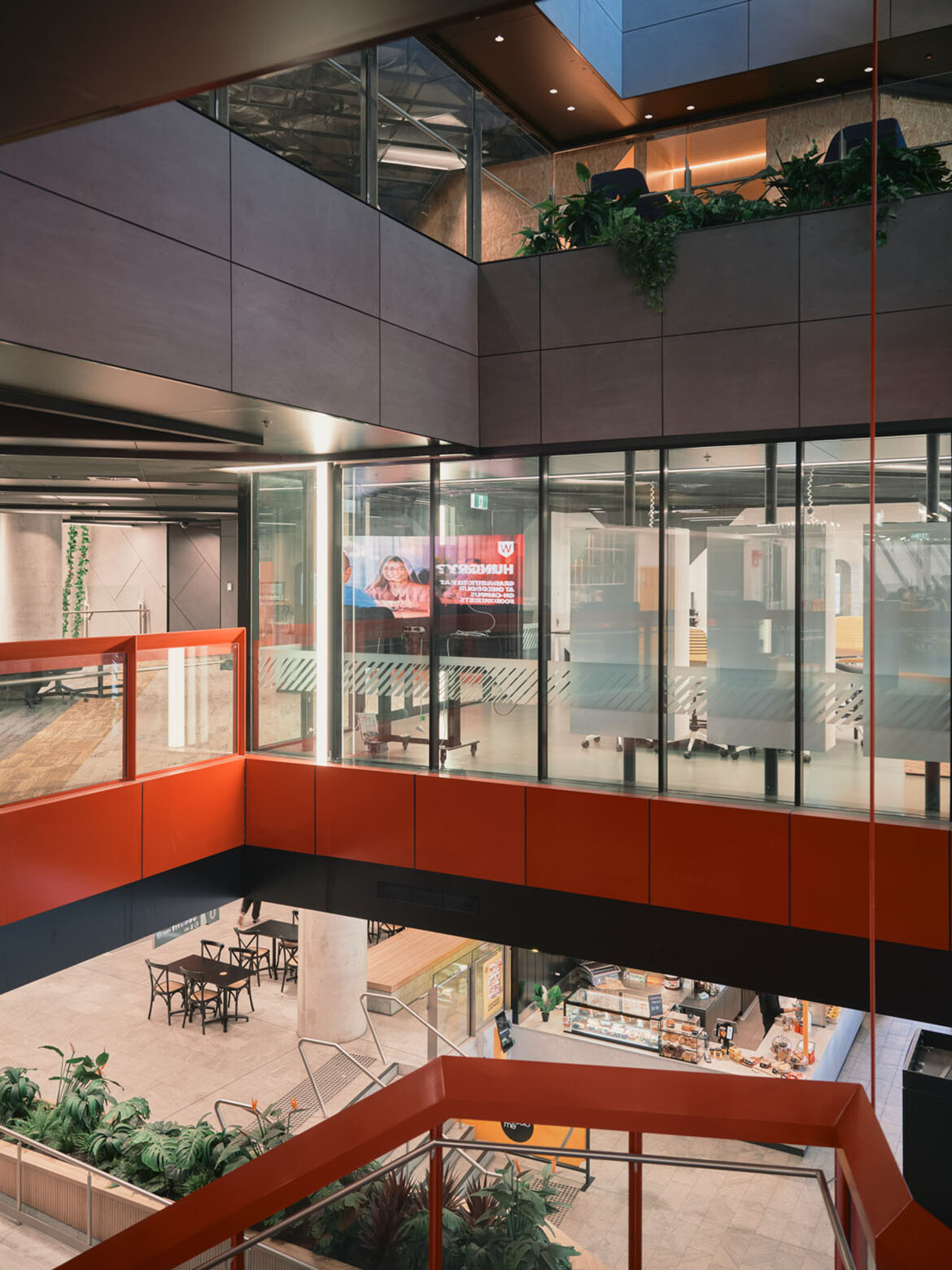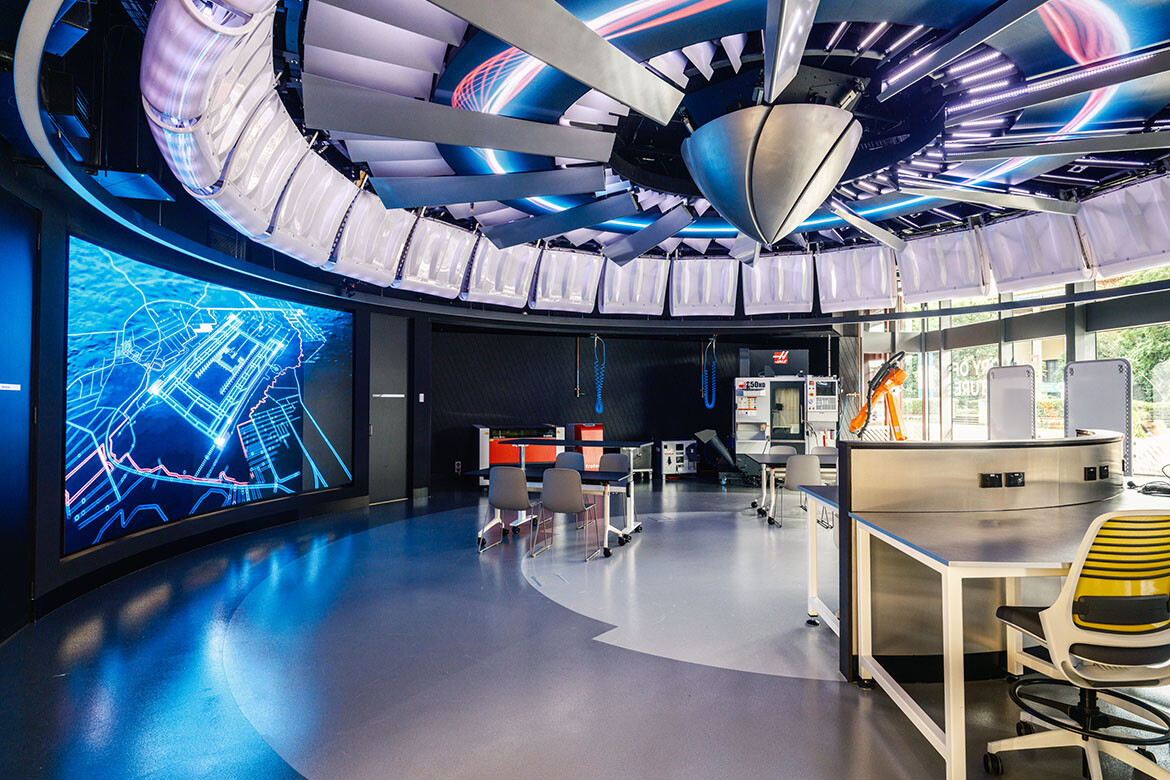
Within Western Sydney University, a compact and irregular ground-floor tenancy has been transformed into the Factory of the Future, a 395-square-metre Industry 5.0 learning environment where students operate robotic arms, test digital fabrication methods and work with technologies that might otherwise sit behind specialist laboratory doors.
Designed by HDR across two levels of the university’s Bankstown City Campus, the 395-square-metre facility is intended to make advanced manufacturing visible and accessible. Its ground-floor Discovery Space faces the street, allowing passers-by to see machinery moving and students working, while the Immersive Training Hub above supports robotics, prototyping, virtual and augmented reality, simulation and industry collaboration.
For Graeme Spencer, Education and Science Principal at HDR, that visibility is fundamental to the project. “From Rickard Road, as you’re walking past, you can see the robots and CNC machine arms moving back and forth and students working late,” he says. “It’s not hidden anywhere.”
The Factory sits within the 18-storey Bankstown City Campus, completed by HDR and Lyons in 2023 for up to 10,000 students and 1,000 staff. Spencer describes the broader campus as a “beacon of education” for Bankstown; the Factory extends that ambition by giving students direct access to equipment, software and expertise linked to the industries growing across Western Sydney.
“It turns a compact and really irregular space into an immersive Industry 5.0 learning environment,” he says. “Students have hands-on access to advanced manufacturing equipment, new software systems and robotics. Students, tutors and industry can all come into one curated space.”
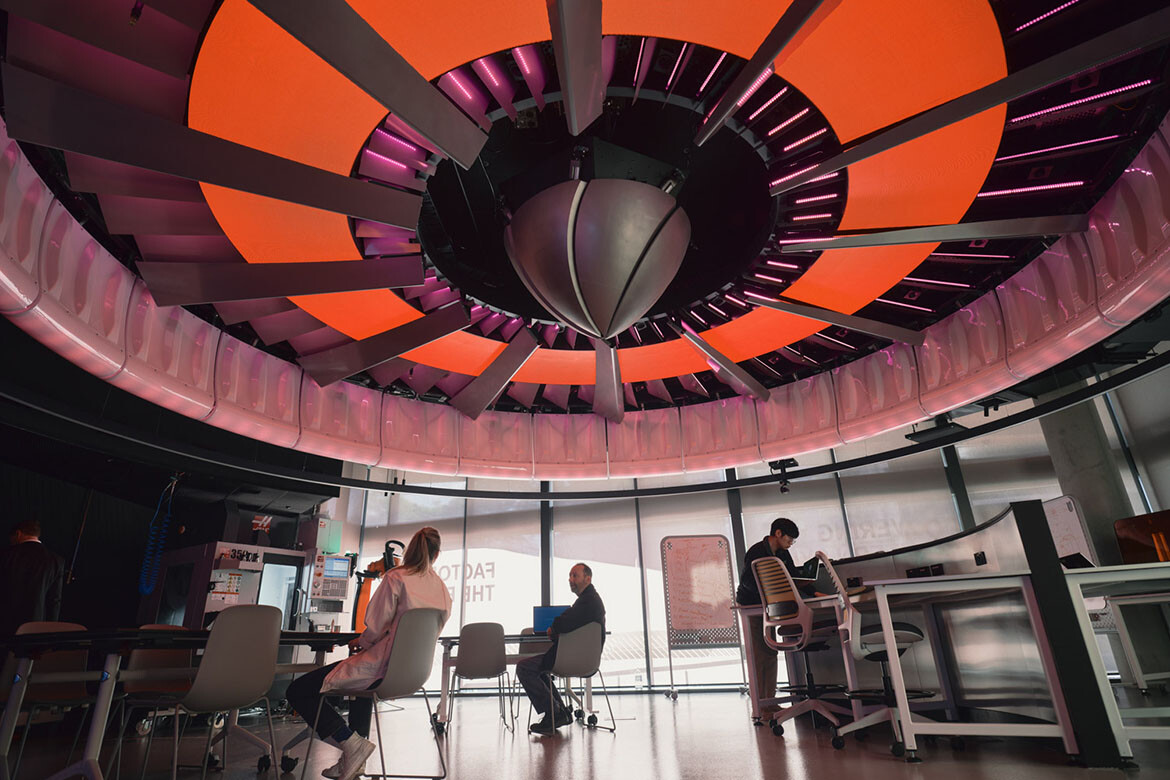
Rather than assigning every activity its own enclosed room, HDR brought different forms of learning together. One student might be operating a CNC machine while another works with 3D printing or virtual reality nearby. The arrangement allows people to observe processes outside their immediate area and understand how different technologies connect.
Related: A retail fit-out that grows from the street
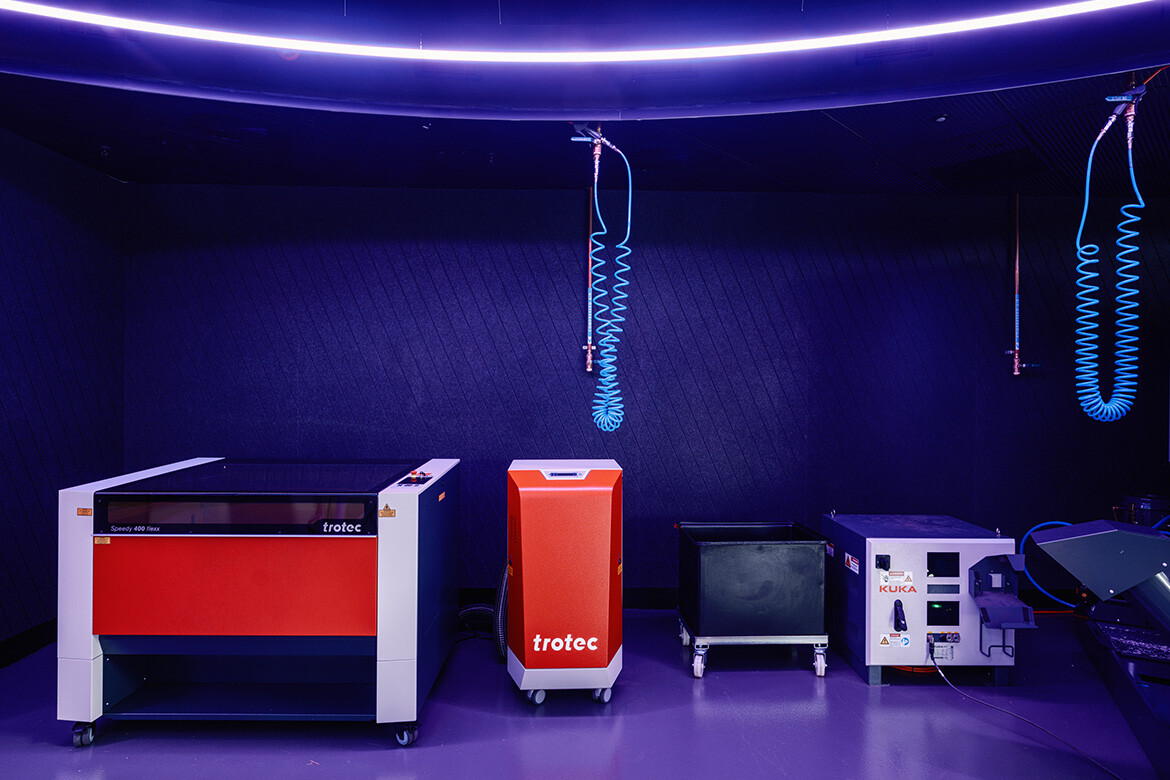
“It’s not defined by walls dividing up every activity,” says Spencer. “It’s a curated space between all of them.”
Indeed, advanced manufacturing equipment changes quickly, so the interior could not be tied to a single set of machines or teaching methods. Modular furniture, exposed services and reconfigurable work zones allow it to shift between workshops, demonstrations, seminars, prototyping, school outreach and industry events.
“We wanted the space to be super flexible, so as new equipment comes in and out, it can be easily replaced,” says Spencer. “It can go into teaching mode or conference mode, or create smaller separated work areas.” Since opening, the facility has been rearranged repeatedly for different classes and programs. Spencer sees that constant adjustment as evidence that the space is being used as intended.
“Every time we go back, it’s arranged in a different way,” he says. “There are different classes happening, robotic dogs walking around — it’s very cool.”
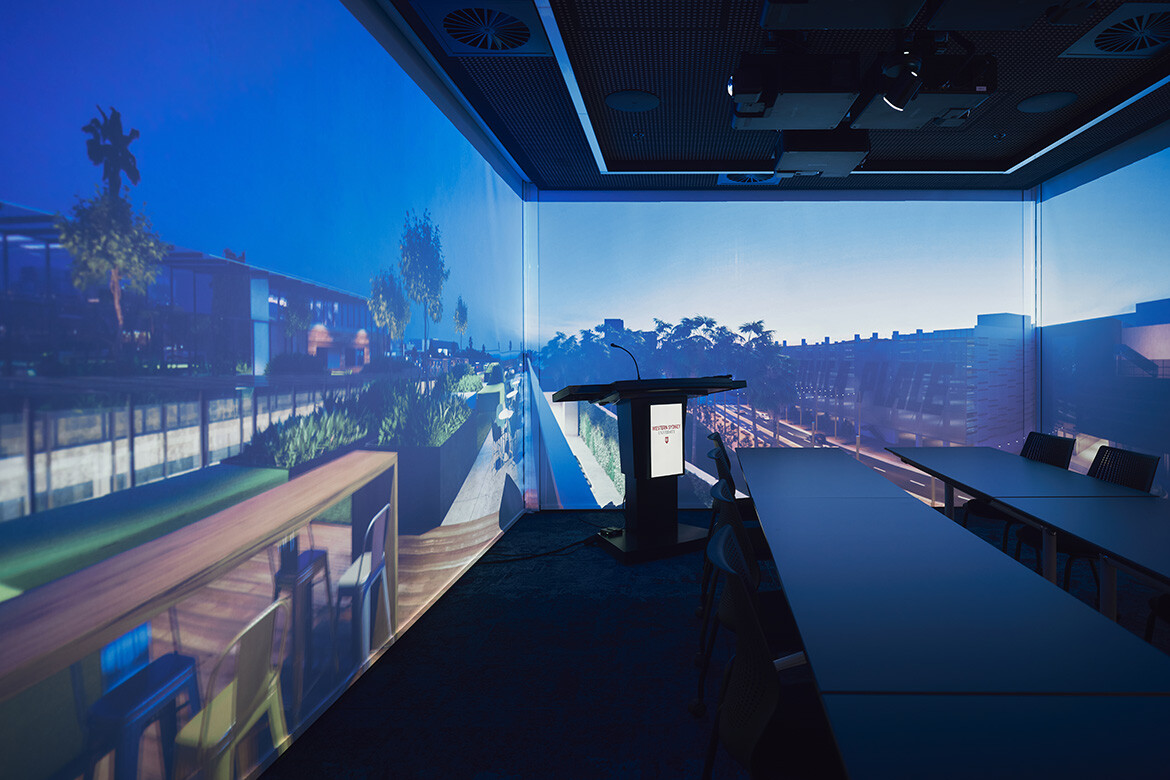
The unusual floorplate could easily have produced a fragmented series of technical rooms. Instead, HDR developed a circular planning logic that draws the activities together and gives visitors a clear route through the facility. The organising idea was informed by Bankstown’s long association with aviation and manufacturing, including the role of Bankstown Airport during the Second World War and the area’s ongoing relationship with aerospace and industrial production.
That history finds its clearest expression in the Innovation Engine, an 8.6-metre kinetic installation suspended over the Discovery Space. Developed with STAKK Studio, its propeller-like form contains 24 motorised cowlings and 96 LED-lit blades, with a nose cone that opens and closes as light, movement and sound alter the room around it.
The Engine is difficult to miss, which is partly the point. It draws people into the Factory, helps them orient themselves and turns the technologies being taught into something visible and physical.
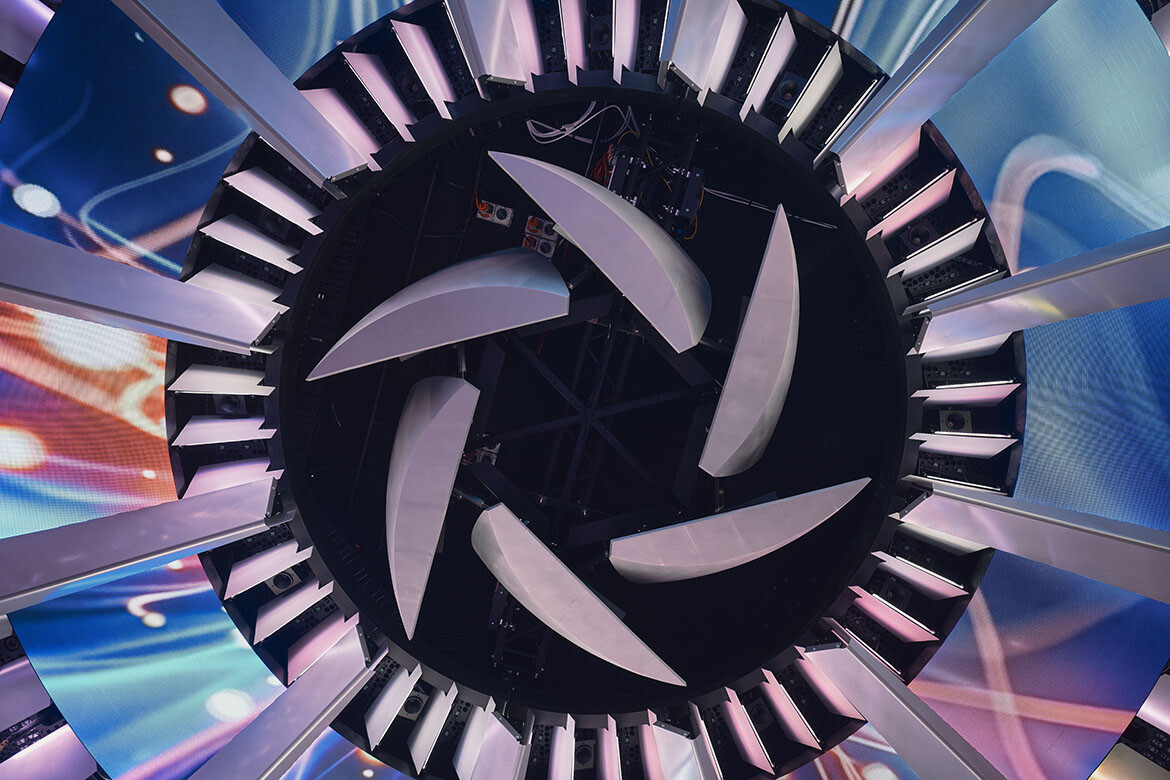
“The Innovation Engine is such a great unifying device,” says Spencer. “It’s hard not to get excited when you see the Engine in action, all the elements moving, opening and closing. Its truly an immersive experience.”
It is also more than a sculptural centrepiece. The installation was produced using the same kinds of processes the Factory exists to teach, including digital fabrication, laser cutting and CNC machining. Its mechanisms remain legible, giving students an engineered object they can read as well as experience.
“It takes the classroom and turns it into a learning experience,” says Spencer. “It’s not about going in, absorbing the material and then going home. It’s much more interactive.”
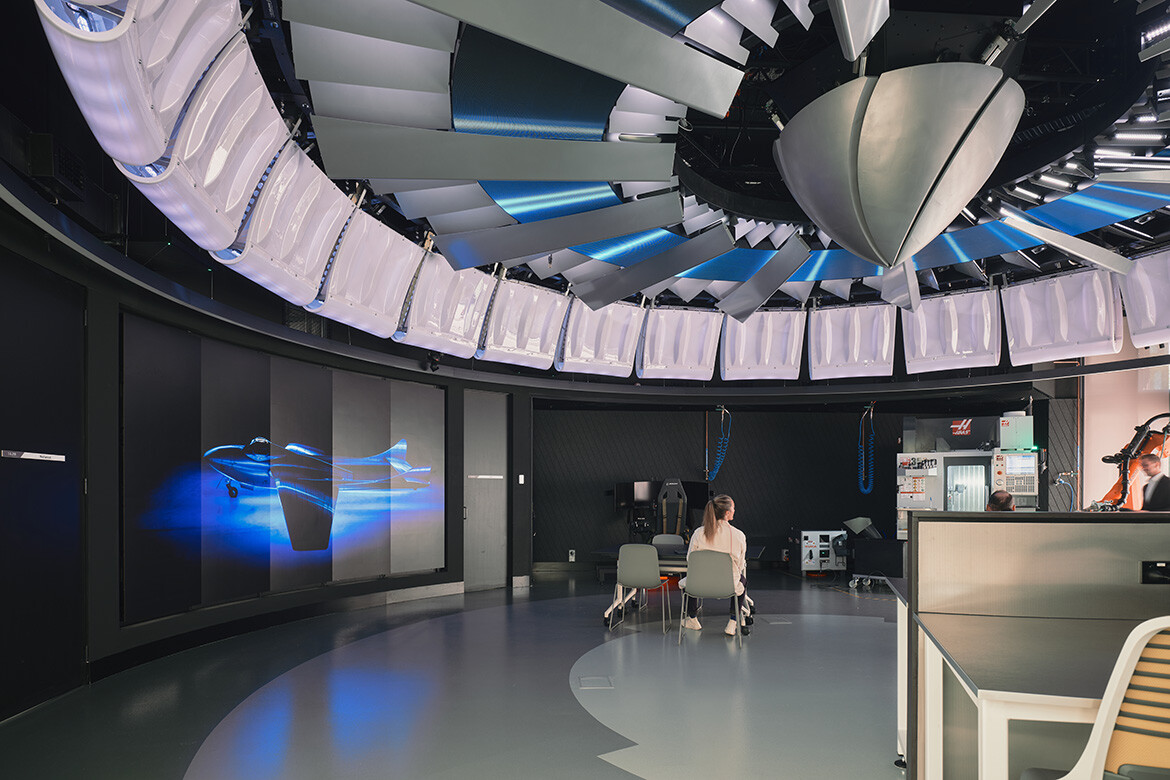
Local manufacturing was embedded in the project’s delivery, with more than 80 percent of the components being made in Sydney and 55 percent sourced within five kilometres of the facility. For Spencer, this was important not only in reducing transport and supporting the project’s sustainability aims, but also in demonstrating the technical capability already present in Western Sydney.
The same regional focus informs the Factory’s relationship with industry. Businesses can bring problems into the university and work through them with students and researchers, whether developing biomedical devices, fabricating aerospace components or producing replacement parts locally rather than waiting for them to arrive from elsewhere.
“You can use hand scanners to capture a part and manufacture the replacement within Western Sydney, instead of waiting ten weeks,” says Spencer. “New economies and new ways of thinking can come out of this.”
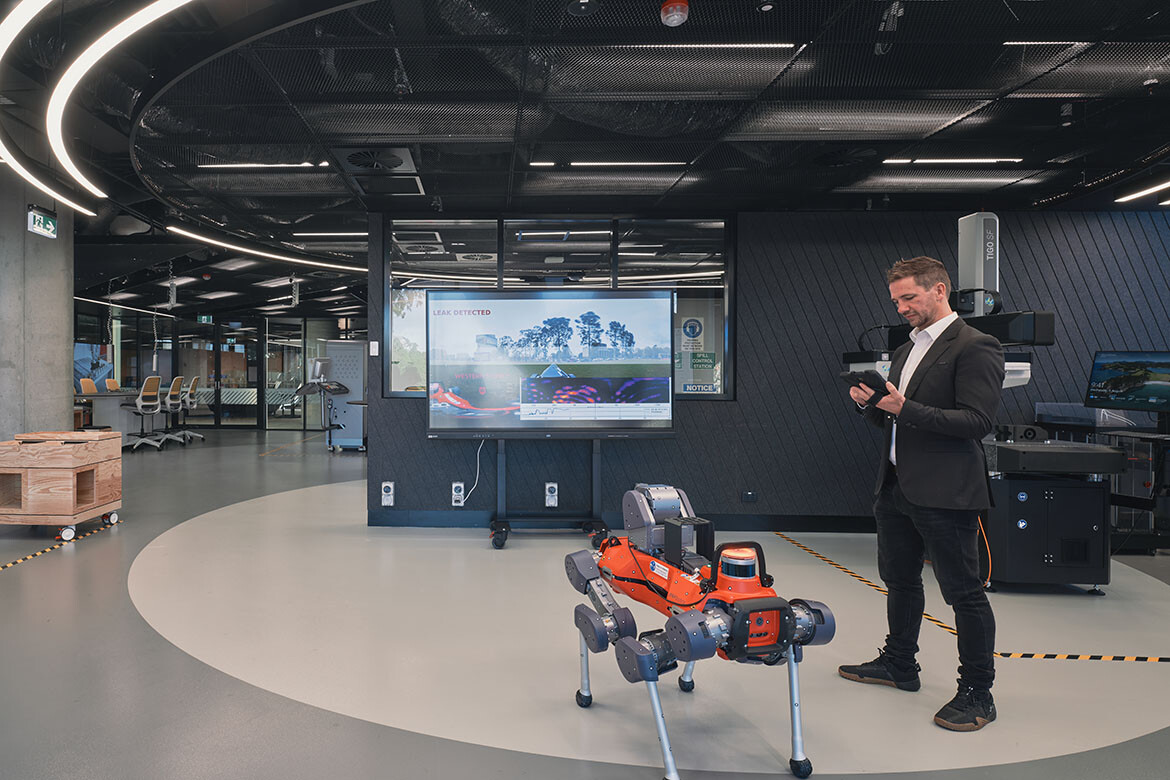
The Factory is also used by secondary school students through Western Sydney University’s outreach programs. This broadens the audience beyond enrolled students and gives younger visitors an early view of the technologies and careers available to them.
Students in Western Sydney no longer need to travel across the city to access this level of equipment and teaching, while local schools, businesses and community groups can enter a facility positioned at the public edge of the campus. “No longer do students have to travel an hour and a half to get this level of education,” says Spencer. “There is now world-class education in Bankstown.”
He points to the diversity of the campus, where more than 120 languages are spoken, and the potential for a facility like this to support both individual opportunity and regional industry. “It places Western Sydney University on the map as a high-tech university while catering for local students,” he says. “It creates opportunities not just for students, but for the community and for local industries to come in and have the university as a partner.”
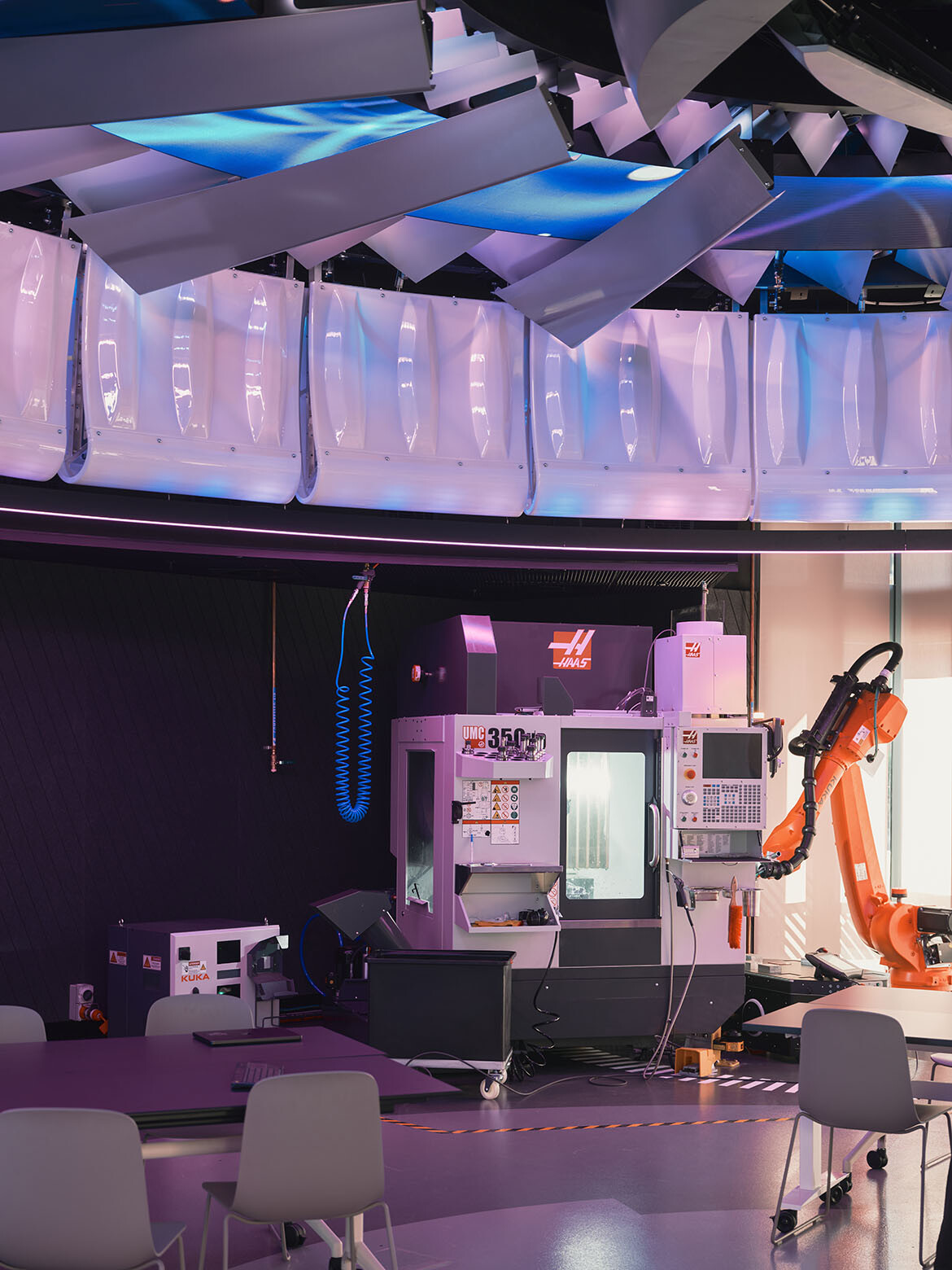
The Factory of the Future is full of spectacle: moving machinery, immersive projection, robotic dogs and a giant turbine that changes shape above the room. Yet its strongest proposition is practical: students can see the technology, approach it and learn through using it.
For Spencer, that access is what allows the project to move beyond the usual idea of a university laboratory. “It gives students hands-on experience for the industries they will go on to work in,” he says. “It is learning by doing.”
HDR
hdrinc.com
Photography
Martin Siegner
Mike Bell, courtesy of Built