The home of architecture and design in the Asia-Pacific
Get the latest design news direct to your inbox!

Get the latest design news direct to your inbox!
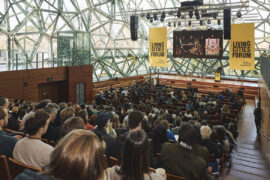
How do our universities cater to education’s ‘new consumers’? That is 21st century students – new age info-natives who study, socialise and ‘hang’ in the spaces in-between home and the lecture theatre. RMIT’s New Academic Street is a radical re-make of a rapidly ageing campus, addressing changing student needs with a complex design scheme that puts the emphasis on technology and study.


June 19th, 2018
The redevelopment of RMIT’s so-called ‘grey ghosts’ signals a much-anticipated final instalment in the university’s decades-long campus transformation. While many may be cheering the revamp of postwar concrete block Buildings 10, 12 and 14, the outcome is significant for more than mere aesthetics.
Along with minor works to Building 8 (designed by Edmond and Corrigan), this major redevelopment ambitiously reconfigures the heart of RMIT’s campus. It also brings the student experience into the 21st century – something these buildings in their original state weren’t equipped to facilitate.
New Academic Street (NAS) is a tour de force by architecture firm Lyons, which has confidently delivered the project in collaboration with Harrison and White, Maddison Architects, MvS Architects and NMBW Architecture Studio. This dynamic mix of Melbourne-based practices literally brings a sense of architectural diversity to the project, dispelling the monolithic quality that had long characterised the precinct, located at the corner of Swanston, Franklin and Bowen Streets.
Incidentally, Lyons initially proposed the ingenious and generous collaboration to university stakeholders, who found it particularly appealing as the participating practices comprise RMIT alumni.
The idea of diversity underscores the redevelopment’s overarching concept as well. “Given that RMIT is a city-based campus, we wanted to bring the diversity of the city into the project,” explains Lyons co-founder Carey Lyon. “Universities are no longer viewed as isolated institutions that look inwards. They want to connect with the cities that surround them and giving this connection a physical architectural form assists in making this happen.”
Laneways were introduced into the scheme to provide links with the surrounding streetscape, and the cosmopolitan spirit of Melbourne’s CBD is peppered throughout the redevelopment via new retail outlets, arcades and walkways. Two infill buildings strengthen the connection between Buildings 10, 12 and 14 and courtyards o er outdoor space for students to relax and socialise.
The new Garden Building, designed by NMBW in its signature pared back style, faces Bowen Street with a rooftop terrace and open public café at street level. Meanwhile the Media Portal at the prominent Swanston and Franklin Streets corner brings university activities into the public realm.
NAS is a city in miniature; an urban village designed as a ‘sticky place’ that encourages a lively sense of community. Indeed, a major challenge the architects faced was how to make the redevelopment attractive to students so that they want to stay on campus.
Infrastructure that encourages social interaction is pertinent, as are spaces that support student-focused learning. “It’s not about a one-size-fits-all approach anymore,” says Lyon. “Rather, it’s about giving students the option to choose the sort of space they want to study in.” This responsive design solution complements the current pedagogical model of the ‘flipped classroom’, where learning isn’t solely delivered through timetabled lectures and tutorials like it once was.
As a result, the NAS scheme o ers a range of different student portals, comprising informal and formal settings for autonomous study or collaborative group work. All up, there are approximately 4600 new seats throughout the project’s 32,000 square metres.
Students can choose to spend their day in the NMBW-designed architecture studio with custom rocking chairs, or the quiet study zones designed by MvS Architects. A popular space for collaboration is the Learning Landscape, designed by Lyons, which echoes the lawn forecourt of the State Library of Victoria.
This ‘grassy’ portal can be found in Building 10, where the original concrete lecture theatre walls facing Bowen Street were demolished and replaced with a full-height glass façade. The decision to do so reiterates the value of transparency in the overall redevelopment and gives students a stunning view of the Royal Exhibition Building in Carlton Gardens too.
Rebuilding RMIT’s Swanston Library was another significant consideration in the redevelopment, not least because it raised issues of how to future-proof the space. As Lyon notes: “We asked ourselves what is a new library and found the answer in reducing the number of books and increasing the amount of student study spaces.”
Spanning two levels of Buildings 8, 10 and 12, the central library supports a progressive service model that allows for roving staff and stronger links to student services. Importantly, it is also digitally enabled, so students can plug-in when using the fantastically futuristic black and white study pods designed by Harrison and White.
An emphasis on technological enhancement permeates every corner of the project and very much operates as a driver for how particular zones are planned. The RMIT Connect hub, centrally located inside the main NAS entrance near the main escalators one level below the library, is essentially an open plan that supports a multi-modal way of providing student services.
Different settings permit for private consultation with staff members or for students to socialise while they wait for text notification of their appointment. With this new services benchmark, the days of waiting in queues are thankfully long gone.
It’s a testament to how well the project’s collaborators worked with each other that NAS is defined by an overwhelming sense of rigour and cohesion. They have shown respect for the existing buildings by valuing intelligent student-focused planning, materiality that’s sustainable in terms of performance and outcomes that are highly functional.
But the real measure of success is the number of students who repeatedly frequent this bustling RMIT precinct. “If they are to be viewed as consumers of education then universities need to offer them a great experience,” says Lyon. And NAS proves this is possible by doing just that.
Landscape Architecture
TCL
This article appeared in issue #73 of Indesign magazine, The ‘Information Age’ issue.
–
Get more design inspiration like this straight to your inbox, sign up for our newsletter.
INDESIGN is on instagram
Follow @indesignlive
A searchable and comprehensive guide for specifying leading products and their suppliers
Keep up to date with the latest and greatest from our industry BFF's!
The internet never sleeps! Here's the stuff you might have missed