The home of architecture and design in the Asia-Pacific
Get the latest design news direct to your inbox!

Get the latest design news direct to your inbox!
The kitchen is no longer a room, but a mindset, says Gaggenau’s global head, Sven Schnee. It’s a living space’s most essential element for bringing “soul into your home”. We chat with Gaggenau at EuroCucina in Milan.


Gaggenau at Eurocucina 2018 (Salone Del Mobile, 2018).
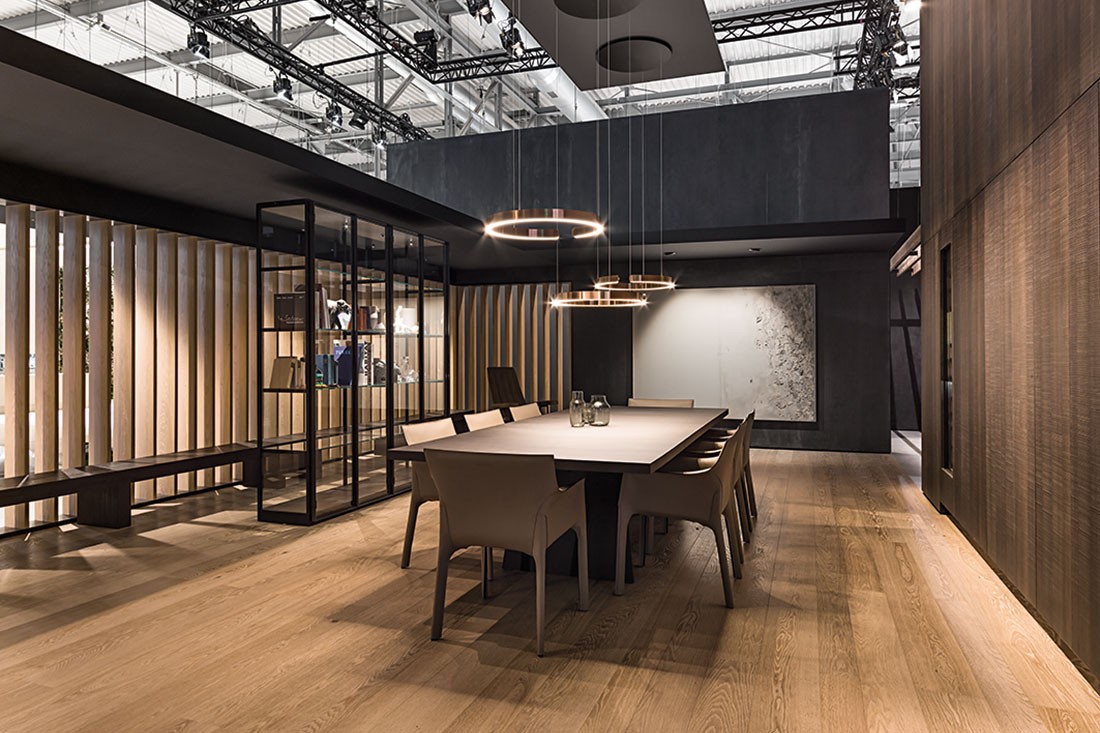
The artwork adds a layer of homeliness to the stand.


The newly released Vario cooling 400 series.
At 335 years old, Gaggenau is very emotional about the kitchen – in the most passionate and immersive of manners. While it may deliver home appliances, its brand culture invites a much deeper relationship with its kitchen products. It views itself as an emotional partner and an enabler that both empowers and shares in its customers’ lifestyle visions and choices.
From the most luxurious of homes – architecturally designed and with ample space – to the smallest of high-density apartments: “You might have the benefit of a kitchen, without having the architecture of a kitchen,” says Gaggenau’s global head, Sven Schnee. “But the kitchen is no longer simply a room, it’s a mindset that puts soul into your home.”
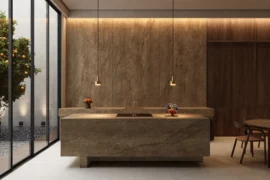
For its 2018 EuroCucina stand at Milan Furniture Fair, Gaggenau ventured away from the ‘hard sell’ product showcase and focused on creating a home environment that would enliven customers’ imaginations. “It’s a booth with almost no home appliances on it,” asserts Schnee. “It’s a home that reflects our culture and the consumers we treasure. It’s a mirror of the choice they might have when it comes to architecture, art, fine dining, furniture, illumination and so on.” So, a stand designed to empower a person’s home vision.
The newly released Vario cooling 400 series.
True to word, Gaggenau outdid itself by envisaging a breathtaking architectural living environment that instantly brings to mind Ludwig Mies van der Rohe’s famous Barcelona Pavilion. With its intersecting planes and its seemingly permeable spaces, both Pavilion and EuroCucina stand alike propose a perfect architectural frame for what might be a highly considered lifestyle.
Bringing the ‘Gaggenau home’ to life was interior wood fittings by Schotten & Hansen, furniture from Walter Knoll and Porro, lighting from Occhio and a bespoke artwork by German artist Eduard Micus.
The artwork added a layer of homeliness to the stand.
Set within this living environment, almost like a precious gem, was Gaggenau’s Vario cooling 400 series of fridges, freezers, fridge-freezers and wine climate cabinets. “They are a little bit like a jewellery box,” says Gaggenau’s head of design, Sven Baacke. “When they are closed they are uniquely set in the furniture. You can’t see anything. When you open them up, they are the perfect stage – a home lighting system, a handless door opening for your food and wine. So, that’s the spirit [of the stand]: it’s not a room, it’s more a home.”
Where two year’s ago technology was all the buzz in the kitchen, this year there was the notable absence of tech-crazed products. Many forecasted that technology would become much more thoughtfully designed ‘in’ to the kitchen. They were spot on: technology is a fully integrated facet of a product’s design, intuitive and sophisticated in its functionality and aesthetic. Gaggenau has taken this a step further to create a sense of transparency too.
The appliances, beautiful and jewel-like as they are, blend into the surrounding environment to put the individual centre stage. “It’s about really showing what you’re doing,” says Baacke.
“Showing how you feel with the ingredients you have. Integrating people into what you do. At the end of the day, it’s not a private kitchen [here on the stand], it’s a social place where you meet with friends and cook together. It’s all very transparent.”
See what else we predict to be on the rise in the kitchen, straight from the 2018 EuroCucina.
INDESIGN is on instagram
Follow @indesignlive
A searchable and comprehensive guide for specifying leading products and their suppliers
Keep up to date with the latest and greatest from our industry BFF's!
The internet never sleeps! Here's the stuff you might have missed