The home of architecture and design in the Asia-Pacific
Get the latest design news direct to your inbox!

Get the latest design news direct to your inbox!
Wynk Collaborative explores the idea of an industrial space as opposed to an industrial-style space for Tanuki Raw.

Entrance to Tanuki Raw. Photo by Jovian Lim
March 1st, 2017
Contemporary Japanese restaurant and bar Tanuki Raw had to make a move when Uniqlo’s Sou Fujimoto-designed flagship store took over a sizeable chunk of the first three floors of Orchard Central last year. The venue reopened at the fourth floor of the building, in a space two levels higher and more than double the size of its original location. Wynk Collaborative was commissioned to design the interior the new space.
The new restaurant comprises 1,500 square feet of indoor space and 1,000 square feet outdoors. The designers retained the industrial aesthetic from the previous interior – a material palette heavy on concrete and cement – and softened and articulated it more with a greater variety of materials like brick, wood and powder-coated metal.
“The concept for the design was based on the idea of an abandoned warehouse space where different fragments of the factory still remain and nature has started to take over,” says Leong Hon Kit, founding partner of Wynk Collaborative.
“Our objective was to create the idea of an industrial space as opposed to an industrial-style space with the usual clichés of filament bulbs and wire mesh. We wanted to create a fun place that feels communal but yet still gives a sense of intimacy and privacy – something that local customers still very much demand,” says Leong.
The irregular shape of the retail unit provided an opportunity to create a processional entrance framed by black powder-coated steel and a slanted ceiling. Lighting at the taller end of the ceiling simulates a skylight, highlighting the main feature of the space – the brick wall. Curved corner bricks stacked perpendicularly to the regular bricks create a three-dimensional relief. It ushers diners inside the space, and turns to span the entire length of the main dining area.
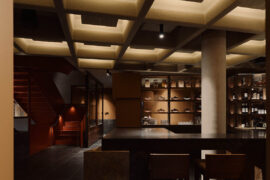
The food bar and the drinks bar are the anchors. A cluster of lights custom-made with industrial steel drums hangs above the drinks bar. The floor of this area is raised such that diners can sit on the bar areas and be at the same eye-level as the staff. Different parts of the dining space are demarcated by variations of the materials so that repeat customers can have a different experience every time they dine in.
INDESIGN is on instagram
Follow @indesignlive
A searchable and comprehensive guide for specifying leading products and their suppliers
Keep up to date with the latest and greatest from our industry BFF's!
The internet never sleeps! Here's the stuff you might have missed