The home of architecture and design in the Asia-Pacific
Get the latest design news direct to your inbox!

Get the latest design news direct to your inbox!
A smart home contains connected devices, but it’s more than the sum of those devices. It should directly respond to its owners’ real-life needs. Philippe Delorme of Schneider Electric shares more.
April 9th, 2019
Connectivity and smart technologies are essential in our daily lives. Just last year, consumers purchased 1.4 billion smartphones globally. And the spending on connected devices of all sorts is forecasted to triple by 2022 (compared to 2017).
This exponential growth shows that personal, connected technology is no longer just for fun – it’s ubiquitous. In our offices, our cars, our homes, and everywhere in between. The choice is smarter homes.
Research indicates that by the end of next year, almost 30 million European households will be smart homes. But exactly what is a smart home? It’s a dwelling that contains connected devices, sure, but it’s more than the sum of those devices.
‘Smart’ living is about functionality and simplification of everyday life. A smart home should directly respond to its owners’ real-life needs. If you are concerned about the safety of your property and loved ones, 24/7 insight into electrical installation condition can bring you greater peace of mind.
The diversity of offers in the smart home market today gives homeowners a broad choice of solutions and customisation opportunities. We’re spoiled for choice, but the huge variety can also make it hard to figure out what’ll work best at your home.
There is no golden formula for choosing the perfect smart home system – it largely depends on your needs. Do you worry about lights left on while you’re away? Or about your home looking unoccupied and inviting to the wrong sort of guest? Perhaps the stability of your electrical system is a concern or you want to save money on energy bills. Or maybe you’re after the ultra-convenience that comes from smart home scheduling. A good smart home system can address all of these needs.
In addition, there are certain things to be considered in every smart home project, such as the control model and the system flexibility.
In a distributed control model, each function – like lighting, heating, or shutter control – is managed separately via its own interface. This approach is common in larger buildings, where a certain level of system independence is necessary for overall stability. But for a homeowner, distributed control can make life complicated.
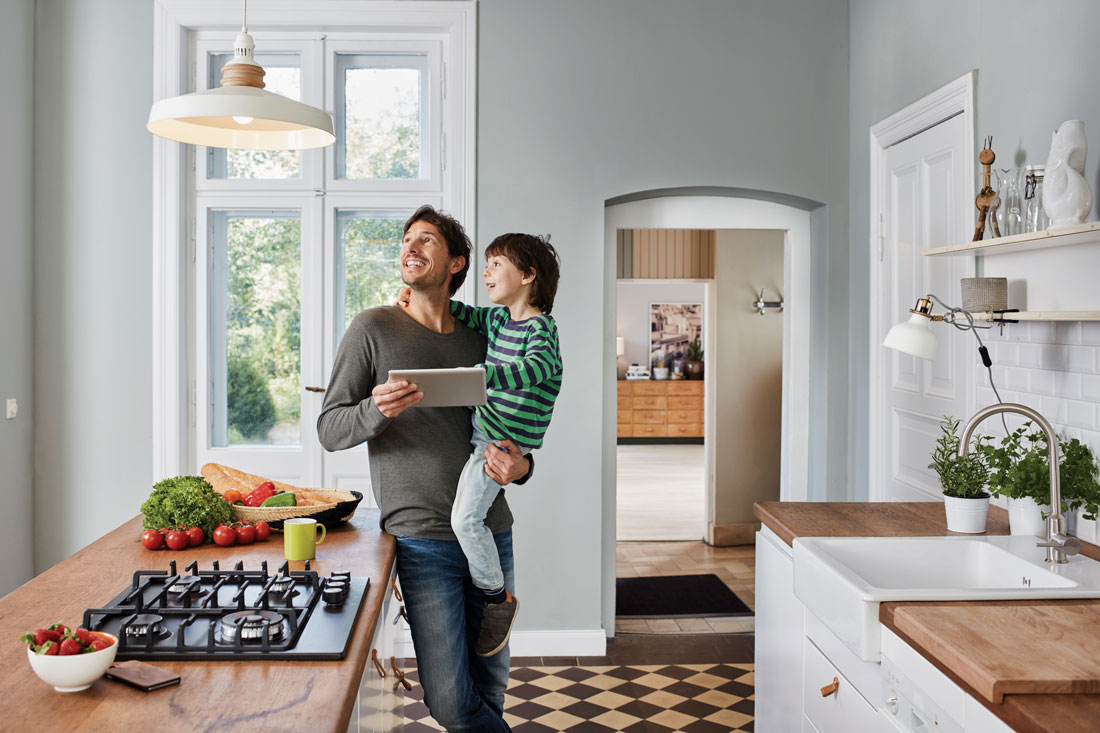
That’s why an integrated approach, with a common interface to control all functions, is a better choice for homes. In this setup, all devices are connected by a hub device and managed via a single app. This makes control easier and more intuitive, which directly translates into greater comfort and convenience.
With no smart home company doing it all, another vital criterion for making a smart choice is flexibility. This refers to both compatibility with third-party solutions and the ability to adjust the functions to specific needs. You need to keep this in mind when installing a smart home system or else risk significant limitations in the future if you wish to expand its capabilities.
Committed to making life at home better and easier, Schneider Electric developed Wiser, a connected home technology, with an intuitive, centralised control scheme and extensive flexibility.
All smart Wiser devices are united by a central hub, called the Home Touch. Meanwhile, the Wiser App lets homeowners manage everything from lighting and shutters to heating and energy management. Pre-defined moods or settings can be activated with a quick tap.
Designed as a modular suite, Wiser allows users to choose only what they need; later they’re free to expand the system as desired. All Wiser functions are also easily integrated with popular voice assistants like Amazon Alexa, Google Home, and Apple HomeKit.
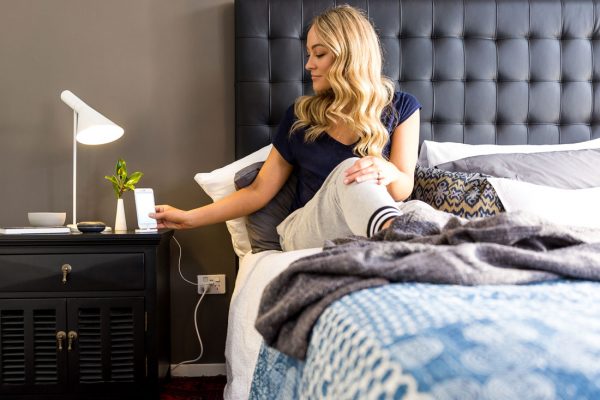
Despite all its advantages, connectivity is still often perceived as lacking simplicity, reliability, interoperability, and post-sales support.
To challenge this mindset and deliver connected solutions that are more tailored and user-friendly, Schneider Electric is partnering with application leaders in different geographies, including: Urmet, a maker of door entry systems from France; Sonnen, a leader in residential battery systems in Germany; and Atlantic, a leader in residential boilers and heat pumps in Europe.
Moreover, together with Danfoss, a smart heating control specialist; and Somfy, a shutter control and security company, we have established a connectivity ecosystemto exchange expertise and explore new ways of improving smart home solutions.
Under all partnerships, we are aligning connectivity and technology strategies with our partners to make all products harmoniously work together. Because a smart home should be in tune with its owners’ needs.
Wiser connected technology for homes is available in select markets today. It’s coming soon to new markets!
INDESIGN is on instagram
Follow @indesignlive
A searchable and comprehensive guide for specifying leading products and their suppliers
Keep up to date with the latest and greatest from our industry BFF's!
The internet never sleeps! Here's the stuff you might have missed