The home of architecture and design in the Asia-Pacific
Get the latest design news direct to your inbox!

Get the latest design news direct to your inbox!
Francesco Meda and David Lopez Quincoces invigorate the future of design at Acerbis through the Remasters collection.

Photography by Alberto Strada
March 15th, 2022
Founded in 1870, Acerbis is known as one of the most enduring furniture companies in Italy. Why? Because Acerbis has always made technology and experiments the two linchpins of its philosophy. Cutting-edge industrial production and collaborations with some of Italy’s most trailblazing designers have been the company’s modus operandi till today.
Acerbis’ recent appointment of Francesco Meda and David Lopez Quincoces as creative directors further affirms its family-led line-age of pace-setting vision. The pair’s prowess in industrial design and architecture, as well as their passion for the history of design brought to life new iterations of selected Acerbis’ furniture archives for the contemporary era.
Each archive design from the Remasters collection highlights an era of Acerbis’ iconic experimentations. The collection not only celebrates the Italian brand’s strong heritage, but also underscores the creations’ modernity that remains progressive even today.

Functionality and simplicity come together beautifully in Florian created by Vico Magistretti in 1989. Inspired by a broom handle, the lightweight, multi-level table built on a foldable structure collapses flat to hang on the wall as a graphic object of circles and lines. The new version folds smoothly and quickly with a modern brass mechanism. Its graphic impact is bolstered with lacquered tones of mustard, green spruce and brick.

Geometry and material speak through Serenissimo table designed by Lella and Massimo Vignelli in 1985. Four, tubular columns and a linear steel girder float the tabletop above for a dramatic visual appearance.

Also designed by Lella and Massimo Vignelli, Creso experiments with a sole pedestal of support to transform a table into a singular form. The new version explores materiality, with its round top and pillar base crafted formidably in travertine, or topped by glass braced by a base with various metallic finishes or hand-made stucco in a wide range of colours.

Created in 1975 by Roberto Monsani who envisioned reimagining the living space, the modular sofa was originally created with a plexiglass shell. Considered avant-garde at the time, today’s version has been elongated and updated with versions in dark stained walnut and black ash. The down cushions, too, are now upholstered in plush velvet.
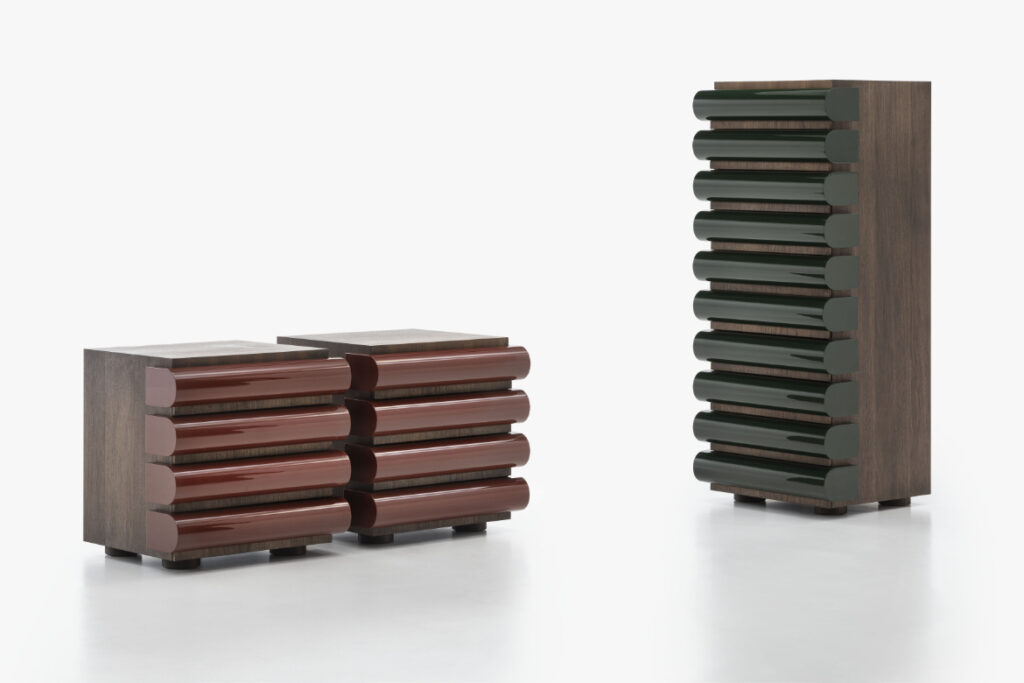
Nanda Vigo’s visionary design has been modernised with brightly lacquered wood contrast and new proportions in both its elongated vertical edition. This new version creates a strong interplay of material difference through colour though Storet is made entirely of a single material – walnut wood. The bedside table that was designed by Vigo but never gone into production is now manufactured for the first time.

Originally designed by Lodovico Acerbis and Giotto Stoppino, the Menhir low table now comes in three different heights and a larger round top. The tabletop is newly rendered in lacquered wood or black ash wood and dark stained walnut for a striking exchange between the table’s column and marble base.

Also designed by Giotto Stoppino, the chair that is constantly in a curtsy stance is now devoid of paint and dye, putting the metal and rawhide leather elements to the fore.
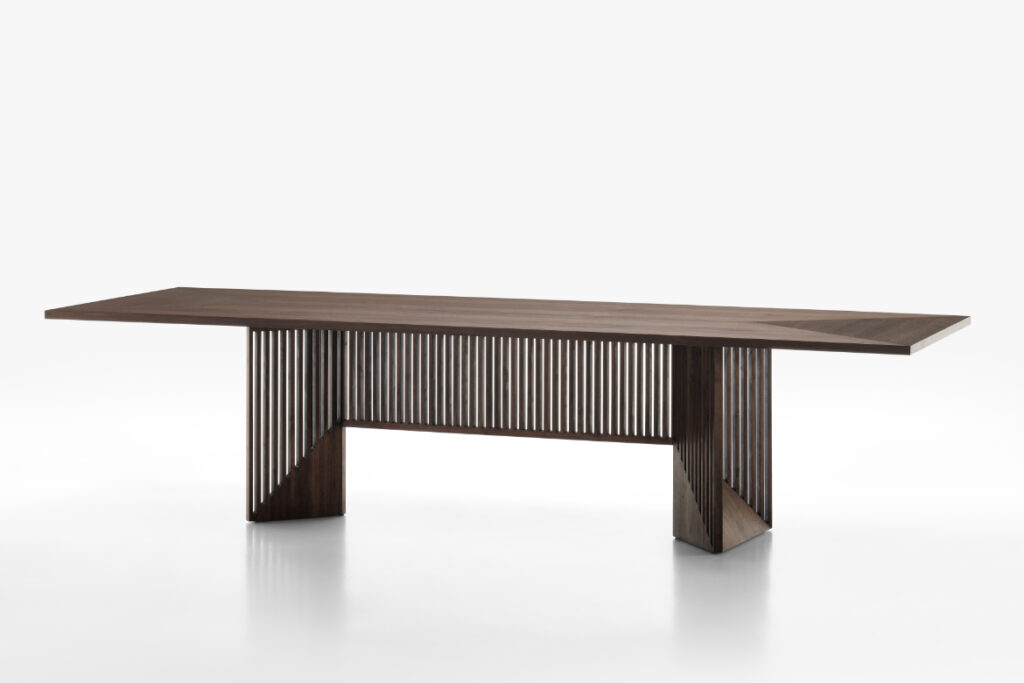
This new version of the Maestro table, originally designed by Gianfranco Frattini introduces contemporary wood such as black ash wood and dark stained walnut. To cater to modern entertaining needs, it is also grander in scale – available in two, five, three, and three and a half metres in length.
Acerbis Remasters collection is now available at Space Furniture.
INDESIGN is on instagram
Follow @indesignlive
A searchable and comprehensive guide for specifying leading products and their suppliers
Keep up to date with the latest and greatest from our industry BFF's!
The internet never sleeps! Here's the stuff you might have missed