In the Melbourne suburb of Essendon, Biasol has created Billie Buoy, a family-friendly eatery that pays homage to the 1980s in a way that makes retro cool again.
Billie Buoy is a new community- and family-friendly eatery located in Essendon, a suburb in the north-west of Melbourne. For the design, interior designer and Biasol Principal, Jean-Pierre Biasol, has drawn on the feel-good vibes of the 1980s and channelled Billie Buoy, a made-up character of his time who was radical, hip and a little offbeat.

The building occupies a corner location with glazing at the front and a graffiti-like slogan splashed on the side that says ‘Wake Me Up When I’m Famous’! While the internal floor plate is just 60 square metres, every centimetre has been fully utilised.
Banquette seating has been included near the front entrance and in the rear dining room. A counter area with stools allows free-flowing circulation between areas. An arch motif has been employed throughout and creates interest while delineating spaces and softening the juncture between ceiling and wall.
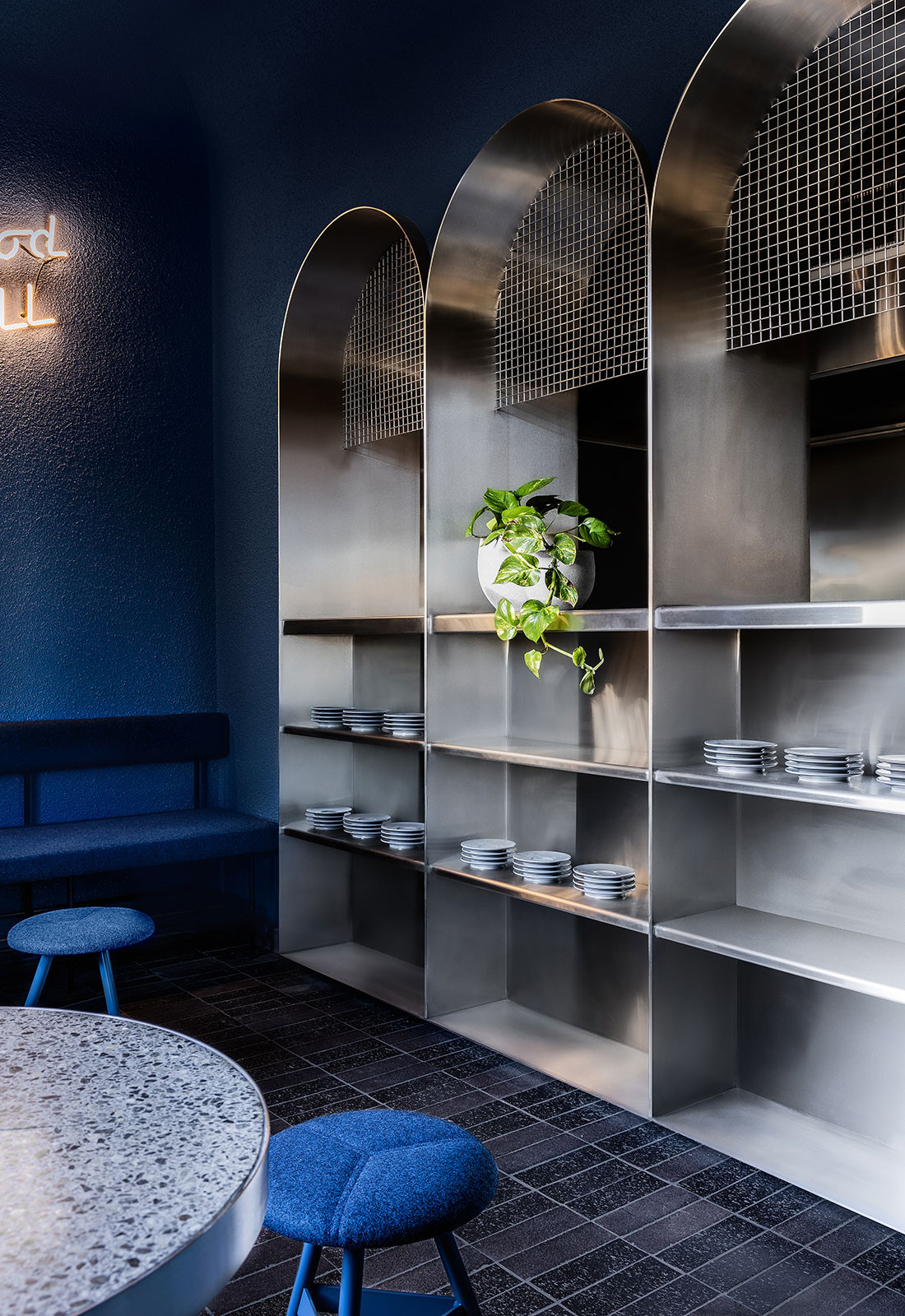
The colour palette is bold and eye-catching with hot pink highlights and cobalt blue in abundance. Materials are textured with a combination of terrazzo, mosaic tiles, rendered walls and felt upholstery that creates depth and variation within the blue hue. An authentic brick floor unifies the interior while a stainless steel bar and arched shelving adds a touch of pizzazz. Hot pink neon weaves its way throughout wall artwork to create Instagram opportunities for customers.

The interiors and branding were developed simultaneously so that they complement one another and combine to form a strong and definitive design. Signage and coffee cups, packaging and apparel all have the signature appeal; Rick Astley’s lyrics are printed on the takeaway bags.
Every detail has been attended to and the total design is an homage to the 1980s in a way that is young, fresh and unforgettable. Billy Buoy is the place to be and is the design statement that makes retro cool again.

INDESIGN is on instagram
Follow @indesignlive
A searchable and comprehensive guide for specifying leading products and their suppliers
Keep up to date with the latest and greatest from our industry BFF's!
In the last instalment of our three-part performance seating series, Alex Bain from Architectus explains why sitting well shouldn’t feel like sitting at all and explores an unexpected success metric of the hybrid workplace: the grounding power of emotional support.
Blending versatile cooking with smart performance, Bosch AccentLine appliances bring a quieter sense of order and simplicity to the modern kitchen.
In the second instalment of our performance seating three-parter, we turn to DKO’s Michael Drescher and Jacob Olsen to peek behind Sayl’s confident architectural form and explore the ideas of inclusivity, adaptability and freedom to move as hallmarks of what sitting your best actually means.
In the first instalment of our three-part series exploring what it means to sit your best, we pose the question to Gray Puksand’s Dale O’Brien, who discusses the importance of ease and majority rule when it comes to sitting and reveals why specifying a task chair is not unlike choosing a Volvo.
Éthos by Biasol in Brighton reimagines the wellness clinic with sculptural interiors, rich materials and a calm, immersive experience.
Through experience and with a passion for great design, Biasol is making gentle and perfect waves on the landscape of design.
The internet never sleeps! Here's the stuff you might have missed
With a plethora of talks, installations, exhibitions and happenings responding to this year’s theme (Design The World You Want), the eleven-day festival was the largest to date and arguably the most accomplished since inception.
In this interview, Michael Leeton reflects on his philosophy of placemaking, connection to landscape and the importance of designing homes that balance intimacy with scale, using his award-winning project House on a Hill as a central reference point.
The Geelong College’s Sport and Wellbeing Centre ‘Belerren’ designed by Wardle is designed around bringing in natural light. But Shade Factor’s job was to help modulate and precisely control it for the most important competitive moments.