The home of architecture and design in the Asia-Pacific
Get the latest design news direct to your inbox!

Get the latest design news direct to your inbox!
2019 INDE.Awards The Prodigy nominees NITAPROW chart the their progress from students at prestigious US architecture schools to one of the Indo-Pacific’s key practices to watch.


Patom is an eco-focused project featuring a café and retail.

Patom.

As any architecture or design graduate will tell you, studio classes are a seminal experience. A hotbed for innovation and experimentation, the university design studio is equal parts a social and educational space in which creative identities are established and life-long relationships forged. Yet for Nita Yuvaboon and Prow Puttorngul, whose time as students at Rhode Island School of Design (RISD) and Columbia University overlapped, their creative paths did not entwine until after their studies.

Playville.
“We knew each other from our undergraduate school at RISD,” Yuvaboon and Puttorngul explain. “Unfortunately, we didn’t have a chance to take any classes or design studios together then, as we were two academic years apart. We saw each other again in New York City while one of us was working and the other was in the graduate program at Columbia University Graduate School of Architecture, Planning and Preservation.”
It was not until 2013, with both women having returned home to Bangkok, that Yuvaboon and Puttorngul teamed up creatively and professionally for the first time. “There was an opportunity to take on a residential/hotel master planning project for senior citizens,” the pair says. “It was too big a project for one person, so we decided to team up temporarily.”

Playville.
Though the masterplan was never realised, the project propelled Yuvaboon and Puttorngul toward establishing NITAPROW, a design practice working across architecture, interiors, furniture, and planning. Following a steep learning curve that entailed acclimatising to one another’s perspectives and creative processes, the practice soon established itself as an exciting new entity in Asian Pacific commercial and residential design.
Though the NITAPROW team has since expanded to include seven other architects in addition to Yuvaboon and Puttorngul, the creative process remains the same. “Natural history and constant awareness of our immediate environment may be our key sources of inspiration,” the duo muses. “We don’t have a favourite type of design. We gravitate towards any type of project that gives us enough time to explore thoroughly.”

Playville.
This intuitive approach to selecting projects is clear in NITAPROW’s built work, which spans from residences to exhibition design, retail spaces, and even a library. Though every project is united by the practice’s refined, richly textured aesthetic, each responds sensitively to its brief.
NITAPROW explains that each project “usually starts with a casual sit down” during which team members bring their initial thoughts and inspiration to the table. The project is then divided into components that can be worked on separately, albeit with the same vision in mind. “It’s hardly ever a ‘your direction’ or a ‘my direction’,” Yuvaboon and Puttorngul say, “most often it’s a combination of the two.”

The cohesion of the pair’s creative vision is most apparent in their more experimental projects, Patom Organic Living and Playville. While the former is a mixed-use site incorporating a plant and organic cosmetics store, showroom, café, and farmers market and the latter a dream-like indoor playground, NITAPROW sees clear similarities between the two. “Plants and toddlers are as puzzling and perplexing as they are fascinating,” they muse, “and they both brought us excitement and joy even before we began the design process.”
Indeed, this sense of “excitement and joy” enlivens both projects, which expertly blend sophisticated colour palettes with a delightful tactility and deft manipulation of natural light.

Patom, organic shop and café.
Both characteristics are also evident in NITAPROW’s ambitious plans for the future, which include the completion of several projects within the next year and collaboration on a co-working space the practice will share with product and industrial designers Piece Co., Ltd. Yuvaboon and Potturngul are also keen to further explore the creative potential of Bangkok and how this will inspire future work, saying: “We enjoy the contrast that our small and quiet design approach brings to this city… the density, temperature, sound, and smell are sensory fireworks, to say the least.”
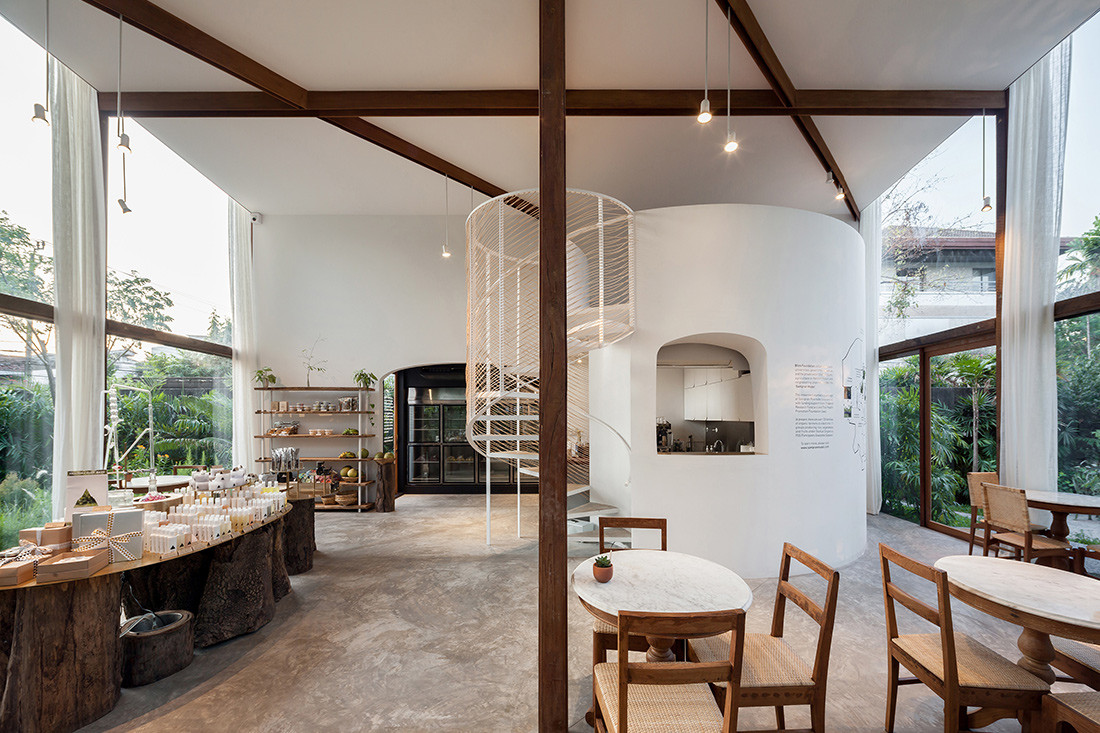
Patom.
INDESIGN is on instagram
Follow @indesignlive
A searchable and comprehensive guide for specifying leading products and their suppliers
Keep up to date with the latest and greatest from our industry BFF's!
The internet never sleeps! Here's the stuff you might have missed