The home of architecture and design in the Asia-Pacific
Get the latest design news direct to your inbox!

Get the latest design news direct to your inbox!
By reimagining the features of a standard hotel room as a modular cluster, Four O Nine created a hotel room design that is spacious, comfortable and personalised. Rik Glauert writes.

September 29th, 2016
Shanghai- and Warsaw-based design studio Four O Nine was recently awarded first prize in the Eurostar Hotel Lab design competition for their recreation of a standard 28-square-metre hotel room.
Frequent travellers would have spent time on their trips noting their hotel’s shortcomings and contemplating the perfect hotel room. Andrei Zerebecky, co-founder and creative director of Four O Nine, found that the first challenge was filtering through his team’s sheer number of ideas. “In the end, we decided to focus on a couple of simple changes and this helped make our detailed decisions more concise.”
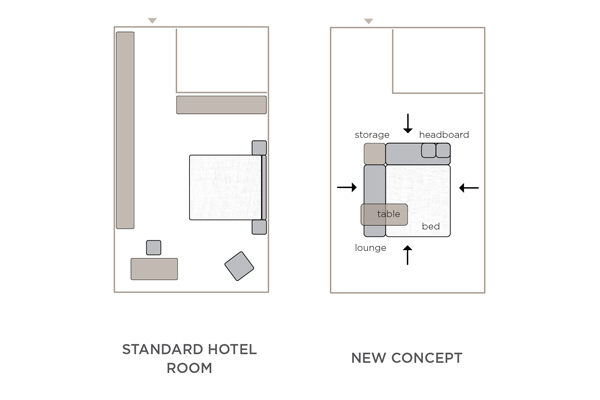
Their concept rearranges the nuts and bolts of the standard hotel room with a new spatial experience centred on a bed island. “The bed is the most comfortable and [most] often used furniture in the room, regardless of guest type,” says Zerebecky. Yet it is often backed against one wall, pointing towards the television, without any thought given to natural light or a view out of the window.
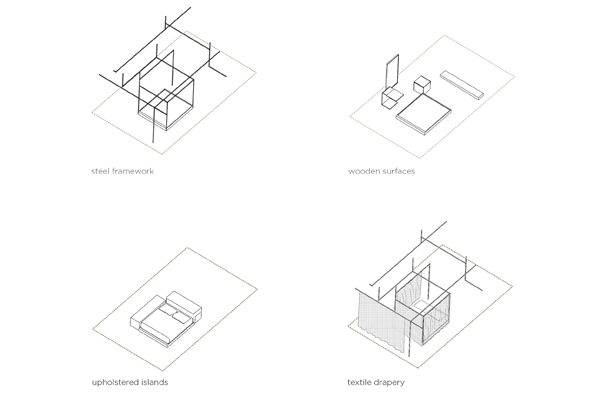
In its new position, the bed becomes part of a modular island, with seating, desk space and storage cleverly integrated around it. The cluster includes four pared down elements, each presented in different but complementary materials.
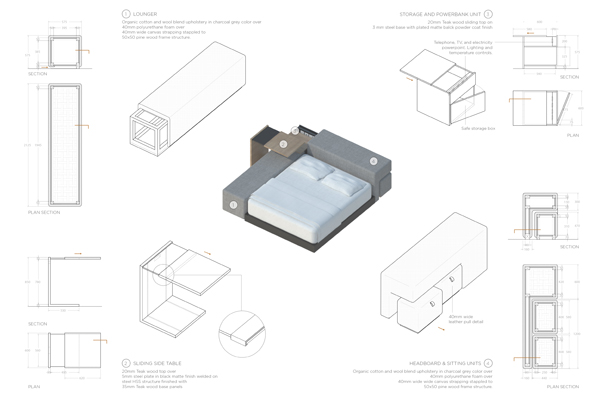
The desk and seating can be moved away from the bed to create a standalone desk or a table for in-room dining, or be left adjacent as a bedside table. A metal rail subtly connects it to the room as a whole. The design is versatile and playful.
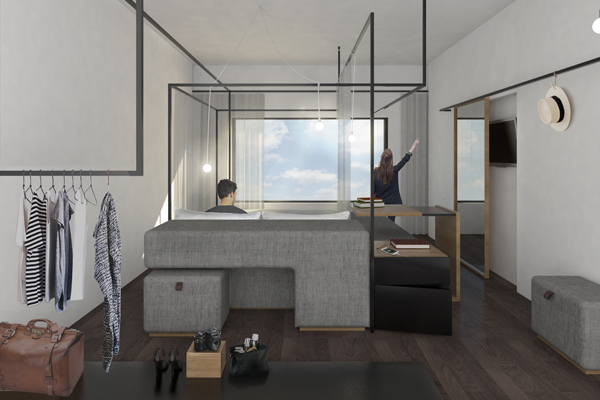
Zerebecky also acted on how visitors use storage in a hotel room. People rarely unpack fully and will often only hang a few key items. Four O Nine replaced bulky hotel cabinetry with sleek and adaptable open storage for the temporary guest.
Streamlined rails encourage creative ways to store and hang key items. Luggage, shoes and other items can be stored on museum-like plinths around the perimeter of the room. The result is a design that “customises the room’s appearance by reflecting a bit of our personality back to us.”
To maximise this personalisation, the room’s palette is restrained but neutral and warm. “We wanted the standard room to feel bigger and brighter while also portraying a sophisticated but subdued sense of luxury using natural materials,” says Zerebecky.
The white walls enhance the sense of space while standing in sharp contrast to the dark walnut floor. The loose furnishings are in a warm, lighter shade of teak. The upholstery and other textiles are in grey wool and natural leather to give a neutral but homely feeling to the room.
Cutting through this, and adding a metropolitan edge, is a black stainless steel rail that continues throughout. The pendant lighting is, like much of the room, adjustable to the guests’ desires. Semi-transparent fabric is draped from the rails surrounding the bed to create an intimate inner space.
INDESIGN is on instagram
Follow @indesignlive
A searchable and comprehensive guide for specifying leading products and their suppliers
Keep up to date with the latest and greatest from our industry BFF's!
The internet never sleeps! Here's the stuff you might have missed