The home of architecture and design in the Asia-Pacific
Get the latest design news direct to your inbox!

Get the latest design news direct to your inbox!
Stephen Lacey spoke with Japanese industrial designer Taku Kumazawa on his recent visit to Sydney.

September 11th, 2013
We imagined that industrial designer Taku Kumazawa lived in a beautiful Nagoya home surrounded by beautiful objects. Perhaps a few Noguchi paper lamps, an eccentric collection of 50s Sanyo transistor radios, maybe even half a dozen of his own Tipo mesh stacking chairs around the dining table.
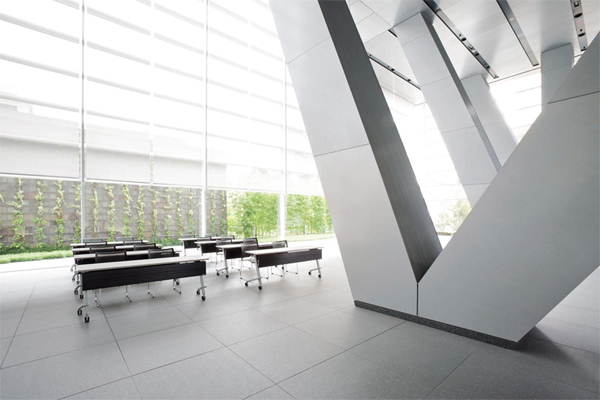
CTZ Table Installation – Japan
But no. Taku admits his wife isn’t really into contemporary design at all, preferring ‘country style’ timber furniture. And he doesn’t own any so-called design classics either. Not even the ubiquitous Eames Chair.
If this wasn’t confusing enough, imagine how we felt when we found out that Taku, one of Japan’s most acclaimed eco-designers, turns out to be a bit of a rev-head. In fact he secretly covets a petrol-slurping Porsche 911 from the early 70s. “A lime green one would be nice,” he laughs.
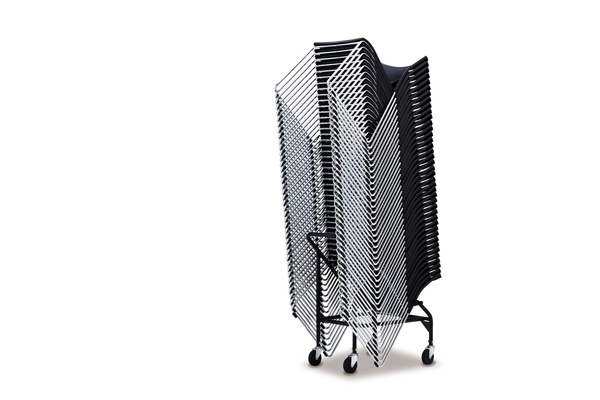
Tipo Chairs – Stacked on Tipo Trolley
Indeed, Taku’s favourite designers aren’t the likes of Saarinen or Starck. He much prefers Luigi Colani who designed for the likes of Fiat, Alfa Romeo and BMW way back in the 1950s. Giorgetto Giugiaro, creator of the VW Golf is another hero.
You get the feeling Taku likes to march to the beat of his own drum. That’s what his employer, commercial furniture manufacturer axona AICHI must have believed when Taku turned up fresh out of a design degree and startled them with his crazy ideas.
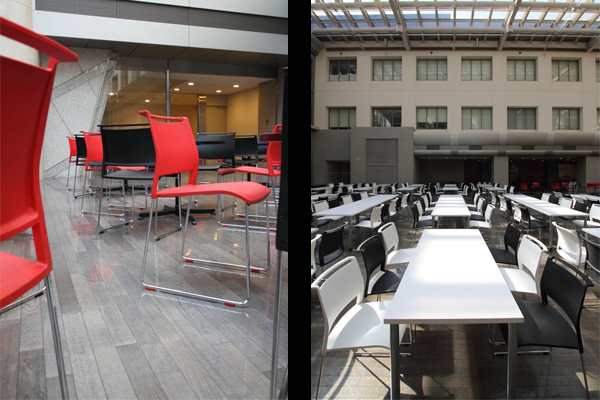
Tipo Chair Installation – Shenshu University Japan
“When I suggested we use recycled material, they thought I was mad,” says Taku. “I always wanted to make furniture that could be separated into different materials at the end of its life. I asked my boss why can’t we do that? And the boss just shook his head. Nobody seriously thought about that 20 years ago.”
“But things have changed. Nowadays Japan is number one in the world when it comes to sustainability. We have to separate our rubbish into 6 different categories. Even the plastic in the front of window-envelopes must be removed for recycling.”
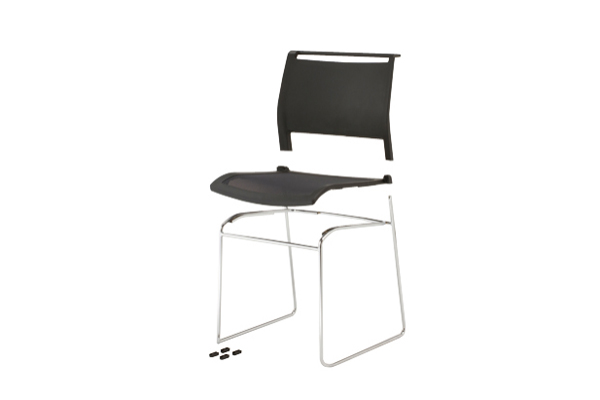
Tipo Chair Components
Things have also changed at axona AICHI, where Taku has remained for the past 16 years. His AFRDI and GECA Certified award-winning Tipo chair is not only incredibly lightweight, comfortable and functional, it is made from 100 per cent recycled materials. The frame is manufactured from the recycled plastic derived from defective automobile engine fans; items that in the past would have become landfill. And at the end of its life, all components are 100 per cent recyclable with simple disassembly into each material type.
Even the packaging for Tipo minimises the environmental footprint when transported around the world. The recycled/recyclable cardboard boxes are designed to hold an incredible 35 chairs. And 40 chairs can be stacked in just 2 metres, minimising storage space. Only Taku – or perhaps an expert in origami – could arrive at such a clever, compact solution.
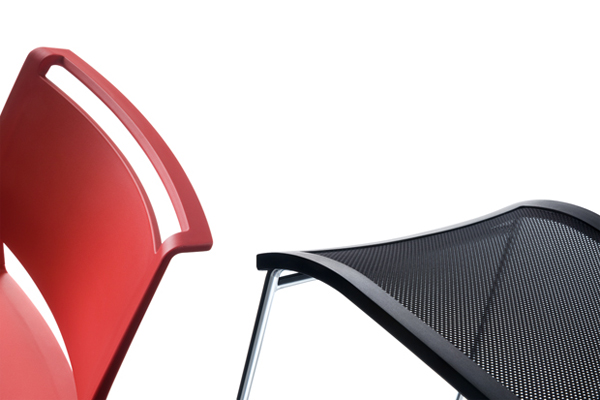
Tipo Chair
What Taku also demonstrates with a chair such as Tipo is that eco-friendly designer furniture need not be a compromise when it comes to performance. It’s little wonder it has become so popular with facility managers and OH&S personnel in offices, educational facilities, conference centres and ecclesiastical markets.
So which comes first…form, function or ESD? “Form and functionality are always considered together, along with price,” Taku says. “ESD is always there, always, although it doesn’t drive the actual design itself.”
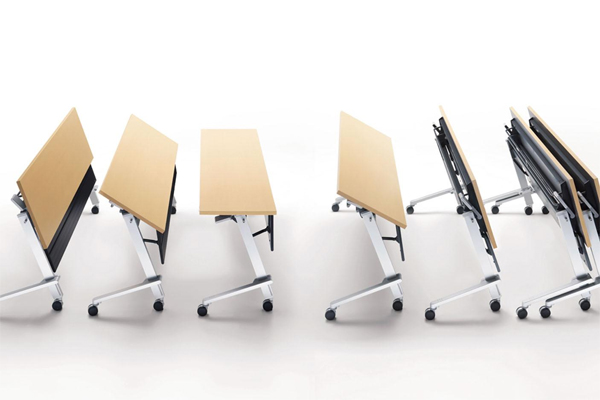
CTZ Table
And what does he think of the view that the most sustainable design is not to design anything? Does the world need another chair?
“It is okay to design a good chair, but what we don’t need is another bad chair; bad form, bad design,” he says. “I never lose hope, because I keep making these good products with recycled materials and hopefully my influence will filter down.”
Mr Kumazawa was in Sydney as a guest of KE-ZU for Sydney Indesign.
axonaAichi
INDESIGN is on instagram
Follow @indesignlive
A searchable and comprehensive guide for specifying leading products and their suppliers
Keep up to date with the latest and greatest from our industry BFF's!
The internet never sleeps! Here's the stuff you might have missed