The home of architecture and design in the Asia-Pacific
Get the latest design news direct to your inbox!

Get the latest design news direct to your inbox!
A structure made with robotically manufactured components represents a new collaboration between the Sino Group and HKU architecture students.
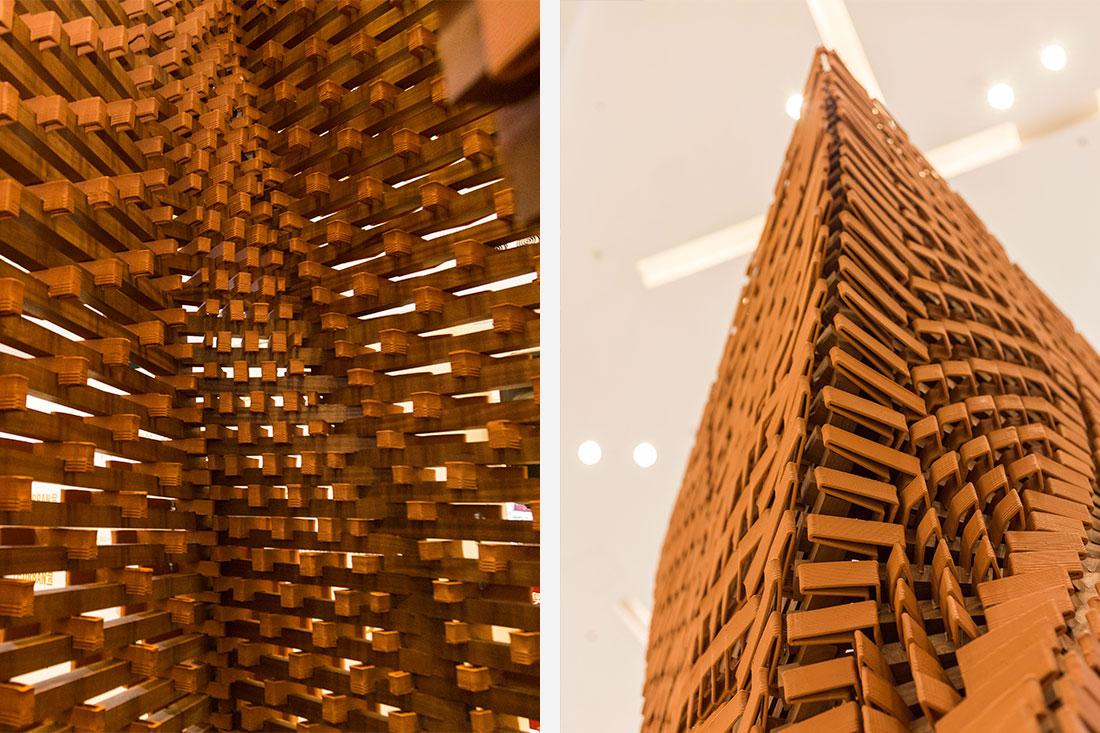
Property developer Sino Group and the Faculty of Architecture at the University of Hong Kong have collaborated to create an installation for the inaugural Sino Group Robotic Architecture Series.
The University’s Robotic Fabrication Lab created a structure made with robotically manufactured clay components as a means of revitalising interest in ceramic material systems for architecture. Clay was selected for its ready availability and its traditional significance in Asia.
“Robotic architecture will have a profound impact on construction as well as costs and efficiency in the decades to come. Facilitated by building information modelling, robotic application will give architects more control in the building construction process,” says Christian J Lange, Project Lead of the Robotic Fabrication Lab and Senior Lecturer at the Faculty of Architecture of the University of Hong Kong.
He continues, “Some architects are moving ahead from using robotic systems as reconfigurable spaces or ‘smart furniture’ to applying robotic fabrication to the design and construction of high-rise buildings. We hope that young architects can gain an exposure to this exciting technology and let their creativity shine through in architectural and building designs.”
Set up in February 2016 and fully fitted in October 2016, the Robotic Fabrication Lab of the HKUrbanLab (the Faculty of Architecture’s research arm) is the first specialised research centre in Hong Kong, leveraging robotics to invent, inspire and innovate building design.
The Sino Group Robotic Architecture Series will be on display at the North Atrium of Olympian City 2 in Hong Kong until 4 July 2017. Students will also host tutorials to explain the process of robotic architecture to the public. The students worked on the project under the tutelage of lecturers Donn Holohan, Holger Kehne and Christian J Lange.
“Robotic fabrication has the potential to achieve diversity while remaining efficient and cost-effective. We look forward to supporting the development of architecture in the age of digitalisation, virtualisation and computerization with the academia and industry players,” says Gordon Lee, Executive Director, Sino Group.
INDESIGN is on instagram
Follow @indesignlive
A searchable and comprehensive guide for specifying leading products and their suppliers
Keep up to date with the latest and greatest from our industry BFF's!
The internet never sleeps! Here's the stuff you might have missed