The home of architecture and design in the Asia-Pacific
Get the latest design news direct to your inbox!

Get the latest design news direct to your inbox!
Celebrated Japanese artist Ryoji Ikeda is returning to Sydney following the overwhelming success of his large scale sound and art installation at Carriageworks in 2013.
July 21st, 2015
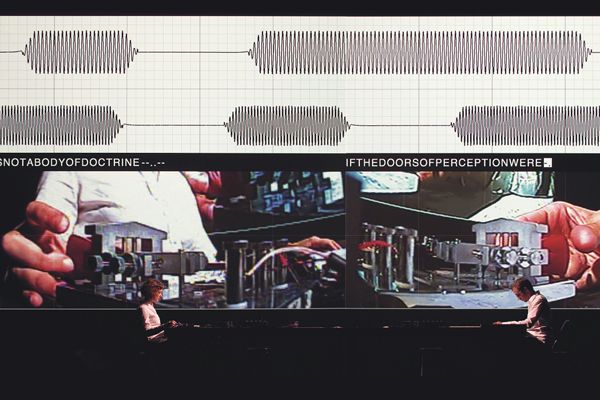
Making its Australian premiere 23 to 26 September 2015, superposition is a new digital and live performance experience. The 65 minutes multi-media work invites audiences into an immersive space where uncertainty and probability coexist.
Using a combination of 10 synchronised video screens, real-time content feeds, digital sound sculptures, and—for the first time in Ikeda’s work—human performers, superposition explores the conceptual world opened up by quantum theory. The two performers complement the wide range of video images. An abstract representation of digital data is created through the combination of sounds and visuals. Sine waves, visualisations of code in black and white, or sometimes primary colours, provoke the audience to question how they digest information in their daily life.
Ikeda attracted critical and popular acclaim, making front page headlines when he presented test pattern [N°5] at Carriageworks two years ago. He returns to Australia for the first time with this major new installation, superposition, which has attracted even further critical acclaim. It was crowned one of the Best Concerts of 2014 by The New York Times, who praised it for showcasing, “Mr. Ikeda’s strict, beautiful, high-contrast vocabulary of digital sound and design”.
Starting out as a sound artist, Ikeda uses scale, light, shade, volume, shadow, electronic sounds, and rhythm to flood the senses. In choreographing vast amounts of digital information, the artist conjures up a transformative environment in which visitors confront data on a scale that defies comprehension, experiencing the infinite.
“Of the many achievements at Carriageworks in recent years, we are especially proud to have introduced Sydney to the mastery of Ryoji Ikeda. His installation two years ago was a high point of contemporary art in this city in recent years,” said Carriageworks Director, Lisa Havilah. “Ryoji continues to fascinate audiences globally with his unique interpretations of mathematics, symmetry, design, light and sound. Part installation, part music performance, superposition is a remarkable feat of engineering and artistic ingenuity.”
INDESIGN is on instagram
Follow @indesignlive
A searchable and comprehensive guide for specifying leading products and their suppliers
Keep up to date with the latest and greatest from our industry BFF's!
Currently in its 38th year, entries to the Retail Design Institute’s (RDI) International Design Competition 2008 are now open. Entry is open to any contract design frim or in-house retail design team with projects completed from 2 November 2007 – 1 November 2008. Both RDI members and non-members may enter. There are four categorie: Department […]
The internet never sleeps! Here's the stuff you might have missed