The home of architecture and design in the Asia-Pacific
Get the latest design news direct to your inbox!

Get the latest design news direct to your inbox!
London Design Festival (LDF) has just finished and, with a number of programmes and exhibitions still running, Kate Goodwin reports on the highlights across the city.

The Natural Materials Lab, Muddy Stools, Material Matters 2024.
October 3rd, 2024
Having celebrated 20 years in 2022, LDF now occupies locations across the British capital with special commissions and pop-ups, studios and commercial showrooms. It is given cohesion through focused design districts, the most coherent of which is Brompton, curated by Jane Withers. The theme there this year is ‘The Practice of Learning’ and has both quality control and curatorial hierarchy. Meanwhile, the wondrous V&A has several strong commissions including new ones from young designers and two projects featured in my highlights below.
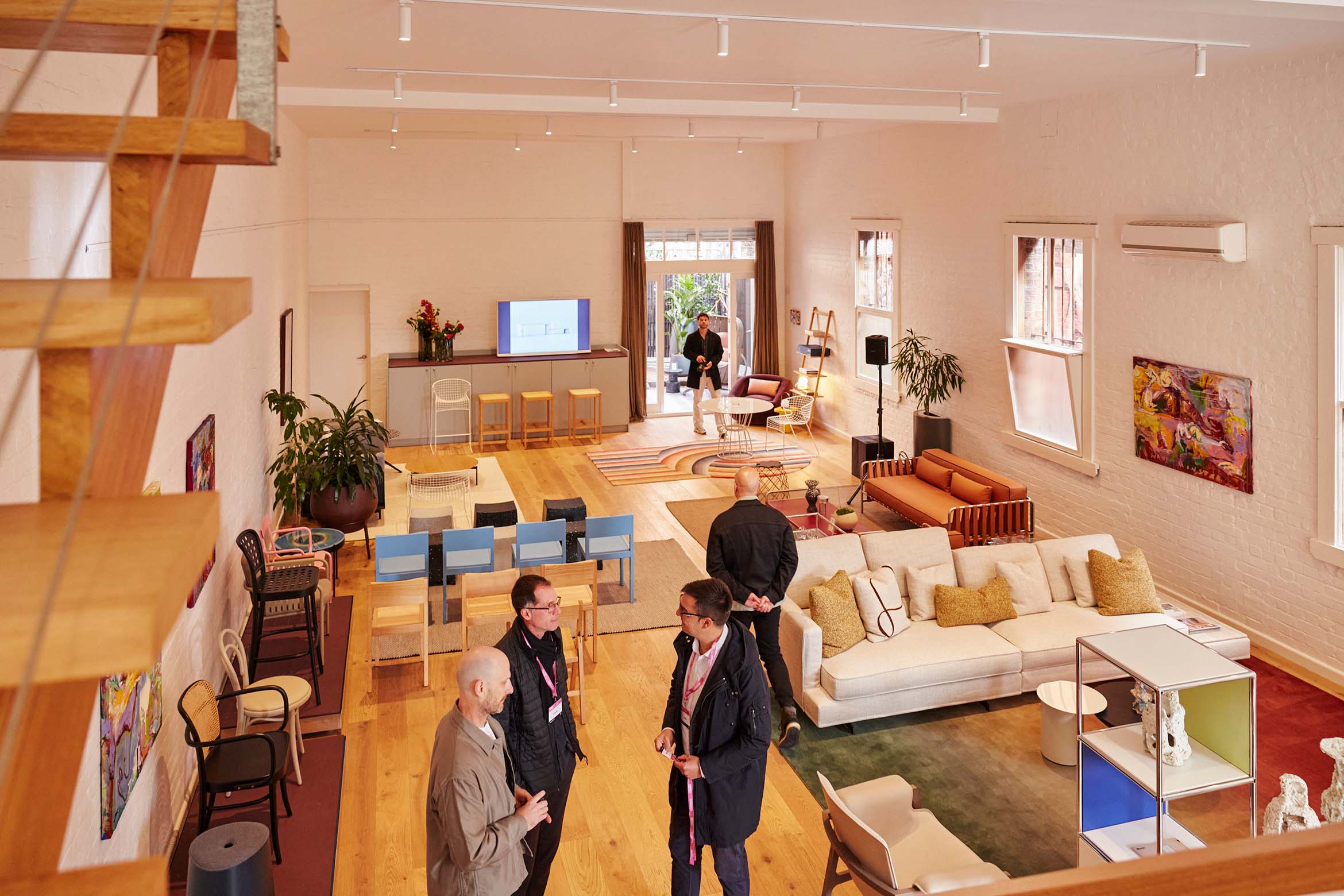
The sheer density of design showrooms around Shoreditch makes it a satisfying spot to explore, from classics such as SCP and Vitra to a new kid on the block: the Wax Building, a former Victorian factory that has been sensitively refurbished. The Material Matters fair in the Bargehouse, Oxo Tower Wharf, is filled to the brim with installations and pop-ups focusing on circular economies and material intelligences.

Across LDF, designers are proposing ways to think and live more sustainably, from supply chains to materials – and it’s all reflected in the products and the exhibition infrastructure to show them. So, here are some of the highlights from London.

Communion, Giles Tettey Nartey
At the V&A until 13th October.
Made from Maple wood, this communal table celebrates and reframes the making of ‘fufu’ – a Ghanaian staple food. The outer ring is imagined for the making process, containing dents, groves and bowls for pounding cassava and plantain with mortar (woduro) and pestle (woma) in a communal and performative act. The central table is intended for the serving and sharing of the meal. A fabulous film, with white robed bodies moving in rhythmic syncopation, creates a choreographed and collective performance of the everyday act.
Off The Shelf; Pavilion by Rio Kobayashi & Webb Yates
Olympia until 28 February 2025.
Of the pavilions, I found Off The Shelf was the most intellectually and materially pleasing. Created by artist and craftsperson Rio Kobayashi with engineers Webb Yates, it references the facades of the local buildings made of Portland stone and the traditional Japanese wooden homes of Kobayashi’s childhood.
Promoting circularity and an economy of means, the pavilion is constructed using off-the-shelf materials that have been weighted, clamped or pressed together, so it can be easily dismantled and its components reused. Lumps of Portland stone are purposefully tied with rope and form the ballast of the structure. It will host different programs for the next six months, including ‘On The Shelf,’ a talks and workshop programme, as well as an inaugural installation by artist and plant biologist Cynthia Fan until 7th October.

Tamart, Wax Building
Also in the Wax Building are Minimalux and LightMass^ (a new collection by Raw Edges).
Tamart is a new British design brand honouring the work a of the modernist architects and polymaths, Tamar de Shalit and Arthur Goldreich. Founded by their son architect Amos Goldreich, their new London space launches with an exhibition – ‘A Time Piece’ – featuring a recreation of a penthouse designed for Sir Charles Clore, along with beautiful drawings and archival material of the creative pair. Tamar’s mid-century designs were informed by an appreciation of Japanese crafts and are timeless. Working from the archive, but adding some new modern twists using sustainable materials, the brand launches three great collections that will be available in Australia from 2025.


Reading Room by Grymsdyke Farm
Material process and experimentation radiates from Reading Room in the slick Cromwell Place galleries. On display are a series of process-driven design objects that have come out of a four-week immersive, in-place making workshop at Grymsdyke Farm in Buckinghamshire, co-created by designers-tutors and students. Attua Aparicio works with different colours of clay to make planters by minimal intervention. Marco Campardo investigates unorthodox ways to use wax to create cast-glass vases. Studio Glithero conducts research into material spilling using plaster. Guan Lee, Grymsdyke’s founder, explores how wax used in bronze casting could become the thing cast.

Sori Yanagi Appreciation Society at Tokyobike
A Jasper Morrison quote in the wall text says it all – “the best designer you’ve never heard of.” An advocate for quality over quantity, Japanese industrial designer Sori Yanagi’s (1915-2011) utensils and products are so seamlessly and practically designed that they have integrated into our everyday lives. The exhibition at Tokyobike coincides with the launch of a book and the Sori Yanagi Appreciation Society, a platform sharing and valuing the life and work of this master. It makes one pause at the skill he employed to merge elements of traditional Japanese craft with industrial processes to create products that are simple and beautiful.

Highlights from Material Matters
‘Senseables’ Stackable chairs change colour in UV radiation by Crafting plastics, made from Nuatan, a biobased and biodegradable material. More than a gimmick, they highlight the vulnerability of the natural environment.
Creating a collection of fabulous objects, designers Inga Sempé, Max Lamb, Andreas Engesvik, Shane Schneck, Rachel Griffin, John Tree and Philippe Malouin transform Hydro CIRCAL 100R, the world’s first aluminium made entirely from recycled post-consumer scrap on an industrial scale.

Fibre Futures is an installation from BIOTEXFUTURE showing how material innovation is being used in the field of high-performance textiles. They challenge the textile value chain, providing alternative resource streams, innovative spinning techniques and bio-manufacturing.
The Muddy Stools, created by Columbia GSAPP’s Natural Materials Lab, conbine digital fabrication with waste materials, melding earth soils, plant fibres and animal manure.

Locally Grown – Studio Sanne Visser
The exhibition is supported by The Embassy of the Kingdom of the Netherlands and is co-curated with Company, Place.
The installation ‘Locally Grown’ by Studio Sanne Visser explores human hair as a scalable, hugely versatile and regenerative material. To one side of the room visitors have their hair cut, echoing a new pilot recycling hub HairCycle that collects waste hair from salons in located in East London. At the centre, hair is being spun and rope-making workshops are conducted. There are displays by nine other studios which have been invited to experiment with integrating hair rope into their products and projects. A special highlight came from Bio Crafted, who are testing hair as an alternative to plastic rope in the rebuilding of coral reefs in French Polynesia by a group called Coral Gardners.


Barricade and Beacon by Studio Bark
Launched with LDF but continuing until February 2025, Barricade and Beacon is also at the V&A. Bringing together architecture and activism demonstrates the role architects, designers and citizens can play in lobbying for change. The display features two protest structures designed in 2019/2020 for Extinction Rebellion. The ‘Barricade’ is a modular box system created by U-Build and Studio Bark that also includes a hole through which arms can link forming a human barrier; ‘Beacons’ is a bamboo tensegrity towers designed for rapid deployment and occupying space in civil resistance. A film shows them in use in recent protest actions.

Sowden Maxi Club Armchair
The Sowden Maxi Club Armchair is part of ‘The Heart of the Matter,’ a showcase of designers at SCP aiming at simplicity, bold colours and making form natural and reused materials. British industrial designer George Sowden was one of the founding members of the Memphis Group, and has produced an eye-catching new range.
The Max Club Armchair, available in two colour palettes, stood out for its bold and uncompromising postmodernism, a once-shunned style that is having a revival. There was also a Wing Chair with a high back that would be a statement piece in the right setting.

Kate Goodwin is an independent architecture curator, critic and educator. She works with architects, artists and cultural institutions on experience and place-making. She is a founder of the platform ‘Architecture Amplified,’ a member of the Tin Sheds Gallery Advisory Board, Adjunct Professor and former Professor of Practice (2020-23) at the University of Sydney. She is a recipient of a Byera Hadley Travel Fellowship, studying the architecture of Aboriginal art centres in the Northern Territory. For 17 years as Heinz Curator and Head of Architecture at the Royal Academy of Arts in London, she directed the public-facing activities that promote a broad engagement with architecture.
London Design Festival
londondesignfestival.com
INDESIGN is on instagram
Follow @indesignlive
A searchable and comprehensive guide for specifying leading products and their suppliers
Keep up to date with the latest and greatest from our industry BFF's!
The internet never sleeps! Here's the stuff you might have missed