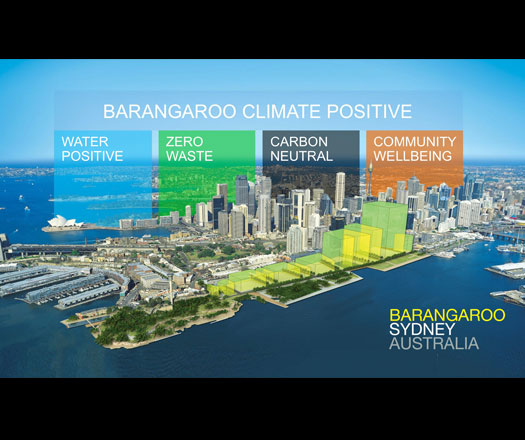
The Barangaroo project in Sydney will produce no waste and more energy and water than it uses.
November 3rd, 2009
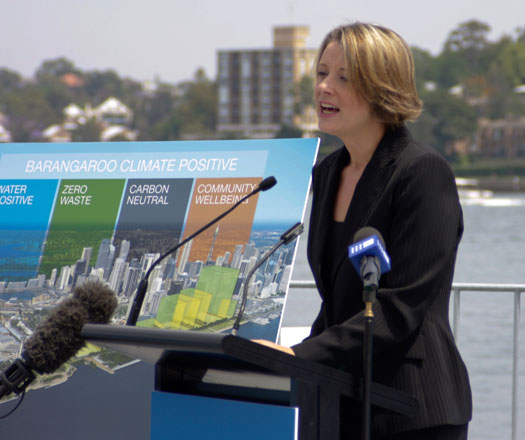
Yesterday NSW Planning Minister Kristina Keneally announced that Sydney’s Barangaroo redevelopment would be one of 16 CBD developments globally work with the Climate Positive Development Program.
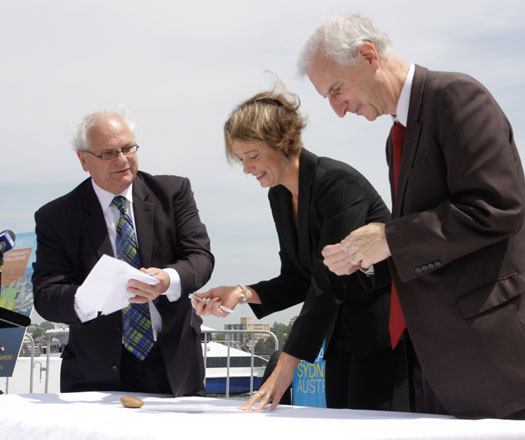
Signing an agreement with the Clinton Climate Initiative (CCI), Keneally has committed the project to becoming one of the first in the world to have a “postive ecological and social footprint”, saying: “Barangaroo will be one of the first CBD districts in the world to be carbon neutral, water positive and generate zero waste.”’¨’¨
Chairman of the Clinton Climate Initiative, Ira Magaziner, said: “I congratulate Barangaroo on its vision and approach in creating a property development that will minimize its environmental impact.”
“By participating in the Climate Positive Program, Barangaroo will help to set new standards in urban development and hopefully inspire other developments across Sydney and the world to follow.”
Stage one of the controversial 22-hectare commercial, residential and public space development on Sydney’s foreshore will cost around $3 billion with a private partner to be announced early next year.
Launched in May this year, the Clinton Climate Initiative is a program of the William J. Clinton Foundation and aims to “create and advance solutions to the core issues driving climate change”. Climate Positive aims to support development of large urban projects to reduce their impact upon the environment, namely through CO2 reduction.
Barangaroo
barangaroo.com
Clinton Foundation
clintonfoundation.org
INDESIGN is on instagram
Follow @indesignlive
A searchable and comprehensive guide for specifying leading products and their suppliers
Keep up to date with the latest and greatest from our industry BFF's!
Stepping into Intuit’s Sydney workplace certainly doesn’t feel like walking into an office. Why? In this film, we discover that, when joy takes precedence as a design driver, even a high-performing commercial CBD headquarters can feel like an intuitive wonderland that invites employees to choose their own adventure.
The Geelong College’s Sport and Wellbeing Centre ‘Belerren’ designed by Wardle is designed around bringing in natural light. But Shade Factor’s job was to help modulate and precisely control it for the most important competitive moments.
Blending versatile cooking with smart performance, Bosch AccentLine appliances bring a quieter sense of order and simplicity to the modern kitchen.
In the last instalment of our three-part performance seating series, Alex Bain from Architectus explains why sitting well shouldn’t feel like sitting at all and explores an unexpected success metric of the hybrid workplace: the grounding power of emotional support.
With the help of Woods Bagot, the Goodman Group has moved to The Hayesbery, a new headquarters more fitting of its essence and sustainable commitments.
It’s unstructured, complex and fluid – how do we begin to define hybrid, so that we might ‘design’ to it? James Calder of Calder Consultants frames the challenge.
Going out into solo practice and running a business is not something architects and designers get taught at uni. Creating a brains trust during the Design Entrepreneur seminar session at FRONT, these are the key takeaways for anyone looking to go out on their own.
The internet never sleeps! Here's the stuff you might have missed

A recent Design Talk Series event presented by Royal Oak Floors saw Melbourne-based interior designer, and founder and principal of Mim Design, Miriam Fanning in live conversation with our editor.
Drawing at a young age gave Angelene Chan an appreciation for architecture and provided the impetus to propel her to the top of her profession.
Adelaide Design Week returns in October 2026 with the theme every*one, inviting designers, makers, studios, collectives and creative thinkers to submit expressions of interest.
Melbourne-based architect and object maker Adam Markowitz blurs the line between design and craft, bringing a deeply considered, material-led approach to his work. As both a practising architect and furniture designer, Markowitz explores how objects can respond to space, light and human use.