The home of architecture and design in the Asia-Pacific
Get the latest design news direct to your inbox!

Get the latest design news direct to your inbox!
Yerrabingin CEO Christian Hampson on how the concept is maturing and the overlap with fundamental design principles, as well as some pitfalls to avoid.

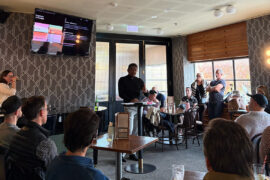
Christian Hampson, photo by Jessica Lindsay.

January 23rd, 2025
There’s a tension in the discourse surrounding designing with, caring for and healing Country. On one hand, there’s a critical need to educate and make changes as we comprehend the importance of the built environment in addressing questions of Country, reconciliation and postcolonial justice. On the other, however, there’s a sense that designing with Country, on one level, simply means good design – that it’s what designers already know and ought to be practising, but are often prevented from doing so due to structural and economic reasons. Collaboration, shared knowledge, public good, anti-anthropocentrism, community, care for the natural environment, custodianship of place – these are all close to axiomatic in architecture circles, so how are we to bring Country into the debate most fruitfully?
Christian Hampson is the CEO and co-founder of Aboriginal-owned design practice Yerrabingin, and he says that “the way that we’ve looked at our contribution to the design space [is about] reciprocal contribution to Country. We’ve always said that [there is an opportunity] in each project for contribution to Country, but then also involving Country to create design influence and innovation. And those two things should be equal. So, we ask: What type of legacy can a project create? How can custodianship be not just about Aboriginal custodianship but also people’s participation and contribution to place?”
The mention of custodianship goes to the heart of the matter. It’s a concept that implies ongoing care of something bigger than the individual, a sense of stewardship rather than exploitation or extraction. For many – indeed, probably most – architects, this kind of attitude is what drew them toward the field in the first place. Architects and landscape designers speak increasingly about the importance of holistic understandings of place, of community and the public good, and of the interconnectedness nature, ecology and the built environment.

“How can a project support, empower and create platforms for Aboriginal community participation in place? There are lots of opportunities for that in built form, landscape form, and how that can actually activate a place for their involvement,” says Hampson, who asserts that an active role as custodian can – and should – take different forms. “It can be of varying levels and it can change over time. When we talk about acknowledgement being a design principle, we’re actually trying to open that up to all cultures. It’s a lovely way for people to connect… which can create custodian models [that differ] depending on what the project is,” he adds.
So, designing with Country is broadly about care, custodianship, reciprocity, diversity and interconnectedness. What, then, is it not? What kinds of approaches to design threaten harm to Country?
To answer this, Hampson turns to the ways in which knowledge, attitudes and approaches are constantly evolving. “It’s an interesting comparison with [the concept of] sustainability – it took a generation before it became a fundamental approach,” he notes. In more concrete terms, he explains that one of the key dangers is bringing in considerations of Country too late in the design process. The approach needs to be there from the very early concept stages, rather than as an afterthought.
Related: Balarinji on designing with Country

Similarly, restricting Country in design to limited and often surface-level additions such as a mural or even a place name can become tokenistic. Returning to the fundamental tension mentioned above, it’s really about Country being an ever-present pillar of the design process rather than something added separately. Another example is the tendency to reach for ‘endemic’ planting in landscape design; instead, Hampson asserts that designing with Country is a living process that must deal with the world as it exists today. It’s not, he says, about Romantically recreating a past but actually about ensuring that the live ingredients of the present are engaged in a spirit of reciprocity, diversity and care.
Hampson’s idea of designing with Country sees it as a living, dynamic part of the design process in Australia. It’s certainly not a passive, sentimental consideration frozen in the past. “We need to be taking knowledge to work with others and create things that work rather than thinking about recreating a particular time,” he says. “That’s what I think designing for Country is about – design excellence and innovation.”

Hampson explains some of the cross-cultural experience that informs Yerrabingin’s approach: “Recently we’ve work with other First Nations designers from other countries and it’s really interesting that there is a component that obviously sits in a cultural space, which is about where cultural information is brought in. I think we’re moving more towards being involved in transformational ideas. They’re not things that are placed on them, but it actually feels like that they are creating space that culture can be drawn into in many different ways.”
“So, we’re doing work with really good friends who are Māori, Sámi and Maasai architects, for example. It’s really interesting that there is almost this fundamental framework that is exactly the same, but it’s just that we’re trying to empower space [to which] our cultural, ecological knowledge can contribute. I think that is probably something that’s going to mature more.”
“The skills that professional designers have can really create amazing outcomes for communities.”
Yerrabingin
yerrabingin.com.au

INDESIGN is on instagram
Follow @indesignlive
A searchable and comprehensive guide for specifying leading products and their suppliers
Keep up to date with the latest and greatest from our industry BFF's!
The internet never sleeps! Here's the stuff you might have missed