The home of architecture and design in the Asia-Pacific
Get the latest design news direct to your inbox!

Get the latest design news direct to your inbox!
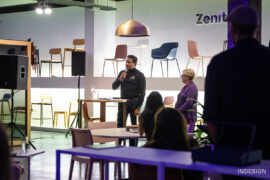
At a glittering event at the DKO studio in Melbourne, the launch of a new book was celebrated with champagne and cheers.


December 12th, 2024
A singular Australian practice has at last been recognised: the story of Grounds, Romberg & Boyd, as recorded by author Maria Larkins, can now be explored in print. Published by Uro Publications with a foreword by DKO’s Koos de Keijzer, this book explores the practice, breaks new ground and is a must-read for every architect and aficionado of design.
When it comes to Australian modernism, the names of Sir Roy Grounds, Frederick Romberg and Robin Boyd certainly might spring to mind, but the practice that combined these great design minds may not be so familiar. Grounds, Romberg & Boyd: Melbourne’s Midcentury Modernists by Maria Larkins tells the story of this influential architectural practice (1953-1962) — from its founding to the creation of many significant works of Australian architecture, and then its collapse after just shy of a decade in operation.
One point of difference that sets this book apart from most architectural histories is its focus on correspondence between the directors, rather than simply buildings.

After a career in newspapers, the book’s author worked from 2004 to 2017 in media relations for architecture practices including LAB Architecture Studio and Kerstin Thompson Architects. This background in journalism might have something to do with Larkins’ focus on the personalities of the directors, their relationship and the period details that defined daily working life for the trio. She captures all of this largely from their written correspondence with one another.
And so, to give one example, in chapter eight, we find a note from Romberg to Boyd, complaining of what he called ‘goatsplay and loafing’ in the main drawing office. To quote from the note:
… for some weeks when passing through the main drawing office, I have observed the following: constant talk in smaller or larger groups; plenty of jokes flying about; general merry-making. On no occasion, at any time, was there full occupancy on the drawing boards, frequently not a single board in operation.

Boyd didn’t appreciate the criticism and responded on the same day, in the same manner — via handwritten note:
Once you used to criticise me for despairing of all employees, expecting too much, too fast, of them. Now that I have at last a team working happily with me you accuse them and me for being too happy.

Nevertheless, Boyd goes on to suggest that ‘martial law’ could be implemented to put a stop to the merry-making, and also ‘time clocks’ for the troublemakers — one of whom he identifies as none other than Graeme Gunn, future Member of the Order of Australia and AIA Gold Medalist.
Related: New Indesign podcast!

It has to be said, Boyd’s law can’t have been too martial — a few pages later, there is a memo on overtime from Boyd to the drawing office:
Mr. Romberg should be informed before 5pm of intention to work overtime any evening. Any beer-drinking in the office should not extend beyond 6.30pm, whether or not overtime is being worked.

This is not your conventional architecture monograph, or even architectural history. It’s very readable, to begin with, but it’s also primarily not a story about buildings — even though the practice had a hand in many well-known examples in Melbourne, not least the National Gallery of Victoria.
More than anything, this is a story about people, their relationships, and how those relationships underpin practice and ultimately build our cities. (It doesn’t hurt, either, that the three protagonists are among the most talented and distinctive personalities to grace Melbourne last century).
Published by Uro, the book can be purchased here.
Bookshop by Uro
bookshopbyuro.com
Photography
Courtesy Uro Publications


INDESIGN is on instagram
Follow @indesignlive
A searchable and comprehensive guide for specifying leading products and their suppliers
Keep up to date with the latest and greatest from our industry BFF's!
The internet never sleeps! Here's the stuff you might have missed