The home of architecture and design in the Asia-Pacific
Get the latest design news direct to your inbox!

Get the latest design news direct to your inbox!
In this Q&A from INDESIGN #88, we spoke to INDE.Awards winners Balarinji about Indigenous design and more.

February 12th, 2024
This article originally appeared in INDESIGN #88, the ‘Education Outlook’ issue – get your copy here.
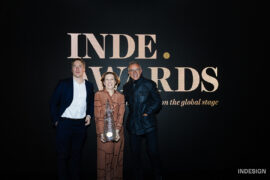
Answers by Yanyuwa man John Moriarty AM, Co-Founder, Chair and Cultural Director of Balarinji and Ros Moriarty, Co-Founder, Creative Executive and Managing Director of Balarinji. The practice won in The Design Studio category at the 2022 INDE.Awards.
Indesign: When Balarinji first started out over 40 years ago, what was the vision for the company? Does it remain the same today, or has that evolved, with the rapidly changing times?
Initially our vision was to celebrate the Yanyuwa heritage and identity of our children. Over time we realised that our family’s personal identity journey could resonate with Australia’s broader search for a unique belonging in the world.
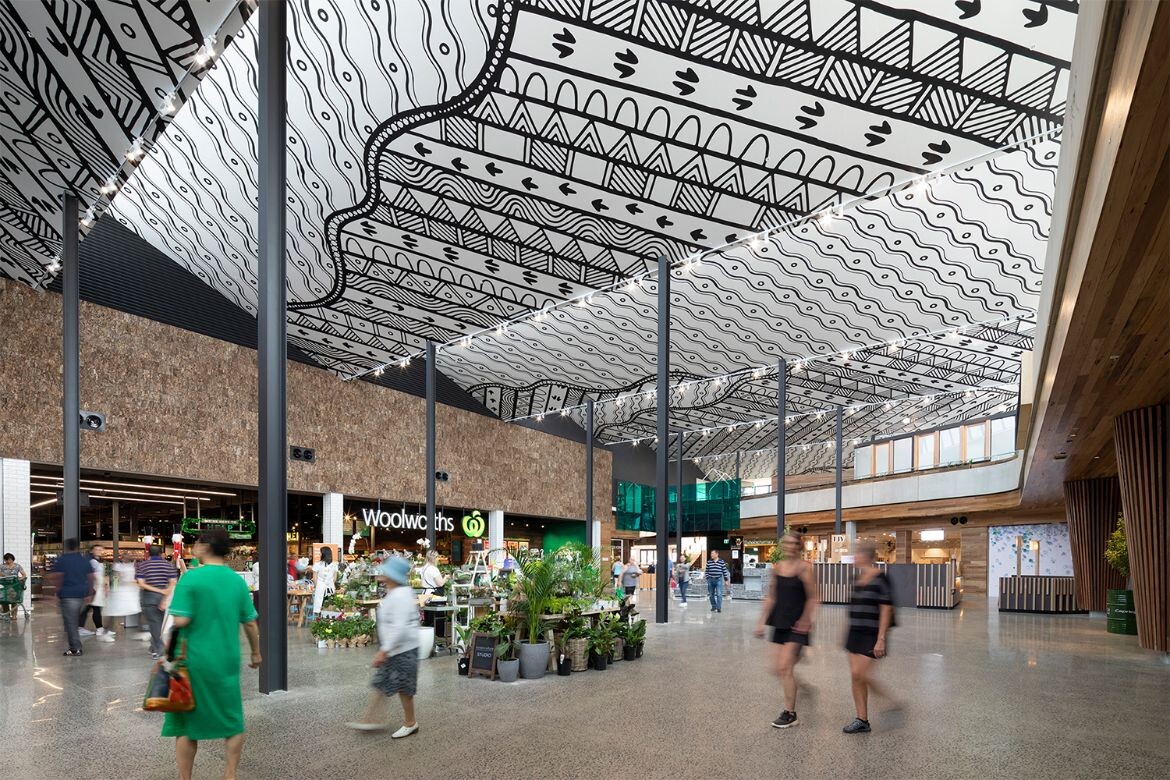
Our vision grew and strengthened as our business evolved. We started in textiles, fashion and homewares, then added graphic design, public art and landmark projects for large government and private organisations nationally and internationally. We now focus our efforts on significant brand and identity campaigns, and deeply embedded responses to the built environment and major infrastructure.

Can you describe one or two milestone moments? What did they lead to?
The Qantas-Balarinji Wunala Dreaming 747 art aircraft was a turning point. It took 18 months of lobbying and an impromptu pitch in an elevator to then CEO James Strong before it launched in 1994. It was intended to be a three-month promotion, but the joy and recognition the aircraft inspired kept her in the sky, including a repaint, for 17 years. It was euphoric for us to see Wunala Dreaming fly. Our nation that had taken John away from his family as a Stolen Generations child when he was four years old was now heralding his culture all around the globe.
Wunala Dreaming was the start of an ongoing collaboration with Qantas, adding Nalanji Dreaming (1995), Yananyi Dreaming (2002) with the art of Rene Kulitja, Mendoowoorrji (2013) with Paddy Bedford, and Emily Kame Kngwarreye (2018), named for the artist.
The Qantas-Balarinji collection of art aircraft has become a powerful acknowledgment and celebration of Australian identity on the global stage. These flying artworks are a great example of how Indigenous design can influence how we think about ourselves as Australians and how we can draw from the strength, integrity and beauty of Aboriginal culture.


What do you see as being the role and opportunity for architects and designers in activating local Aboriginal narratives through masterplanning and the built environment?
Australia’s foundational Aboriginal narrative offers an original frame of thinking for masterplanning and the built environment, but it’s largely been missing from our public spaces. It comes from a different worldview that is layered, complex and holistic. Aboriginal society, sustainability and ways of connecting with Country are a distinctive and rich founding narrative for all of us as Australians.
Imagery, story, philosophy, intellectual framing, language – the incredible sources of inspiration are both an opportunity and a responsibility. The responsibility lies in bringing Aboriginal people who are local to Place to the centre of the co-design process. Then we can activate authentic voice to draw out knowledge, protocols, history, culture and the contemporary stories of Aboriginal communities, for co-designed interpretation from the beginning to the end of projects.
There is much for everyone to learn from the deep, interconnected relationship Aboriginal people have with the physical and spiritual elements of Country. It is about belonging, where language, culture, knowledge, Dreaming, Law, and Ceremony are interdependent and one with Country.
Related: Revisiting the INDE.Award win!

What do you think are the roadblocks or challenges we must still overcome as we continue to embed Aboriginal culture and sensibilities into our national identity?
Aboriginal knowledge cannot be taken in theoretically or without collaboration, deep engagement, and co-design with locally connected Aboriginal stakeholders. Aboriginal and Torres Strait Islander people rightly expect an evolution away from typical approaches to integrating Aboriginal culture and knowledge into built projects that are a reflection on, rather than truly in partnership with, Aboriginal people.
It is still far more usual to see Aboriginal elements as art installations or referencing native plantings in landscape design. There are very few architectural examples that have been deeply informed by the Aboriginal worldview, as it has rarely been considered relevant or important for contemporary urban developments.
It takes committed clients, curious design teams and new paradigms and project processes in order to lift the roadblocks to making Australia’s founding Indigenous narrative more visible. This visibility is necessary if bridges are to be built for a richer, shared Australian identity that celebrates our unique place in the world.
Find out more about INDESIGN #88 and susbcribe here!
Balarinji
balarinji.com.au


INDESIGN is on instagram
Follow @indesignlive
A searchable and comprehensive guide for specifying leading products and their suppliers
Keep up to date with the latest and greatest from our industry BFF's!
The internet never sleeps! Here's the stuff you might have missed