The home of architecture and design in the Asia-Pacific
Get the latest design news direct to your inbox!

Get the latest design news direct to your inbox!
Relocating the Royal Australian Air Force’s (RAAF) College for the Officer Training School (OTS) was a hard task made easy by Logical Commercial Interiors.
April 3rd, 2008
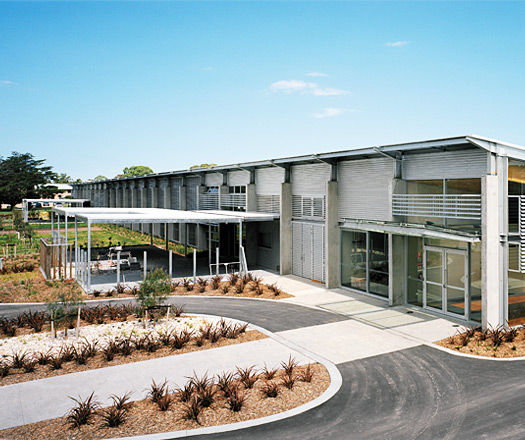
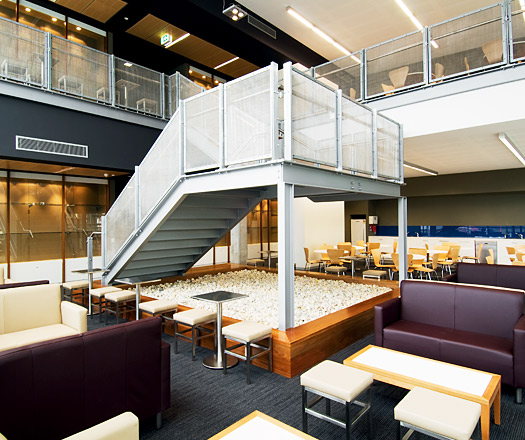
When parliamentary clearance was given to the Defence Services Group, Infrastructure Asset Development Organisation (DSG IAD) in 2005 to relocate the Royal Australian Air Force’s (RAAF) College for the Officer Training School (OTS) from RAAF Base Williams, located at Point Cook, to RAAF Base East Sale, in Victoria in 2005, and to relocate the Recruit Training Unit from RAAF Base Edinburgh, (SA) to RAAF Base Wagga Wagga, (NSW) simultaneously; an enormous task was ahead. The brief was to build facilities for the training, lecturing, dining, and accommodation, of up to 120 officers and 60 staff at any one time within each facility.
The planning and design phase of the new facilities was only the beginning. Once the buildings were under construction the magnitude of the next step – specifying, sourcing procuring and installing the furniture, fittings, and equipment, became apparent. If this wasn’t challenging enough, the tender, awarded to Logical Commercial Interiors in August 2007, called for the job to be completed by Christmas 2007 with the first intake of students and recruits scheduled for January 2008. This four-month deadline was a problematical constraint, one which required serious planning in conjunction with the project stakeholders if they were to achieve the best results with these resolute deadlines.
Donia Melnyk, Managing Director of Logical Commercial Interiors (LCI) was enthusiastic about the project and quickly set about producing a plan for the project’s Managing Contractor, Thiess. Melnyk’s experience, in conjunction with assistance from the project stakeholders, guaranteed that the procurement of everything – from waste bins, beds, to washing machines, office furniture, and even sword trolleys – was completed to brief. Which was “to supply robust, functional and cost effective product, with a short lead-time”. The sourcing and manufacturing of sword trolley’s turned out to be the biggest challenge. Melnyk visited and discussed this element of the project with 23 different manufacturers before finally being able to deliver a set of trolleys that ensured the safe storage of weapons.
Following sign-off on the selection furniture with project stakeholders, Melnyk moved on-site to make certain that products arrived from suppliers on time and to manage the installation. A Quality Assurance program was managed effectively in conjunction with Thiess, ensuring immediate resolution and close out of defects prior to project completion.
Logical Commercial Interiors (LCI) provided peace of mind for Thiess and the RAAF College Relocation Project Stakeholders, and has extended their successful track record with this project. Proving that bigger is not always the better choice when it comes to getting the job done. In spite of numerous challenges, LCI met the brief, ensuring DSG IAD delivered its project to their end user stakeholders, RAAF College, with “100% of the package [supplied] on time, and for 80% of the budget”.
Logical Commercial Interiors
(61 2) 9568 2579
donia@lci.com.au
www.lci.com.au
INDESIGN is on instagram
Follow @indesignlive
A searchable and comprehensive guide for specifying leading products and their suppliers
Keep up to date with the latest and greatest from our industry BFF's!
Celebrating the best of Australian and International design, the shortlist for the 2010 Australian International Design Awards has been announced. Amongst this year’s entries are an eclectic range of leisure and functional items, including a re-usable coffee cup, playground swing equipment, fire retardant underwear and high tech medical instruments. Presented by Standards Australia, the AIDA […]
The team at More Space magazine were kind enough to share this video with us – a sneak peek behind the scenes with Tokujin Yoshioka and his team during the installation of his latest exhibition, Waterfall, on display at Sydney’s Sherman Contemporary Art Foundation until 17 December.
The internet never sleeps! Here's the stuff you might have missed