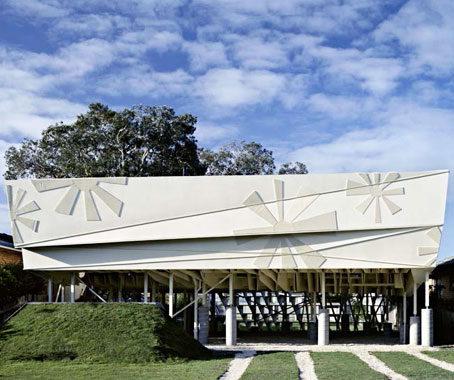
The work of New York-based SYSTEMarchitects focuses not only on new ways of looking at everyday living concepts, but also on innovative ways of on-site construction.
The practice’s portfolio ranges from a funky take on a homeless shelter (below) to Burst* House (above), a family residence built on the East Coast of Australia.
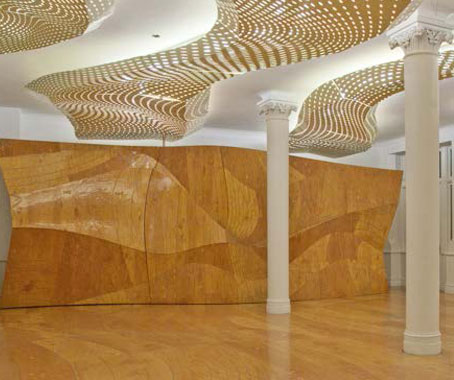
AaShelter – Jeremy Edmiston, Robert Baker, Charles Kwan, Hui Jin
Burst*’s structural elements were digitally pre-cut off site.
Winning the Wilkinson Award for Residential Architecture in 2006, it illustrated how technology is allowing architects to reconsider the building process to minimise the carbon footprint both on and off site.
“All architecture requires innovation, specific to the project. The exact conditions of any project can be quite unpredictable,” says Jeremy Edmiston, principal of SYSTEMarchitects.
Edmiston believes there are immense advantages in digital pre-fabrication, as it allows for accurate cutting of construction material, reducing on-site waste dramatically, as well as allowing for quality control.
“It allows for ideas to be built which were once thought almost impossible in terms of time, cost and geometry,” Edmiston explains.
The aim of SYSTEMarchitects, Edmiston says, is to create relevant designs that respond to current issues – such as sustainability, which fosters an active community of architects.
“Many users are asking us to consider the relationship between what we do and nature in a way that pays attention to the ongoing quality of the planet. Exciting, no?” asks Edmiston.
He believes that the first objective of architecture has always been for the work to connect with the culture and the users of today.
“Architects have always addressed the natural environment, its potentials and its limits. Bernini’s church in Rome is still being used to this day, 400 years or so later. How much more sustainable can a building be?”
Hero image: Burst* House: BURST*003 SYSTEMarchitects with Douglas Gauthier. Photo by floto+warner
SYSTEMarchitects
systemarchitects.net