The home of architecture and design in the Asia-Pacific
Get the latest design news direct to your inbox!

Get the latest design news direct to your inbox!
Architect Sasha Ivanovich reports from Dubai’s sustainability Forum.
January 25th, 2010
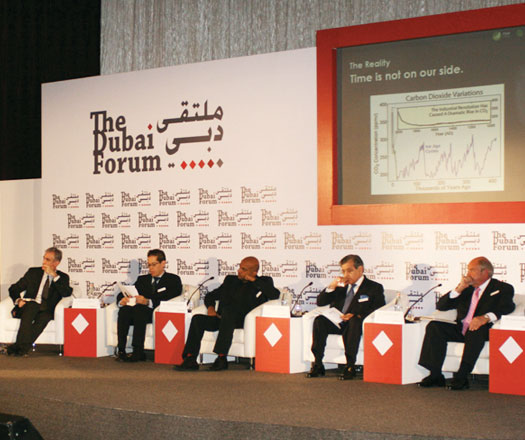
On 4 January 2010 the tallest building in the world was officially opened. The next day, the Dubai Forum, a global conference on architecture for sustainable societies also took place.
The one-day conference presented a snapshot of diverse sustainable practices and global indicators from a wide range of experts and practitioners.
Architects, urbanists, developers, journalists, architectural critics and social activists shared the rostrum over five seven-member panels, which ignited issues of emerging strategy, methodologies and working examples towards a sustainable society:
From India Dr Sunita Kohli (architect) and Romesh Chopra (Civic Activist) brought attention to long established urban design and social practices dealing with extreme climate and dense population, whilst Dr Illac A. Diaz introduced us to the alarming flooding issues becoming prevalent in numerous settlements across the Philippines.
Dr. Tom Bentley (UK) spoke about new edible plant growing practices in confined and controlled environments, whilst Paul S. Sochaczewski (Thailand) introduced the modern city/suburb icon – the golf course – as a green and water reservoir interchange.
Fari Hatam (architect, Dubai) gave an example of traditional cultural adaptation with his Dubai mosque project whilst Prof Michael Sorkin (architect, USA) offered his practices in urban greening sustainability conversion projects, bringing to attention Dubai’s carbon footprint, at the top of the global chart.
The discussion on extreme climates offered an opportunity for me to present our work in design for climate in the extreme north of Western Australia requiring low cost outputs, prefabrication and transport over 4000km.
On Dubai
Delegates were treated to a coach tour of Dubai, complete with architectural commentary and the opportunity to see within the ocean of Dubai sky grappling towers, some of the best Dubai’s first and most recent architectural heritage, Dubai’s (artificially created) Palm Islands resort villas, the new rapid transit monorail (in operation), a glimpse Dubai indoor ski resort, Dubai’s canal exquisitely manicured waterside parks and Burj Dubai – the just completed, tallest (820m) building in the world.
The tour gave much food for thought on the meteoric rise of Dubai – population rise from one million to five million in 20 years – its car dominated cityscape linking vast indoor commercial centres and for this city, perched on the edge of a sandy desert and a climate yielding over 40 degrees of temperature for most of the year, the question of sustainability.
Our concerns were substantially washed away the night before the conference. It was the official opening of Burj Dubai, to which the delegates were official guests.
We had misgivings about a city evidently composed of office and apartment towers shopping malls and hotels, its mix of inhabitants – transient workers, expats and native Dubais – scarcely seen but in the interiors of shopping malls and hotels.
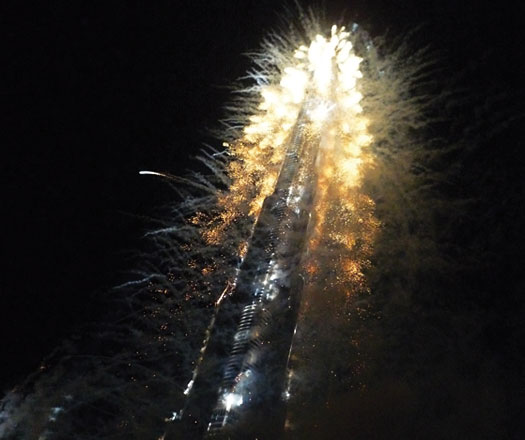
Those concerns vanished in the three hours before a memorable vision – Burj Dubai exploding in a show of light and sound.
Set in a circle of lakes and dancing fountains synched to sound and light, attended by a constellation of comparatively short illuminated city towers, the Burj’s chameleon-like glass facade pulsated in rhythm before tens of thousands Dubai inhabitants of all ages.
Filled with people, the Burj Dubai plazas and fountains acquired purpose and the perfectly crafted skyscraper achieved transcendent meaning.
Leaving behind that critical mindset – with its concerns and mundane issues of cost, utility and comparative value – for a shared moment with thousands of fellow human beings we experienced a living symbol – the best of man, crafted, touching the stars.
Sasha Ivanovich
siaarchitects.com
INDESIGN is on instagram
Follow @indesignlive
A searchable and comprehensive guide for specifying leading products and their suppliers
Keep up to date with the latest and greatest from our industry BFF's!
The internet never sleeps! Here's the stuff you might have missed