The home of architecture and design in the Asia-Pacific
Get the latest design news direct to your inbox!

Get the latest design news direct to your inbox!
In Jakarta, Denton Corker Marshall has created a new powerful landmark and symbol for Australia. Yvonne Xu writes.

July 14th, 2016
Like traditional embassy buildings that are fortress-like and grand in stateliness, the architecture of the Australian Embassy in Jakarta impresses with a powerful, monumental presence. It was designed to evoke popular Australian landform images such as Uluru, or, perhaps more fittingly – Kata Tjuta, a group of large stone rock formation whose Aboriginal name means ‘many heads’.

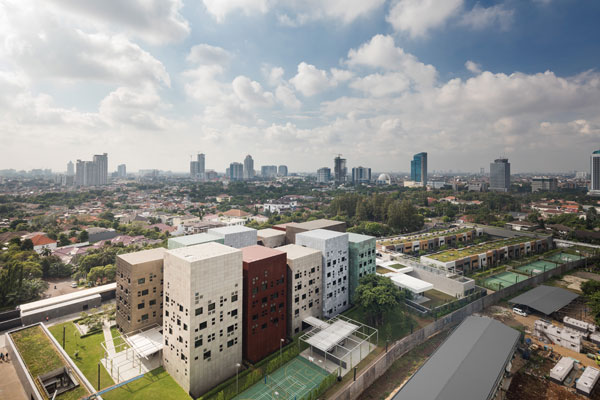
The new embassy is a complex comprising a Chancery, a Head of Mission Residence, 32 staff accommodation units, and medical and recreational facilities. Dominating the site is Chancery, an otherwise monolithic form cut into a series of 12 cubic volumes or ‘billets’ rising from land.
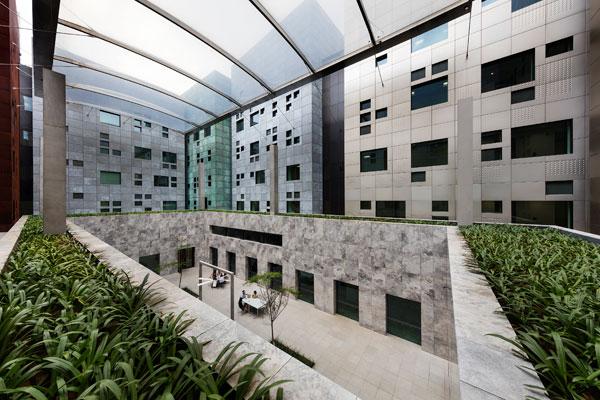
“The Chancery footprint is necessarily large and it is physically and conceptually the dominant building on the site. Nonetheless, the mass of the Chancery is broken down into a series of cubic volumes in order to provide articulation and human scale to what could otherwise be an overwhelming presence,” a representative of Denton Corker Marshall shares. “Breaking down the large bulk of the Chancery [also] helps to mediate between the high-rise buildings at the back and the low-rise residential buildings around the Embassy compound.”
Internally the 12 volumes are interconnected and a central courtyard offers light to the buildings through rectilinear windows. Each of the volumes is clad in a different metal including zinc, copper, brass, steel, and aluminium – metals all mined in Australia to reflect the country’s natural resources and mineral wealth. The buildings’ metal skins are debossed, textured surfaces, giving further variation to the building volumes.
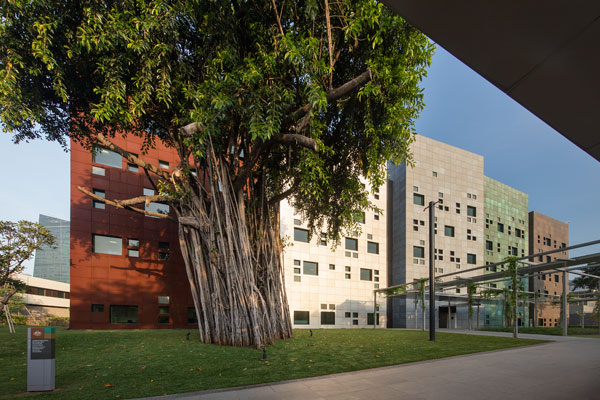
While the pure geometry of the Chancery gives the embassy building a confident clarity and legibility within its urban context, the rectilinear form is also applied as a leitmotif throughout the design concept. Apart from the building form and features, it can be seen in the furniture and even in the signage within the compound.
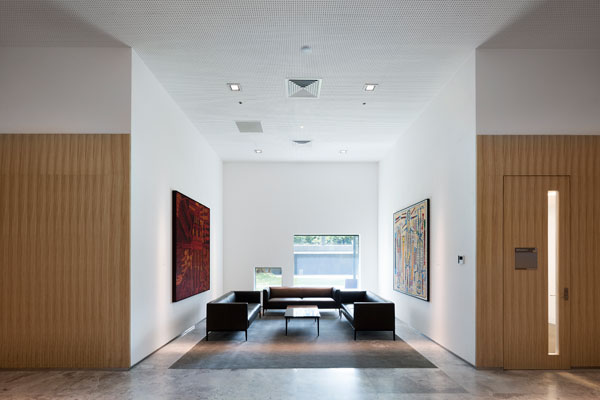
Denton Corker Marshall explains that the rectilinear form is a metaphoric representation of the Australian character. It says the attributes include it being uncomplicated, direct, unequivocal and confident.
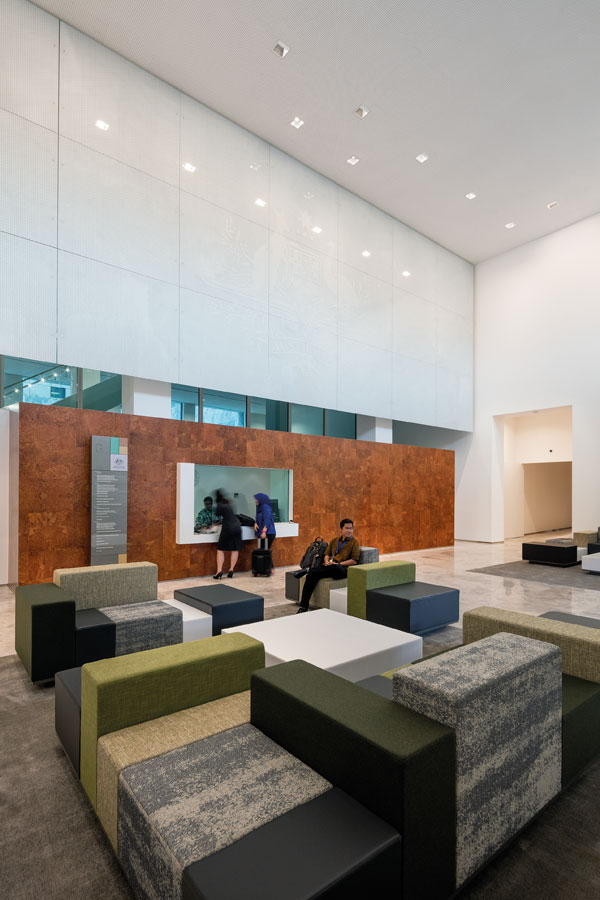
The language of the new embassy building is clear, dignified of its typology but also powerful because of an overall coherent execution. For instance, the custom designed furniture in the Chancery lobby is grouped formationally and therefore, again, evocative of the land references. Its colours and textures were also culled from the Australian bush.
Denton Corker Marshall
dentoncorkermarshall.com
INDESIGN is on instagram
Follow @indesignlive
A searchable and comprehensive guide for specifying leading products and their suppliers
Keep up to date with the latest and greatest from our industry BFF's!
The internet never sleeps! Here's the stuff you might have missed