The home of architecture and design in the Asia-Pacific
Get the latest design news direct to your inbox!

Get the latest design news direct to your inbox!
In the 1970s, renowned American artist Gordon Matta-Clark produced a series of spatial performances to reconceptualise the relationship between people and architecture. Alluding to Matta-Clark’s repertoire, “Debris”, the first solo exhibition of Portuguese artist Alexandre Farto (Vhils) in Hong Kong, encourages visitors to reflect on the urban condition. Sylvia Chan writes.
March 31st, 2016
“Debris”, presented by Hong Kong Contemporary Art Foundation (HOCA), includes a tram transformed into a moving art object, and works created by Vhils in response to life in Hong Kong and other cities. The tram runs across Hong Kong Island from 12 March to 10 April, and the exhibition is on show from 21 March to 4 April at Pier 4 in Central. The concept of having multiple locations for this exhibition was decided by the artist together with HOCA. “The idea is to set up an exhibition in a main site while creating interventions around the city that can be seen as extensions of the exhibition,” says Vhils.
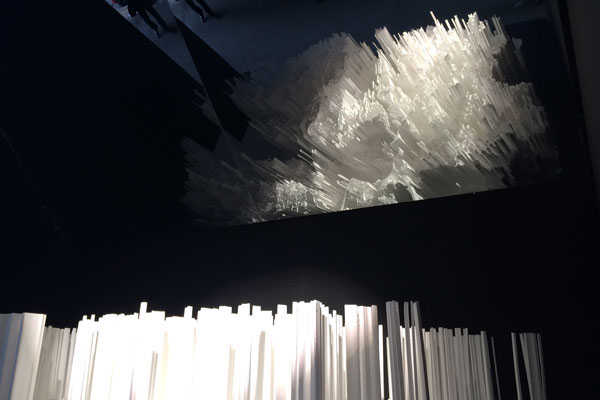
The tram and the exhibition together showcase “the sum of all the debris” which the artist collected in Hong Kong. “[The debris] has been worked and recontexturalised in the show, to present a reflection on the contemporary city and its cycles of expansion, construction, destruction, and the waste it generates,” Vhils explains.
The tram transformed by Vhils is covered by layers of advertising posters, which can be found in every corner of the city. Making reference to the illegal outdoor ads, the tram explores the aesthetics of vandalism. “A city is made up of contributions from all its citizens. Even those who are not in a position to affect the social, economic, or urbanism policies are still contributing to [the city’s] life and character simply by living and working there,” Vhils says. He adds that people’s identities evolve in response to the city, and the tram is conceived as a moving tribute to the personal histories of the city inhabitants.
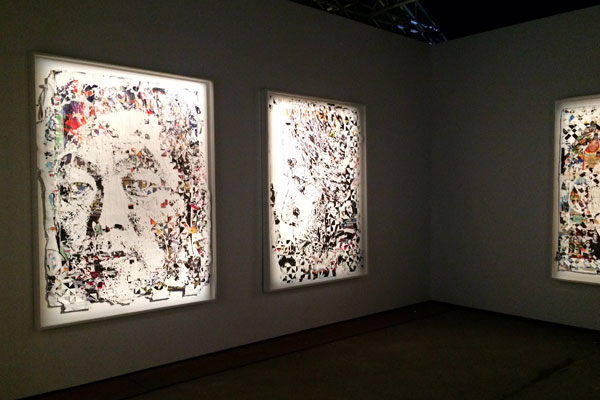
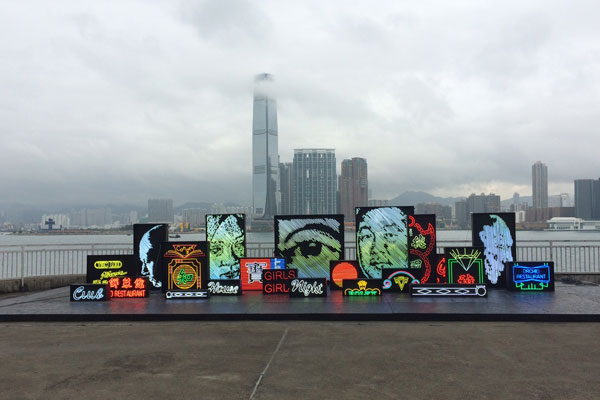
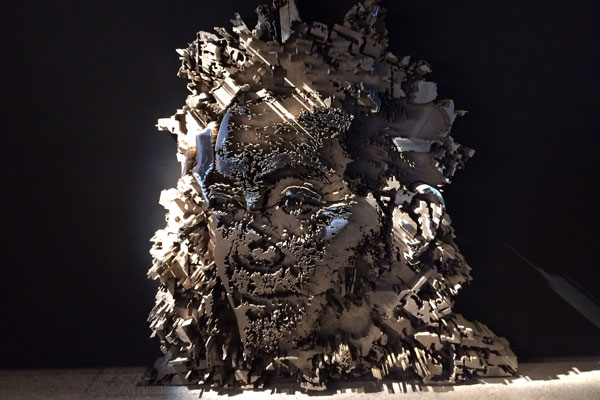
At the exhibition space at Pier 4, Vhils showcases portraits of city inhabitants created by way of posters, billboards, metals, styrofoam, and even wooden doors. These fragments are juxtaposed with each other to represent the saturation of stimuli that confront people in the public space. Some works, such as Scratching the Surface, involve the act of drilling, a reminder of Gordon Matta-Clark’s social critiques through art. Carved into a wall, the word “invisible” is paradoxically visible in the exhibition space. A series of neon light boxes was installed at the outdoor space with the Victoria Harbour as the backdrop, further connecting the exhibition to the city.
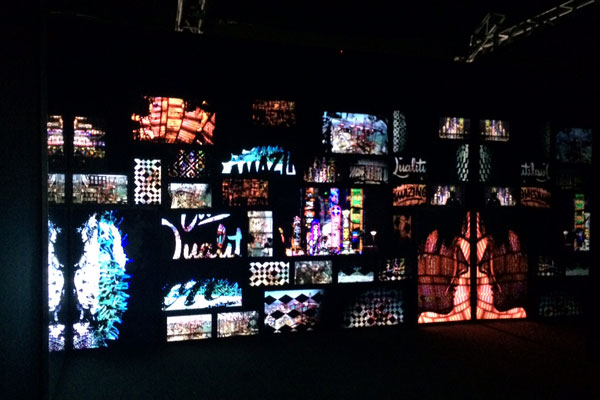
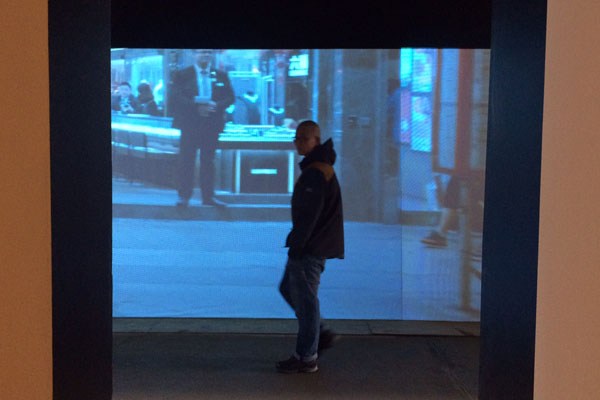
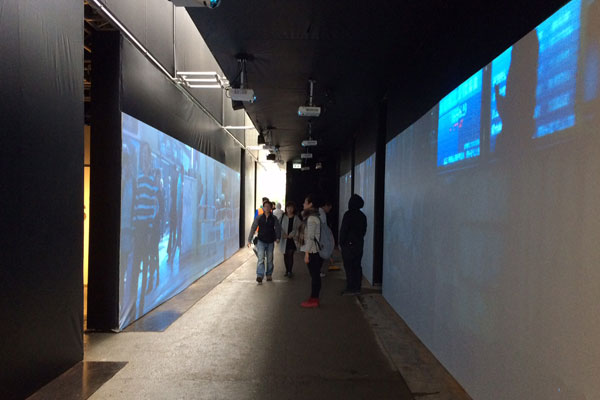
One of the highlights at Pier 4 is a video of the streets of Hong Kong installed as the spine of the exhibition space. In the video, the crowded sidewalks in Hong Kong unfold in a decelerated motion. The video prompts visitors to reflect on the role of the individual within the masses. Vhils explains that while the contemporary city offers comfort, it is important “to reflect on what we lose in this exchange.”
Vhils says the identity of Hong Kong is complex, and it is increasingly difficult to define a local identity in simple terms given the homogenisation of urban spaces around the world. While the artist does not attempt to represent the identity of Hong Kong in its entirety through “Debris”, he hopes to capture details that are representative of the city. Vhils says, “The aim is to establish a reflection on how these [different elements] affect the identity of the people who live here and, by extension, of the city itself.”
Vhils believes that Hong Kong has the qualities of a generic city and also its own unique characteristics. “To me [Hong Kong] encompasses both the best and the worst of our present-day urban societies,” says Vhils. While the city consumes a disproportionate amount of resources and generates a lot of waste, it is also “a dynamic, creative, and highly-efficient melting pot of cultures and traditions.” Vhils reminds us, however, that this melting pot is also the source of perpetuating social asymmetries. Through “Debris”, Vhils encourages visitors to look beyond the city’s surface, and engage with the dynamics and contradictions that define the city of Hong Kong.
The tram runs across Hong Kong Island from 12 March – 10 April, and the exhibition is on show from 21 March – 4 April at Pier 4 in Central.
INDESIGN is on instagram
Follow @indesignlive
A searchable and comprehensive guide for specifying leading products and their suppliers
Keep up to date with the latest and greatest from our industry BFF's!
The internet never sleeps! Here's the stuff you might have missed